
Every independent practice knows the patient. They walk in mid-morning, no appointment, one eye red and watering, convinced something’s badly wrong. Or they’ve had a shower of new floaters since the weekend and they’re frightened. A few years ago your options were limited: squeeze them in if you could, or send them to an already-overwhelmed A&E or a GP who’d likely refer them straight back to you anyway.
That’s exactly the gap the Community Urgent Eyecare Service is built to close. CUES is being rolled out across England, and for independent opticians it’s one of the more genuinely useful developments in NHS primary eye care in years. It brings urgent patients to you, it’s funded by the NHS, and it puts your clinical skills front and centre. If your practice isn’t set up to deliver it yet, 2026 is the year to fix that.
Here’s what CUES actually is, why it’s gathering pace right now, and the practical steps to get your practice ready.
What CUES actually is
The Community Urgent Eyecare Service is an NHS-commissioned pathway that lets patients with sudden or recent eye problems be seen quickly by an accredited optometrist in the community, instead of heading to hospital or their GP. Think red eye, painful eye, flashes and floaters, sudden changes in vision, foreign bodies, recent-onset double vision — the urgent presentations that don’t belong in a routine sight test slot but rarely need a hospital eye service either.
It’s the natural successor to the Minor Eye Conditions Service (MECS) that many areas have run for years. Where MECS focused on minor conditions, CUES widens the scope to urgent and emergency presentations and usually adds a telemedicine hub so practitioners can get advice or arrange onward care without bouncing the patient around the system. The headline points that matter to patients are simple: it’s free at the point of use, it covers adults and children, and they don’t need a GP referral to be seen.
Crucially, this isn’t a service reserved for the big multiples. It’s delivered through local practices of every size, and the smallest independent on the high street can be an accredited provider sitting right next to the national chains. The whole point is neighbourhood access — patients being seen close to home, fast.
Why this is picking up speed in 2026
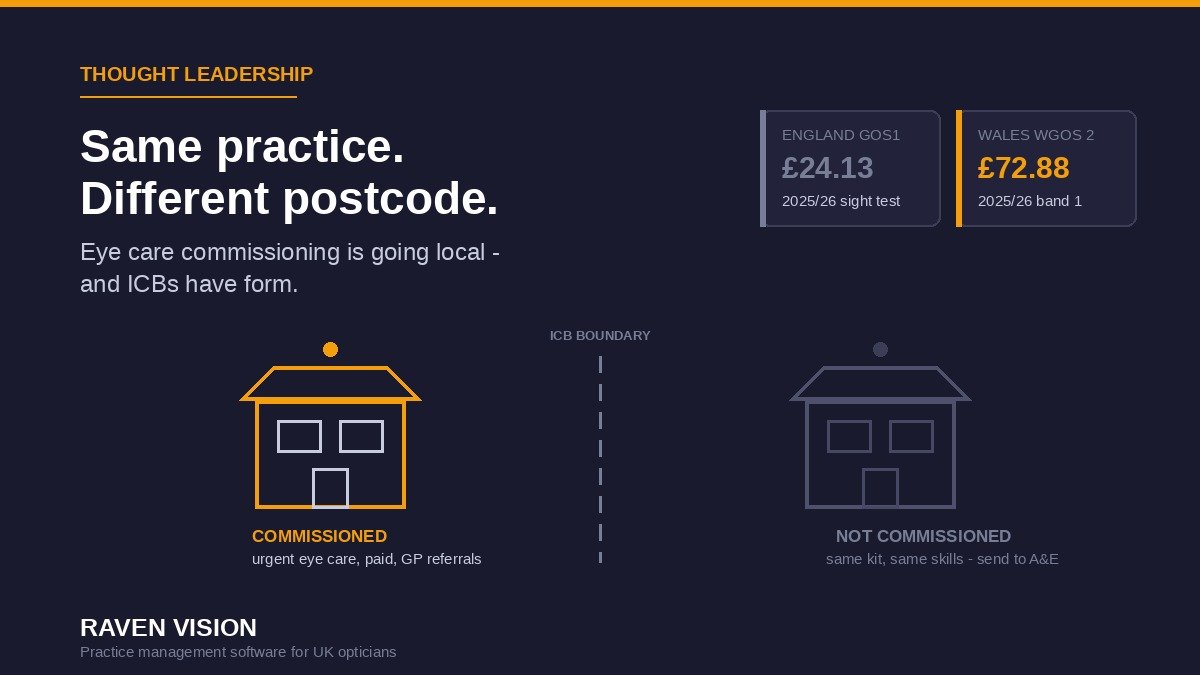
CUES went live in a number of areas from July 2025, and commissioning has been spreading region by region since. The direction of travel is clear: the College of Optometrists has called for every part of England to have a commissioned service so patients everywhere can get urgent eye care from primary care optometry rather than crowding hospital clinics.
The pressure behind that push is real. Hospital eye services are some of the busiest outpatient departments in the NHS, and a large share of what walks into eye casualty could be managed perfectly well in a community practice. Moving that work into accredited opticians’ chairs is cheaper for the system, faster for the patient, and a better use of the clinical training optometrists already hold. That alignment of incentives is why CUES keeps expanding — and why it’s worth getting ahead of in your area rather than waiting for it to arrive.
What CUES actually means for your practice
It’s easy to read all this as policy noise. It isn’t. For an independent practice, becoming a CUES provider changes three concrete things.
A stream of NHS-funded clinical appointments
Each CUES episode is a funded appointment — clinical work you’re paid for that has nothing to do with frame margins or the next pair of varifocals. For practices feeling squeezed on retail, that diversification matters. It’s recurring, it’s tied to your clinical capability rather than your dispensing, and it doesn’t sit at the mercy of whether someone’s ready to spend on eyewear that month. If you’ve been thinking about how to break a revenue ceiling that’s purely retail-driven, NHS-commissioned clinical services are one of the cleaner ways to do it.
New patients walking through the door
This is the part independents underrate. A CUES patient is often someone who has never been to your practice before. They’ve been signposted to you by NHS 111, their GP, a pharmacy, or the service directory because you’re the accredited local provider. You sort out their red eye, they have a genuinely good experience, and now they’re a candidate to register for their routine care, their kids’ eye tests, and their next pair of glasses. Urgent care is one of the few channels that puts brand-new, motivated patients in your chair without you spending a penny on advertising.
Clinical standing in your community
Being the practice the local system trusts with urgent eyes changes how you’re seen. GPs start sending patients your way. Pharmacies know where to point people. Patients tell their families. Over time you become the obvious place for anything eye-related in your area — and that reputation is hard for a chain to buy.
How to get your practice CUES-ready
Wanting the upside is the easy part. Here’s the practical groundwork.
Get yourself and your team accredited
Accreditation for CUES (and MECS before it) runs through the LOCSU and WOPEC training framework. In broad terms there are two parts: online distance learning that covers the clinical ground — red eye, flashes and floaters, age-related macular degeneration, cornea and foreign bodies, sudden loss of vision, dry eye — followed by a practical, station-based assessment. Part one has to be done before you sit part two.
The route in is your Local Optical Committee. Contact your LOC for the access code to the WOPEC courses; if your LOC is a LOCSU member there’s usually no charge for the online modules, though practical assessment or accreditation can carry a fee. Contact lens opticians who want to take part should go through ABDO. The honest takeaway: this is a known, well-trodden pathway, not a bureaucratic maze — but it takes a few weeks, so start before commissioning lands in your area, not after.
Sort out genuine urgent-access slots
A CUES contract usually comes with a commitment to see urgent patients within a set window — often the same day or next day. That’s a different rhythm from a fully booked routine diary. You need protected slots you can release for urgent cases, and a booking setup that lets reception or the telemedicine hub drop a patient in quickly without unpicking the whole day. This is where a flexible appointment management system earns its keep — being able to ring-fence urgent capacity, see your real-time availability at a glance, and slot someone in without the usual phone-tag is the difference between CUES feeling smooth and CUES feeling like a fire drill.
Tighten your triage and your records
Urgent care lives and dies on good notes. You’re documenting presenting symptoms, examination findings, decisions and onward referrals — and that record needs to be complete, retrievable, and tied to the patient. If a CUES patient comes back two days later, or the hub asks what you found, you want the full picture in one place, not scattered across paper and memory. A single patient record that holds clinical history, CUES episodes and routine care together keeps you safe clinically and makes the paperwork side of being a provider far less painful.
Close the follow-up and referral loop
A lot of urgent presentations need a check a few days later, or a planned recall once the acute issue settles, or an onward referral that you have to track to its conclusion. Letting any of those slip is both a clinical risk and a missed chance to convert an urgent patient into a registered one. Reliable recall turns “I should follow up with that red-eye patient” from a sticky note into a system that actually chases it.
The admin reality — and staying on top of it
Let’s be straight about the part nobody enjoys: NHS-commissioned services come with claiming and reporting. Every CUES episode has to be recorded and submitted correctly to be paid, on top of your existing GOS work. Do it loosely and you’ll either leave money on the table or spend your evenings reconciling claims.
This is the same discipline that already trips practices up on GOS, and the fix is the same — get the claiming built into the patient flow rather than treated as a monthly scramble. Handling NHS service claims and reconciliation in the same system you use for everything else, like Raven Vision’s integrated eGOS and claims, means the funded work you do actually turns into funded income without a separate admin burden bolted on the side. The clinical care is the point of CUES; the goal is to make sure the back office never becomes the reason it isn’t worth doing.
So is it worth it?
For most independent practices, yes — with eyes open. CUES won’t replace your retail income and it isn’t a goldmine per appointment. What it does is broaden your base: funded clinical work, a steady flow of brand-new patients, and a stronger position in your local system, all built on skills you already have. The practices that do best treat it as a long game — get accredited, deliver a great experience, convert urgent patients into loyal ones, and let the reputation compound.
The ones who struggle are usually the ones whose systems can’t keep up — no protected urgent slots, scattered records, recalls falling through, claims piling up. Get the operational side right first and CUES becomes a genuine asset instead of a source of stress.
If you’d like the practice infrastructure that makes services like CUES manageable — flexible urgent booking, one clean patient record, recall that actually runs, and NHS claiming built in — take a look at what Raven Vision costs and what’s included. It’s £149 a month, built inside real practices by people who’ve run them, and set up to make the clinical work the focus and the admin the easy part.
Your patients are already turning up with urgent eyes. CUES just means you finally get recognised — and paid — for looking after them.