
Walk into ten UK independent optician practices today and nine look broadly the same. Sight tests, contact lenses, a wall of frames, an OCT in the back, a tired window display about lutein. They all do the same things at roughly the same prices, and all spend the same evenings wondering why patients are drifting towards the chain on the high street.
The reason is simple. When everyone offers the same general service, the only thing patients can compare is price and convenience — a fight independents almost always lose against scale.
The independents quietly thriving in 2026 are not the best generalists. They’ve picked one clinical specialism and built the practice around it. They still see general patients, still test for cataracts, still dispense varifocals. But there’s a centre of gravity, and patients — and other professionals — know exactly what it is.
This is a shift more owners need to take seriously this year. Not next year.
Why generalist independents are getting squeezed in 2026
The squeeze isn’t new, but it’s tightened. Three things have converged.
The chains have got better at convenience. Same-day appointments, app-based booking, contact lens direct debits, and aggressive frame pricing have eroded the historical “we’re easier” reasons for picking a corporate. They were always cheaper. Now they’re often quicker too.
NHS GOS fees haven’t kept up. The base sight test fee hasn’t moved meaningfully against the cost of running a clinical practice with modern kit. Any practice surviving on NHS volume alone is sliding backwards a few percent every year.
Patient expectations have shifted. The same patients who tap their phone to book a barber and a GP are now comparing your practice not to the chain down the road but to every other professional service they touch. “Average” no longer feels neutral. It feels behind.
The generalist independent practice — the one that does everything for everyone — is sitting in the exact middle of that squeeze. Not cheap enough. Not fast enough. Not specialist enough.
What a clinical specialism actually is — and isn’t
The phrase “clinical specialism” gets used loosely. It does not mean dropping general optometry. It does not mean turning patients away. And it does not mean putting “specialist” in your website header and hoping.
A clinical specialism is a deliberate decision to be unusually good at one thing. Unusually good means: the kit, the protocols, the staff training, the recall cadence, the patient communication, and the referral relationships are all built around that one area. It means a GP, an ophthalmologist, or a parent in your town would say “go to that practice for X” without hesitating.
It is closer to “we are the dry eye practice in this town” than “we also offer dry eye assessments”. The first sentence is positioning. The second is a service list item.
The point of a specialism is not the additional revenue from that service. It’s that the specialism reshapes everything around it — how patients find you, how they describe you, what they expect to pay, and who refers in. The £80 specialist consultation is the visible thing. The repositioning underneath it is the strategic move.
The strategic case: four reasons specialism wins
The strongest argument for picking a specialism isn’t financial. It’s structural. Four things change at once when an independent commits to one.
You become discoverable. “Independent optician” is a generic search. “Myopia management specialist Manchester” is a very specific one — with much less competition and patients who have already self-qualified. Specialism unlocks long-tail discovery in a way generalism never will, especially as AI-powered search becomes the default route for “I need help with X near me”.
Patients self-select for value, not price. A patient searching for a dry eye specialist isn’t comparing your £80 consultation to a £25 NHS sight test. They’re comparing it to seeing an ophthalmologist privately for £300. Specialism quietly moves the price reference point — which is the only sustainable way to stop competing on price.
You become referrable. GPs, ophthalmologists, paediatricians, even other opticians need somewhere to send patients with specific problems. If you’re the obvious local answer for one thing, those referrals flow steadily — and they bring with them the most valuable patients: ones who already trust the system.
You build operational depth, not breadth. A practice generally good at fifteen things runs on the personality of the owner. A practice exceptional at one thing runs on a documented protocol — trained, audited, repeated, and eventually delegated. Specialism makes the practice less dependent on the owner.
Five specialisms independents are quietly building right now
You don’t need to invent something exotic. The strongest specialisms in UK independent optometry right now are ordinary clinical areas done at an unusual level. Five are worth naming.
Myopia management. The clearest specialism for any practice with paediatric patients in the chair. Atropine, MiSight, OK lenses, axial length measurement, structured progression conversations with parents. Once you’re known for this, parents drive past three closer opticians to bring their kids to you — and they stay for life.
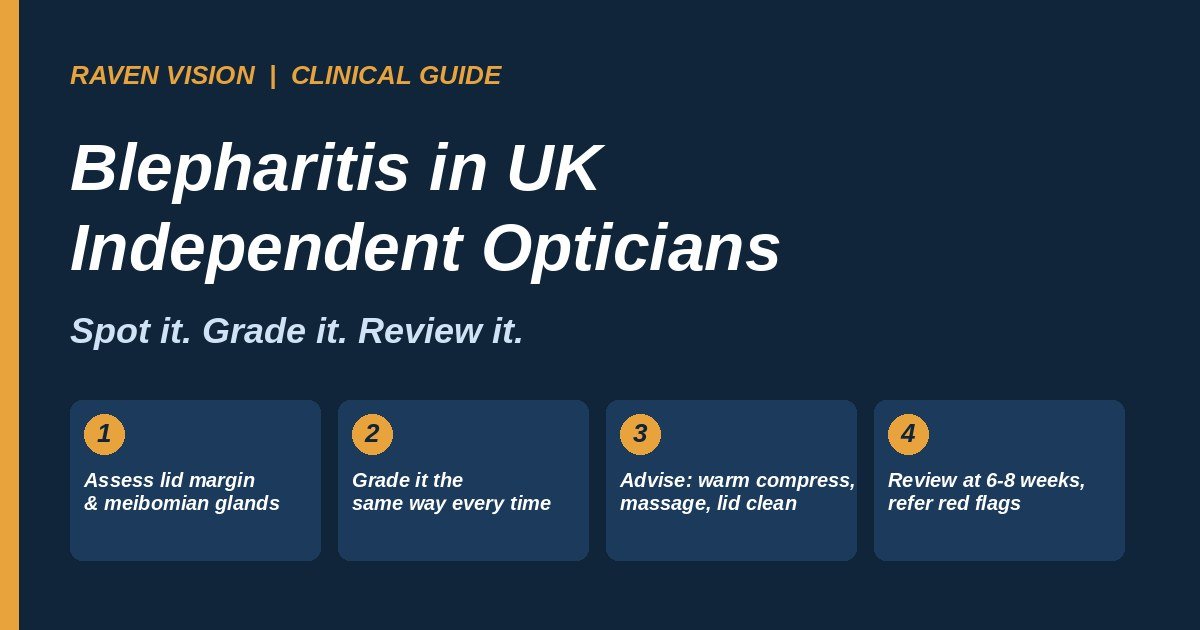
Dry eye. Demand is enormous and most patients are under-treated. A proper dry eye clinic (history-taking, meibography or LipiView equivalent, tear film assessment, IPL or LipiFlow if you go that far, staged management) sits comfortably between the under-resourced GP and the over-priced HES route.
Specialist contact lenses. Scleral lenses, RGPs, post-graft, keratoconus, irregular corneas. Very few practices do this well and HES waiting lists are long. If you have an optometrist with the interest, this is a high-value, low-competition niche.
Low vision. Older, growing population. Magnifiers, lighting assessment, task analysis, RNIB pathways, links to local sight loss charities. Quiet, deeply needed, and almost no chains take it seriously.
Sports vision. Cyclists, shooters, golfers, racing drivers. Sports-specific tinting, prescription sports eyewear, dynamic visual skills assessment. Small market, high spend, very loyal patients who tell their friends.
None of these are exotic. All are within reach of a well-run independent. The difference is doing one of them properly rather than all of them tentatively.
How to pick the right specialism for your practice
The wrong way to pick is to choose the most “interesting” or the most profitable on paper. The right way is to look at four honest signals.
What’s already showing up in your appointment book? If you’re already seeing twelve dry eye patients a week without trying, that’s a tell. The market has already told you what it wants from you. Lean in.
What does your clinical team genuinely love doing? A specialism takes years to mature. The optometrist who lights up about scleral lenses will go further than the one who chose a niche for the margin. Energy compounds.
What does your local market look like? If there are already three established myopia management clinics within twenty minutes, that’s a saturated specialism for your area. Look at what’s missing locally, not what’s trendy nationally.
What kit do you already have, or can credibly invest in? A dry eye specialism needs meibography. A myopia clinic needs axial length. Pick something where the kit gap is one purchase, not five.
The right specialism for your practice is usually the obvious one — the area you already lean into, that your patients already mention, that your team is already curious about, and that your kit half-supports. The mistake is overthinking it.
Building the specialism without losing the general patient base
This is the question every cautious owner asks: if I position the practice as a dry eye clinic, do the general patients drift away?
In practice, no. They don’t. But only if you do three things at once.
First, separate the brand layer from the service layer. The practice name, signage, and main website still say “Raven Opticians” or whatever the practice is called. The general patient sees the same friendly local optician they always did. The specialism lives in a dedicated section of the website, a dedicated page Google can find, a dedicated referral leaflet, and in how the team talks about that specific service area. The practice doesn’t reinvent itself overnight; it adds a centre of gravity.
Second, protect the general patient journey. The specialism shouldn’t add friction for the routine eye test patient. Their booking flow stays simple. Their appointment slot doesn’t shrink. Their dispense conversation isn’t suddenly about IPL. The specialism is a parallel track, not a replacement.
Third, make sure your reception, dispensing and recall workflows can hold two patient types at once. A specialist patient and a general patient have different needs — different appointment lengths, different recall cadences, different communications, different price expectations. Trying to run them through identical templates is where most practices come unstuck.
This is precisely where your practice management software either lifts the load or sinks the move. If your PMS can’t tag patients by clinical category, can’t differentiate recall cadence by specialism, and can’t run separate appointment templates with different durations and pre-test requirements, you’ll be doing it all by memory — which is not a scalable specialism.
What infrastructure you actually need
People worry about kit. They should worry more about everything around it.
The kit list for most specialisms is shorter than owners assume. Myopia management needs an axial length device and a treatment protocol. Dry eye needs meibography, tear film assessment, and a treatment ladder. Specialist contact lenses need a topographer and decent fitting sets. Low vision needs magnifiers and a quiet consulting room. None are catastrophic capital decisions weighed against the lifetime value they unlock.
The harder infrastructure is the soft stuff:
A clinical protocol that anyone in the team can follow. Not a folder in someone’s drawer. A documented sequence — what’s measured, in what order, with what kit, recorded in what fields, with what follow-up. If only the owner-optometrist can run the specialism, it’s a hobby, not a service.
A patient communication system specific to that specialism. Different recall intervals, different appointment reminders, different educational content between visits. A dry eye patient on a stepped management plan doesn’t get the same six-monthly text as a routine sight-test patient.
A referral infrastructure. A one-page leaflet for local GPs. A relationship with two or three ophthalmologists who refer overflow your way. A line in your website footer that says, in plain English, “we accept private specialist referrals for X”. This is how the specialism gets oxygen.
Pricing you’ve worked out on paper. Specialist consultations should not be sight test fees with a markup. They should reflect the kit cost, the chair time, the expertise, the materials, and the outcome. If you find yourself apologising for the price, you haven’t priced confidently.
Marketing that says one thing. A dedicated landing page for the specialism. A blog cadence that builds clinical authority in that area. Google Business posts that consistently reference the specialism. Patient case studies (with consent) that show what good looks like. None of this is glamorous. All of it compounds.
Where Raven Vision fits
We built Raven Vision inside Shaukat’s own practices first because every PMS decision matters at the workflow level — and clinical specialism is the clearest example.
You can tag patients by clinical category so a dry eye patient and a myopia patient look different the moment they appear in the diary. You can set differentiated recall cadences. You can build specialist clinical record templates that capture the right data (meibography images, axial length trends, fitting parameters) in structured fields instead of free-text notes. You can run specialist appointment slots with different durations and pre-test requirements. And you can communicate with each cohort using templated SMS and email that reflect what they actually need to hear.
The software doesn’t build the specialism. The clinical protocol does. But the software is what makes the specialism repeatable across a team, auditable over time, and visible in your numbers — instead of living in the owner’s head. If you’re running a specialism on spreadsheets and sticky notes today, that’s the PMS as bottleneck, not your clinical team.
Two uncomfortable questions to ask yourself
Before you pick a specialism, sit with these.
If a journalist had to describe your practice in seven words, what would they actually write? If the honest answer is “another nice independent optician on the high street”, you don’t have a position yet. That’s not an insult — it’s the starting point.
What do your patients already say about you when they recommend you to friends? Listen carefully. Sometimes a specialism is already forming around you — you just haven’t claimed it. The people who think of you as “the children’s eye place” or “the dry eye people” are giving you the answer for free.
The first 90 days
If you want to act on this rather than think about it for another year, here’s the shape.
Days 1–30 — decide and audit. Pick the specialism. Audit what you have: kit, training, patient interest, local competition. Talk to the clinical team — get them bought in, not informed. Pick a launch date for the outward-facing presence.
Days 31–60 — build the protocol. Write the clinical protocol in plain English. Define the appointment slot. Set the pricing. Build the recall cadence. Set up the patient tag, clinical fields, and templated communications in your PMS. Train every team member — receptionist, DO, optometrist. If the receptionist can’t describe the specialism in two sentences, the patient won’t either.
Days 61–90 — market and refine. Launch the dedicated webpage. Write three blog posts that build clinical authority. Send a letter to the ten most relevant local GPs. Add the specialism to your Google Business profile. Track the first cohort. Tune the protocol with what you learn.
By day 90, you don’t have a finished specialism. You have a working one. The next twelve months turn it into a reputation. The twelve after that turn it into a moat.
The harder truth
Independents that don’t pick a specialism in the next two or three years will find the squeeze keeps tightening. Not catastrophically — a well-run general practice will keep going for years. But the gap between “ticking along” and “thriving” is widening, and specialism is the cleanest path across it.
It’s also the cleanest path to a practice that doesn’t need you in it every day, doesn’t have to fight on price, and is worth meaningfully more if you ever decide to sell. Specialism builds clinical value, business value, and personal optionality at the same time.
“Everything for everyone” is now a strategy with a clear ceiling. The practices breaking through that ceiling decided what they’re actually here to be exceptional at. That decision is one of the most important strategic moves a UK independent optician will make this year.
To see what a PMS built specifically for modern UK independent optician practices looks like, book a demo with Raven Vision. We’ll walk through how the specialism workflows — clinical tagging, differentiated recall, templated specialist communications — actually run in a live practice.