
Ask an independent optician owner what they did last Tuesday and you’ll get a confident answer: “clinic in the morning, then bits and pieces.” Ask them to account for the afternoon hour by hour and the confidence drains away. There was a supplier call. Something about the rota. A GOS query. An email that turned into six emails. By half five, a full afternoon had gone and nothing on the actual to-do list had moved.
That’s not a personal failing. It’s what happens when the most expensive hour in the building — yours — is the only one nobody tracks. You track your optometrist’s testing time to the minute. You know your dispensing optician’s conversion rate. You can pull your frame stock turn. But the owner’s week, the single biggest lever in the practice, runs on vibes.
This post makes the case for a one-week time audit: what it is, how to run it without hating your life, what the results almost always show, and what to do about them. It’s the least glamorous exercise in practice ownership and one of the highest-return.
The numbers behind the feeling
If your week feels like it disappears, the research says you’re in good company. UK business leaders spend on average over seven hours a week on admin and operational tasks — around a fifth of their total working time — at an estimated cost of nearly £19,000 a year per business. A 2026 survey of UK small business owners put the figure for repetitive, automatable admin at eight hours a week. That’s 384 hours a year. Ten full working weeks, spent on work that doesn’t need an owner to do it.
And owners aren’t working short weeks to begin with. Roughly a third of UK SME owner-managers report working more than 61 hours a week. In optics specifically, the GOC’s 2024 workforce survey found job dissatisfaction rising — one in four registrants dissatisfied, up from one in five the year before — with workload the recurring theme, and “could some of this admin be delegated?” the recurring question.
So the honest starting position for most practice owners is this: you’re working more hours than almost anyone in the building, a big slice of those hours is admin that someone (or something) else could handle, and you can’t currently say which slice. The time audit fixes the last part first, because you can’t cut what you can’t see.
What an hour of your time is actually worth
Before running the audit, it helps to put a number on the thing you’re auditing. Take your practice’s gross margin from clinical work and dispensing, divide by the clinical hours you personally work, and you’ll usually land somewhere between £150 and £300 an hour of value created when you’re in the test room or on the shop floor with a patient.
Now compare that with what you were doing at 3pm last Thursday. Chasing a lab about a late job — a £15-an-hour task. Re-keying patient details between systems — £12. Manually texting recall reminders — £12. Building the rota in a spreadsheet — £15. Every hour of admin you personally absorb is an hour bought at consultant rates and spent on clerical work.
This is the same trap we covered in why your practice shouldn’t need you every day: the practice quietly reorganises itself around the owner’s willingness to absorb whatever nobody else owns. The time audit is how you catch it doing that.
How to run a one-week time audit
The method matters less than the honesty, but here’s the version that works in a real practice without becoming a project in itself.
Track one normal week in 30-minute blocks
Pick a normal week — not the week before Christmas, not the week your optom is on leave. Carry a card, use your phone notes, or print a grid. Every 30 minutes, write two or three words about what you actually did. Not what you planned. What happened. “Test,” “frame rep,” “GOS resubmission,” “Facebook,” “fixing printer.”
Don’t tidy it up as you go. The untidiness is the data.
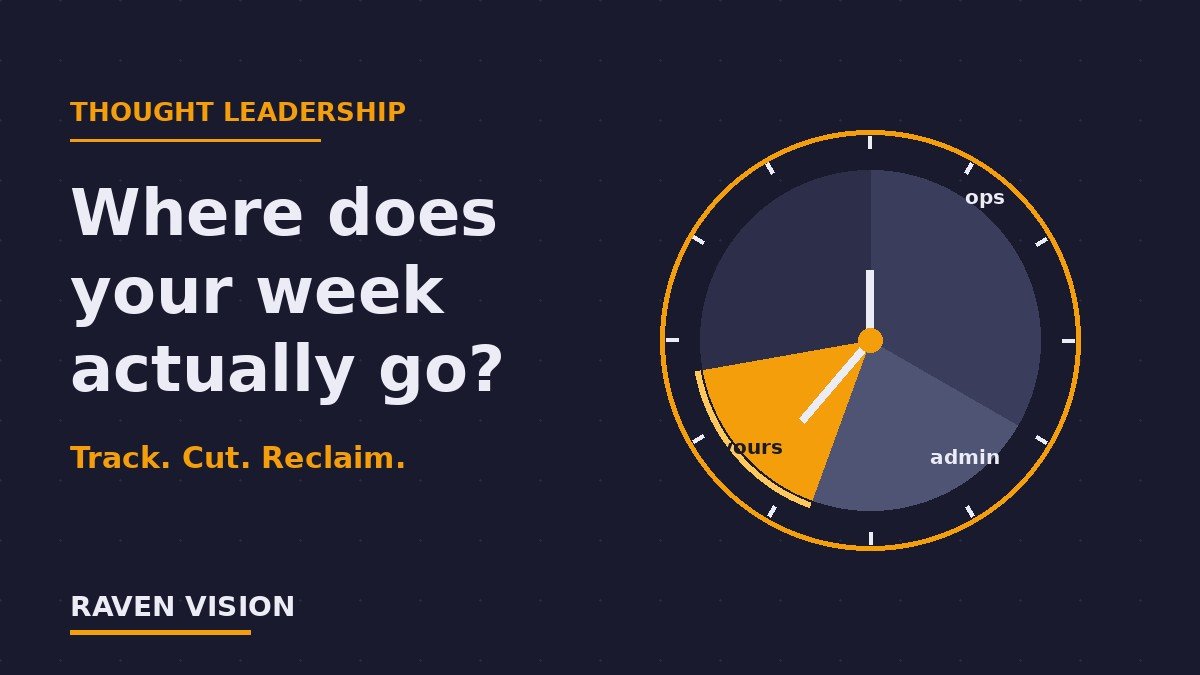
Sort every block into four buckets
At the end of the week, code each block into one of four categories:
- Clinical — testing, contact lens fits and aftercare, anything only a registered professional can do.
- Commercial — the work that grows the practice: reviewing the numbers, marketing decisions, pricing, planning, supplier negotiations.
- Operational — keeping the machine running: rotas, ordering, staff questions, lab chasing, day-to-day decisions.
- Admin — pure clerical: data entry, filing claims, sending reminders, re-keying, invoice shuffling, hunting for information.
Then add one honest flag to any block: “did this need me?” Not “am I good at it” or “do I like it” — would the practice have got the same outcome if a trained staff member or a piece of software had done it?
Total it up and sit with the result
Most owners who do this for the first time find something like: 40–50% clinical, 5% commercial, 30% operational, 20% admin. The number that should bother you isn’t the admin figure. It’s the commercial one. The work that only an owner can do — deciding where the practice goes next — is getting the scraps of the week, usually the tired hours after closing. Everything we said in the mid-year reset about practices drifting without review has its root cause here: the person who should be steering is busy rowing.
The three patterns almost every audit reveals
1. The interruption tax
Count how many blocks contain more than one task. A test, interrupted by a staff question, interrupted by a phone call the front desk didn’t feel able to answer. Context-switching is why a nine-hour day can produce four hours of output. The fix is rarely “better focus” — it’s clearer ownership, so fewer things default to you. If the same question interrupts you three times in a week, that’s not an interruption, it’s a missing rule. Write the rule, hand it over.
2. The admin that software should have eaten
Look at your admin blocks and ask which of them are, bluntly, you doing a computer’s job. Manually sending recall letters and reminder texts. Re-entering patient details from one system into another. Cross-checking the diary against a paper day sheet. Working out who’s due a contact lens check from a spreadsheet. A modern practice management system does all of this automatically — recall and reminders run themselves, and patient records, diary and claims live in one place so nothing gets re-keyed. If your audit shows three hours a week of this, that’s 150 hours a year you’re donating to a workaround.
3. The delegation you keep not doing
Some blocks will be operational work you’ve kept for years because “it’s quicker to do it myself.” The audit calls the bluff: quicker than what? Ten minutes saved today, repeated forever, versus an hour spent training someone once. If you found yourself nodding along to when to hire a practice manager, your audit is the evidence base for that decision — it turns “I feel stretched” into “here are eleven hours a week of operational work that need an owner’s authority but not an owner’s judgement.”
Cut, delegate, systemise — in that order
For every block that didn’t need you, run it through three doors, in order:
Cut. Some of it shouldn’t be done by anyone. The report nobody reads. The supplier meeting that’s really a social call. The third check of something checked twice. Be ruthless here first, because delegating pointless work just makes it someone else’s pointless work.
Delegate. Operational work with a clear outcome goes to a named person with real authority to finish it — not “help me with the rota” but “the rota is yours; here are the constraints.” Expect it to be done 80% as well as you’d do it at first. That’s the price, and it’s cheap.
Systemise. Whatever survives cutting and can’t be delegated to a person goes to a system. Recall, reminders, GOS claims, reporting, stock alerts — this is exactly the category where software stopped being a luxury. The question isn’t whether you can afford to systemise it; it’s how long you can afford an owner doing it by hand.
The two objections you’ll raise (and why they don’t hold)
“I don’t have time to track my time.” The audit costs about ninety seconds a day — a glance at the clock and three words on a card. If a practice owner genuinely can’t find ninety seconds, that’s not an argument against the audit. That’s the audit’s first finding.
“My week’s too unpredictable to measure.” Every owner says this, and every completed audit says otherwise. The interruptions feel random, but they cluster. It’s the same staff member with the same category of question. The same supplier chase. The same claims re-work at the same point in the month. Unpredictable weeks are usually predictable problems wearing different outfits, and one week of tracking is enough to see the pattern. You’re not aiming for a perfect dataset — you’re aiming for the three biggest leaks, and those show up loud.
What good looks like after 90 days
Run the audit again a quarter later and aim for three shifts. Clinical time roughly steady — you’re probably not trying to test less, just to stop clinical days leaking. Admin down by half, mostly eaten by software and the front desk. And commercial time up from an hour a week to four or five, in daylight hours, when your brain still works.
That last one is the whole point. Nobody opens a practice to become its filing clerk. The owners who break through the plateau we described in the revenue ceiling post aren’t working more hours than you. They’ve moved the same hours up the value chain.
The software question underneath all of this
Here’s a fair test of your current practice management system: how much of your audit’s admin column exists because of it? Every re-keyed record, every manual reminder, every report assembled by hand in a spreadsheet is your software sending you an invoice, payable in owner-hours.
Raven Vision was built inside working practices — our co-founder Shaukat still runs three of them, and he had no interest in doing admin a system should do. Appointments, patient records, automated recall, GOS claims, stock and reporting sit in one place at £149 a month, everything included, with free data migration so switching doesn’t become another job on your list.
If your time audit shows hours going to work a system should be doing, book a demo and bring the audit with you. We’ll show you, line by line, which of those hours you’d get back.
Start with the card and a pen on Monday, though. The audit costs nothing, takes a week, and most owners can name the first change they’ll make by Wednesday lunchtime.