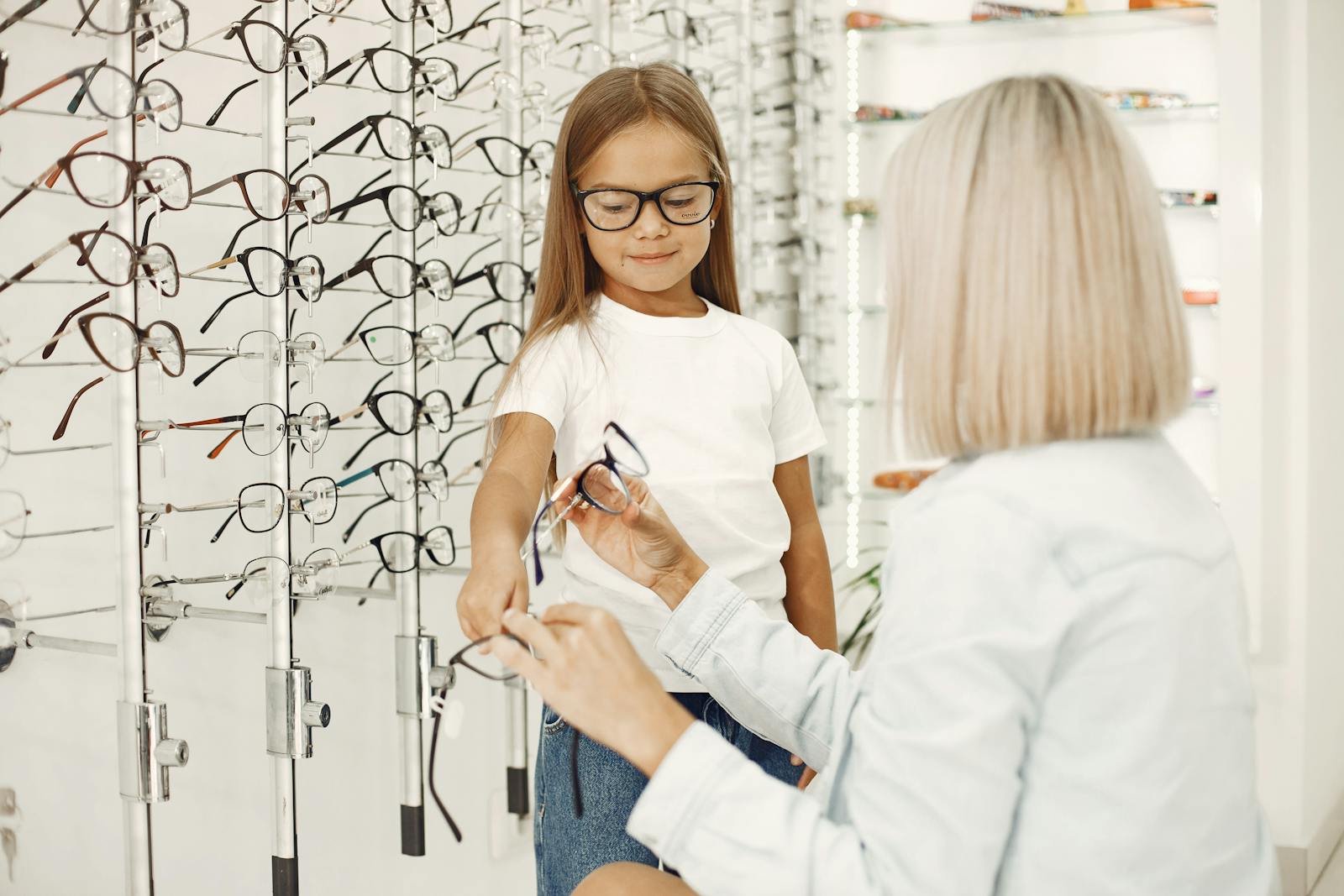

Walk into any independent optician’s practice on a Saturday morning and you’ll see two kinds of patients waiting. There’s the regular: the 50-something who’s been coming since 1998, knows the receptionist by name, and books another appointment before they leave. And then there’s the family — a parent with a four-year-old who’s about to start school, or a tween whose teacher just flagged that they’re squinting at the whiteboard.
That second group is where independent opticians have a quiet, enormous opportunity. Children’s eye care in the UK is patchy, under-promoted, and frequently overlooked by busy parents who assume the school nurse or GP has it covered. They don’t. And when families finally do turn up — usually because something has gone wrong — they’re looking for somewhere they can trust. That’s the role your practice can step into. Not the chain on the high street. You.
This is a long read. Stick with it. By the end you’ll have a clear picture of why paediatric eye care in independent practice matters in 2026, what parents don’t know, and how you can build the kind of family-focused service that fills your appointment book and keeps families coming back for the next twenty years.
Why so many UK children fall through the eye care gap
Here’s the awkward truth about children’s vision in the UK. Despite eye tests being completely free for under-16s on the NHS, uptake is nowhere near where it should be. Surveys from organisations like the Association of Optometrists have repeatedly shown that a large proportion of children have never had a sight test before they start school, and many don’t have one until a teacher, parent or sports coach raises a concern.
The school vision screening programme — which used to feel like a safety net — varies massively by region. Some local authorities run it, some don’t. Some catch only the most obvious problems. Even when a child is screened at school, the result often gets lost in the post or forgotten by half-term. Parents are left assuming everything’s fine, because nobody’s told them otherwise.
Add to that a generation of parents who themselves grew up before everyone was glued to a screen, and you end up with a strange situation. The children who need an eye test most — the ones doing close work on tablets for hours a day — are the ones least likely to be sitting in your testing room.
What the NHS actually covers for children’s eye care
This is the part most parents don’t know, and where your practice can do real public service work just by saying it out loud, often.
NHS-funded sight tests are available for every child under 16, and for anyone under 19 in full-time education. There’s no income test, no postcode lottery, no catch. The test itself, the dilating drops if needed, the sight test report — all funded. On top of that, NHS optical vouchers help cover the cost of glasses. For most families, a child’s first pair can come in well under what they expect to pay.
Despite all of this, parents still ring up asking how much it costs. Half of them genuinely don’t believe it’s free. The other half have heard it’s free in theory but suspect there’s a catch. There isn’t, but the perception alone keeps people away.
This is one of the simplest comms wins available to an independent practice. The phrase “Free NHS eye tests for children — book online any day” should be on your website’s homepage, your booking confirmation emails, your Google Business Profile, your front window, and the back of your appointment cards. Repetition matters.
The clinical case for early and regular eye tests
Beyond the public health angle, there’s a serious clinical reason to push children’s eye care: vision develops in childhood, and the window for fixing certain problems is narrow.
Amblyopia and the developmental window
Amblyopia — what most parents call “lazy eye” — is one of the most preventable causes of permanent vision loss in adults. The visual system in children continues developing into roughly the seventh or eighth year of life, and amblyopia caught in this period is highly treatable. After that window, treatment becomes much harder. A child who’s never had a sight test before age seven is rolling the dice in a way most parents would find shocking if you told them plainly.
Refractive error and school performance
Uncorrected refractive errors — hyperopia in particular — are massively under-diagnosed in younger children because they don’t always read as obvious blurred vision. What you see instead is a child who avoids reading, gets headaches, can’t concentrate, or gets labelled as having a behavioural problem when in fact they just can’t focus on the page.
Every independent optician has the same story: a parent comes in convinced their child has ADHD, leaves with a prescription for hyperopia, and three weeks later sends a thank-you card because school has suddenly become bearable. These cases are common. They just don’t get reported because the kid never makes it to your chair in the first place.
Myopia and the screens problem
Myopia rates in UK children have climbed steadily for the last two decades, and there’s growing concern that the post-2020 jump in screen time has accelerated it further. The clinical evidence on outdoor time, near work and myopia onset is now strong enough that the College of Optometrists and major bodies recommend specific lifestyle advice for at-risk children.
Practices offering proper myopia management — orthokeratology, dual-focus contact lenses, atropine where appropriate — are positioned to be the place parents send their friends to once word gets out. It’s also a service the multiples have been slower to roll out consistently, which gives independents a real edge.
How to make your practice the family practice in your area
If you accept the case for paediatric work, the next question is practical: how do you become the practice that families actively choose? This is less about clinical capability — most independents already have the skills — and more about removing friction and building trust.
Make the practice physically child-friendly
You don’t need to turn the dispensing area into a soft play. You do need to make a four-year-old feel like they’re somewhere they want to be. A small bookshelf with picture books. A box of fidget toys for siblings. A Snellen chart with pictures, not just letters, for pre-readers. A chair that goes high enough for a toddler to feel like a grown-up.
Most importantly: a team that knows how to talk to a child without talking down to them, and how to manage parent and child at the same time. The first time a five-year-old has a cover test done, the way the optometrist holds the conversation makes the difference between a return visit and a child who tells everyone the optician is scary. Train for it. It’s a skill.
Train the team for paediatric exams
Paediatric optometry is its own thing. The College of Optometrists offers higher qualifications in paediatric eye care, and there are excellent CPD pathways through bodies like BCLA for fitting children with contact lenses. Investing in this is one of the highest-leverage things a practice can do. You unlock a service line, you justify a higher fee for advanced services like myopia management, and you give your team something to specialise in beyond standard refractions.
Build relationships with schools and GPs
The single most underused marketing channel for independent opticians is the local primary school. Offer to come in and do an eye health assembly for free. Bring a model eye, some funny glasses, a few myopia facts. Leave behind branded postcards with “Free NHS eye tests for under-16s” and your booking link. Do this once a term at three schools and you’ll have a steady drip of family bookings for years.
Local GP surgeries are another quiet referral source. Pop in, introduce yourself to the practice manager, leave them a stack of cards. GPs see kids with headaches and reading issues all the time — they need somewhere to send them, and they’ll send to whoever they remember.
The recall problem nobody talks about
Here’s where most independents lose paediatric patients. A family comes in. The child has an eye test. Maybe glasses are dispensed. Everyone’s happy. And then… nothing. No reminder a year later. No nudge before school resumes in September. The family forgets, and by the time they think about it again the child has had a growth spurt, the glasses don’t fit, and they end up at a chain because that’s the first one that pops up on Google.
This is a solvable problem, and it’s pure operational hygiene. A practice management system that handles paediatric recall properly should let you:
- Tag every paediatric record with the child’s date of birth and recall interval
- Auto-send a recall reminder by email or SMS at the right cadence — annually for most children, every six months for ones in active management
- Trigger a “back to school” campaign every August aimed specifically at parents whose child last visited 9–12 months ago
- Flag children who’ve moved into a new age bracket where exam frequency should increase
If your current system can’t do that without manual lists and spreadsheets, it’s probably costing you more in lost paediatric revenue than the software costs to replace. Raven Vision was built for exactly this kind of recall workflow, with smart reminder rules and a back-to-school template that runs itself.
Marketing your paediatric service to UK parents
Most parents Google one of three things when they’re worried about their child’s eyes:
- “When should my child have their first eye test”
- “NHS eye test for children near me”
- “My child is squinting / has headaches / can’t see the board”
If your website doesn’t have content that answers those exact phrases, you’re invisible to the people most likely to book. A simple paediatric services page — “Children’s eye tests at [Practice Name]: free on the NHS, friendly to nervous kids, online booking in 60 seconds” — earns its keep within a quarter once Google starts ranking it.
On social, parenting Facebook groups in your local area are gold. Don’t go in selling. Go in answering questions. When a parent posts asking “where should I take my five-year-old for his first eye test?”, you want to be the practice three other parents in the comments have already recommended. That happens through showing up, being helpful, and never being pushy.
Booking friction matters more for paediatric appointments than almost anything else. A parent juggling school pickup and a half-eaten snack does not have time to phone you between 9 and 5 to book. Online booking, with availability they can see and a confirmation email that arrives in their inbox while they’re still standing in the playground, doubles your conversion rate from interest to booking. Online booking is built into Raven Vision and integrates straight into your website with real-time availability — no separate plugin to maintain.
The longer game: every child is a thirty-year patient
The real reason paediatric eye care matters for an independent practice isn’t this year’s revenue. It’s the next three decades.
The eight-year-old you fit with their first pair of frames in 2026 is the 23-year-old who comes back for contact lenses in 2041. They’re the 38-year-old presbyope who needs varifocals in 2056. They’re the 58-year-old who brings their own kids in for the practice’s continuing family discount. Independent practices that win paediatric work are buying themselves a future patient pipeline that the multiples — with their churn-and-burn marketing — simply cannot replicate.
That’s the strategic case. Treat children’s eye care as a loss-leader and you’re missing the point. It’s the foundation of an independent practice that’s still standing in 2050.
What to do this week
Don’t try to overhaul everything in one go. Pick three things and do them well:
- Audit your messaging. Walk past your shop window, scroll your homepage, read the last five booking confirmations you sent. Does the phrase “Free NHS eye tests for children” appear at least three times? If not, fix that today.
- Ring one local primary school. Offer to do a free eye health assembly next term. The headteacher will say yes — they always do, because they get a free curriculum slot filled.
- Check your recall list. Pull every paediatric patient who hasn’t been seen in 12+ months. Send them a personalised back-to-school reminder. If your current system makes that painful, that’s your sign.
If the recall part is what’s stopping you — if your current practice management software treats paediatric patients exactly the same as everyone else and you’re stuck running spreadsheets to keep on top of it — that’s exactly the problem Raven Vision solves. Book a 20-minute demo and we’ll show you how a properly set-up recall system can fill 5–10 paediatric appointment slots a week without anyone on your team lifting a finger. £149 a month, three months free, no lock-in. Your future twenty-three-year-old contact lens patients will thank you.