

Most independent opticians know contact lenses are a revenue lever, and most know they could be doing more with them. Somewhere between the daily disposable patient who pops in twice a year and the monthly wearer you’ve been seeing for fifteen years, there’s a service waiting to be designed properly.
Contact lens services are one of the few areas where UK independents can decisively outperform the corporates — if they treat them as a programme rather than a side product line. Big chains push volume, generic fits, and a cookie-cutter aftercare flow. An independent practice with the right pathway, the right pricing, and the right software can build a CL base that’s profitable, sticky, and growing every quarter.
Why contact lens services matter more than they used to
Three things have shifted in the last few years that make CL genuinely strategic for UK independents.
First, recurring revenue is now a survival mechanism, not a nice-to-have. Sight test fees haven’t moved much. Frame margins are squeezed by online competition. The patient who pays you £30 a month for lenses on a direct debit is worth more to your practice — over a five-year horizon — than three pairs of mid-range glasses. Predictable income smooths the lumpy cash flow that kills small practices in quiet months.
Second, multifocal lens technology has finally caught up with what presbyopic patients actually want. The gap between “I tried CLs once and it didn’t work” and “I’ve worn them happily for ten years” is much smaller than it was in 2015. Patients you wrote off as glasses-only fifteen years ago are genuine prospects again, and most of them haven’t been re-asked.
Third, myopia management has created a whole new category — kids in MiSight 1 day, orthokeratology, low-dose atropine — that didn’t exist as a service line a decade ago. These patients are seen four to six times a year, parents pay privately, and once they trust a practice they refer their friends.
Contact lens services aren’t a clinical sideline. They’re one of the most predictable revenue streams in your practice and one of the strongest retention tools you have.
The contact lens patient lifecycle (and where most practices leak)
Before you can run a CL service profitably, you have to be honest about what the lifecycle actually looks like in your practice — and where patients fall out of it.
The textbook flow goes: interest at sight test → trial fit appointment → first aftercare 1-2 weeks later → second aftercare at 6-8 weeks → annual aftercare → ongoing supply.
The real pattern in most independents is messier. A patient asks about CLs at a sight test. The optom mentions you offer them. Then nothing happens because there’s no clean trigger to book the trial. Or the patient gets fitted, takes a trial pack home, and you never hear from them again because there’s no automated nudge for the first aftercare. Or they buy six months of monthlies, then drift to the internet because the supply experience felt like an afterthought.
The fix isn’t clinical — it’s operational. You need a defined pathway with named handoffs, a software workflow that doesn’t let patients fall through the cracks, and a person who owns the service. The clinical bit is already in your head. It’s the operational bit that bleeds revenue.
Pricing your CL service so the maths actually works
One of the quiet problems in UK independent CL services is that practices price as if it’s still 2010. £40 fitting fees that haven’t moved in eight years. Aftercare bundled into the supply price so you can’t see what’s profitable. Margins on lenses set against an internet price you can’t beat anyway.
Three principles tend to fix this.
Charge separately for clinical time and for product. Your fitting fee, your aftercare fee, and the lens cost should be visible separately on the patient’s account. When patients see clinical time priced as professional service — not bundled in with a box of lenses — they value it differently. And when you can see what each component contributes, you can manage them independently.
Stop trying to win on lens price alone. You will not beat Vision Direct on a box of monthlies. You will absolutely beat them on convenience, fitting expertise, and the fact that you’re the only person in the chain who actually checks the patient’s eyes. Price your supply at a sensible margin — typically 25-35% — bundle in delivery and aftercare, and lead the conversation with service rather than pence per box.
Build pricing tiers that match patient behaviour. Daily disposable wearers are higher value than monthlies because unit price is higher and dropout is lower. Set a tier for full-time daily wearers, a tier for part-time, and a clear add-on tier for myopia management. The tier structure makes it easier for the patient to understand what they’re paying for and easier for your team to talk about money without flinching.
Direct debit subscriptions: the spine of a modern CL service
If there’s one operational change that transforms a CL service, it’s moving from one-off lens purchases to a direct debit model.
The maths is straightforward. A monthly direct debit at £25-£35 covering lenses, solutions, and a free annual aftercare exam locks in around £300-£420 of revenue per patient per year. Multiply that by 200 CL patients and you have £60,000-£84,000 of recurring revenue that doesn’t depend on whether anyone walks through the door this week.
What direct debits really do, though, isn’t just smooth your cash flow. They change the patient relationship. A DD patient is a member of your practice. They’re ten times less likely to drift to the internet. They turn up for aftercare because it’s “included.” They tell their friends about the practice that “delivers their lenses.” They behave like subscribers, not customers.
The barrier to setting this up is almost always operational. You need a way to set up a DD mandate at the chair, a way to manage the lens supply against the mandate, automated reminders for aftercare, and clean reporting so you know who’s active, who’s failing payment, and who’s on which tier. That’s not a clinical problem. It’s a software problem — and it’s one of the things modern practice management systems should make trivial.
Aftercare cadence: the difference between a profitable service and a leaky one
Aftercare is where most independent CL services either compound or quietly bleed. The pattern that works is unfussy: a short check at 1-2 weeks after the initial trial, a second at 6-8 weeks once the patient has settled, an annual aftercare bundled into the DD subscription, and — crucially — automated recall messages from the practice management system, not a sticky note on someone’s monitor.
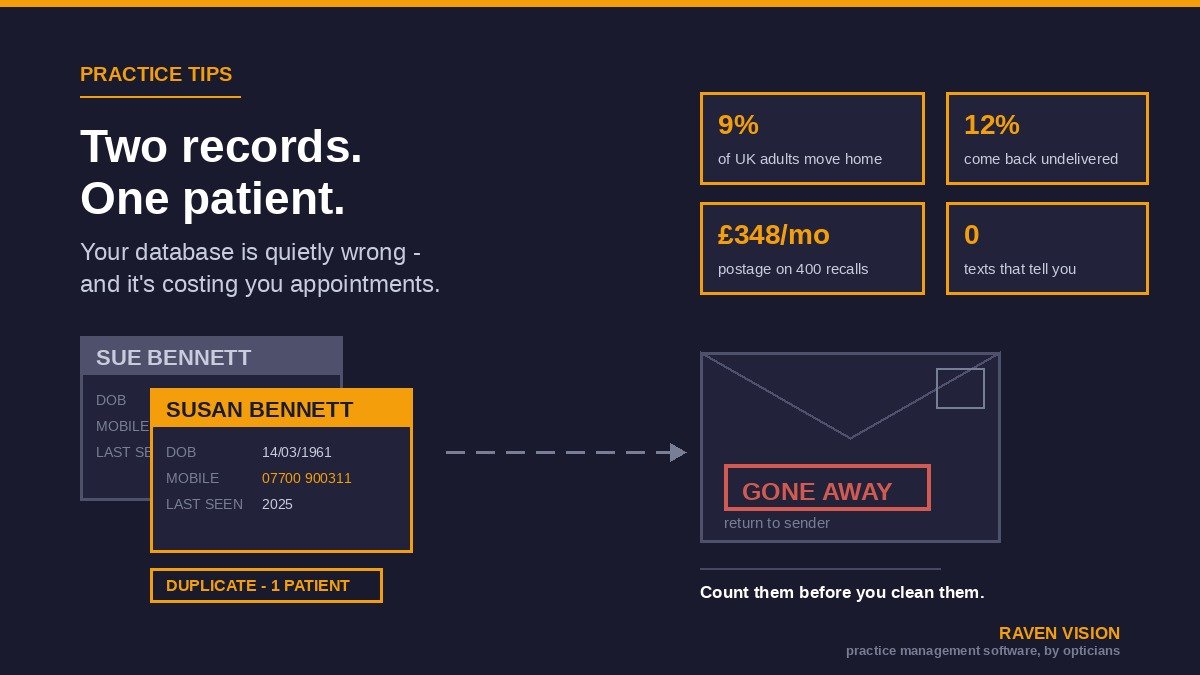
The quiet killer is the in-between drift. The patient who started monthlies in March, was supposed to come back in October, didn’t, and is now buying lenses online. Without a recall system that fires automatically and an escalation path when patients don’t respond, you’ll lose 8-15% of your CL base every year to inattention. If your recall is currently a spreadsheet and a part-time receptionist’s memory, that’s the first thing to fix. Practice management software with proper recall automation pays for itself in retained CL patients alone.
The modalities mix: where the growth is in 2026
Not every CL category is growing equally. The mix in your practice should reflect where demand is actually heading.
Daily disposables continue to take share from monthlies. Comfort, hygiene, and the “no solutions, no case” convenience are winning out, and the unit economics for the practice are usually better despite the higher patient cost. If your daily-to-monthly split is still 30:70, you’re behind the curve.
Multifocal CLs are quietly one of the strongest growth areas. Modern multifocal performance is genuinely good, and most presbyopes have never been offered them. A scripted “have we tried you in multifocals recently?” at the next sight test will surface more candidates than any marketing campaign.
Myopia management is the category where independents can build a real moat. Clinical involvement is high, parents are engaged, and corporate chains haven’t built proper pathways for it. A practice that becomes the recognised local centre for myopia management typically pulls patients from a wide radius and converts the whole family.
Specialty fits — keratoconus, post-surgical, irregular cornea — are lower volume but high-margin and high-loyalty, and they build referral links with local hospital eye services that strengthen your standing well beyond the CL revenue.
How your practice management software makes or breaks CL
The single biggest hidden cost in a poorly running CL service is admin time. The receptionist hand-typing direct debit details, the optom rifling through paper records for the last fit, the dispensing optician chasing aftercares by phone. None of that scales, and all of it is solvable with the right software.
Look at your current PMS and ask three honest questions. Does it handle direct debit subscriptions natively, with mandate management, failed payment alerts, and reporting — or is a third-party DD provider taped onto the side of it? Does it automate aftercare recall by modality and last visit, or is recall a manual job someone does on a Friday afternoon when they remember? Does it surface CL-specific reporting — penetration, DD active count, dropout, modality mix — without building a custom dashboard?
If the answer to any of those is “no,” your CL service is running with one hand tied behind its back. A practice management system designed for independent opticians should treat CL as a first-class workflow, not an afterthought.
Compliance, records, and audit-readiness
The clinical side brings record-keeping requirements that aren’t optional. The GOC and the College of Optometrists are explicit about what needs to be documented at fitting, aftercare, and supply: keratometry or topography on file, lens parameters specified, fitting notes and over-refraction, slit lamp findings at every aftercare, supply records linked to a current valid specification.
Beyond compliance, incomplete records make it almost impossible to switch a patient to a new modality, handle a complication well, or bring a new optom into the practice and have them take over CL patients smoothly. Whatever PMS you’re on, your CL records should be searchable, structured, and complete. Paper fit notes inside an otherwise digital practice are clinical and operational risk you don’t need to carry.
Growing your CL base: the four warmest sources
You don’t need a marketing campaign to grow a CL service. The warmest sources are already inside your practice.
Existing spectacle wearers who’ve never been asked. Run a list of patients aged 18-55 who’ve never had a CL fit, and add a one-line CL question to the sight test workflow: “Have you ever tried contact lenses, or would you like to?” You’ll be surprised how many say yes.
Presbyopes still in glasses-only. Most over-45s in your patient base have never been offered modern multifocal CLs. A targeted recall campaign — “we’ve got new options for varifocal wearers, would you like to try them?” — converts at a far higher rate than cold marketing.
Parents asking about myopia control. If parents are mentioning their child’s prescription is creeping up at every sight test and you’re not having a structured myopia management conversation, you’re leaving the door open for a competitor to pull that family. A clear myopia pathway, properly priced, with parents getting written information at the appointment, is one of the highest-value moves an independent can make.
Patients with active lifestyles. Sport, theatre, parents of young kids, hospitality workers — anyone whose glasses are in the way for chunks of their week. Daily disposables for “just when you need them” is an easy yes for this group, and it often grows into full-time CL wear.
KPIs that tell you whether your CL service is healthy
Five numbers tell you whether your CL service is healthy or quietly leaking.
CL penetration rate — the percentage of your active patient base wearing CLs. UK independents typically sit at 10-15%; top performers hit 20%+.
DD active count and average DD value — how many patients are on a recurring subscription, and what they spend on average. Trend matters more than the absolute number; flat for six months means something is broken in your pathway.
Annual dropout rate — the percentage of CL patients who lapse in 12 months. Below 8% is excellent; above 15% is a retention problem.
Aftercare attendance rate — the percentage of due aftercares actually attended. Below 70% suggests your recall workflow needs work.
Modality mix — daily disposables vs monthlies, multifocal share, myopia management share. Watching these shift over time tells you whether the conversations at the chair are evolving with the technology.
None of these need a custom dashboard. They should fall out of your PMS as standard reports. If they don’t, that’s a sign your software isn’t built for the way modern CL services run.
Common pitfalls to avoid
A handful of mistakes show up over and over. Quoting fitting fees on the phone before the patient has been examined — it commodifies the clinical work and trains patients to shop on price. Using the same trial pack for everyone regardless of lifestyle — it sets the wrong expectations and increases dropout. Letting CL supply leave the practice without an active aftercare booking — if a patient walks out with three months’ worth of lenses and no next appointment, you’ve already started losing them. And treating CL as the optom’s job alone. It’s a team sport, and a service that depends on one person collapses every time that person takes a fortnight off.
Where Raven Vision fits
Raven Vision was built inside a working independent practice, which is why CL workflows aren’t bolted on — they’re a core part of how the system thinks. Direct debit subscription management, automated aftercare recall by modality, structured CL clinical records, supply ordering linked to mandates, and CL-specific reporting all sit inside the same system you use for the rest of the practice.
If your current setup involves a spreadsheet for direct debits, paper for fit notes, and a person who manually chases aftercares, you’re paying for that gap in lost retention every month. Book a demo and we’ll walk through what a properly run CL workflow actually looks like, against your current numbers.
The point
Contact lens services aren’t a side hustle for an independent optician. Done well, they’re one of the most defensible parts of the business — predictable revenue, sticky patients, clinical work that builds local reputation, and a category where corporate chains structurally underperform.
The practices that will be in good shape in 2027 and 2028 are the ones building the operational backbone now: clean pathways, modern pricing, direct debit subscriptions, automated recall, and software that treats CL as a first-class workflow. The clinical capability is already there. The opportunity is in finally running it like a service, not a series of one-off transactions.