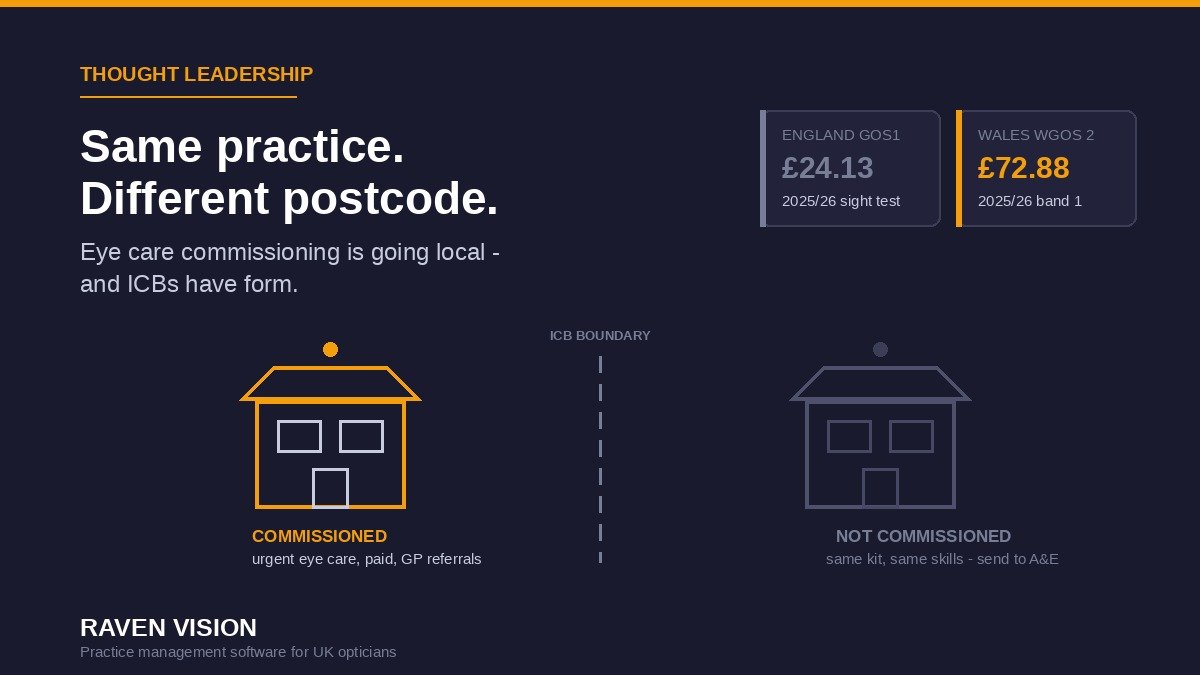


Here’s a number that should bother every practice owner: the GOS1 sight test fee in England is now £24.13. That’s the whole payment for a routine NHS sight test. So when a claim gets rejected, queried, or simply sits unpaid for weeks, you’re not arguing over a rounding error — you’re chasing money you’ve already earned, on volumes where the margins are thin to begin with.
Most independents I speak to don’t have a claims problem because they’re careless. They have one because the process lives in too many heads, on too many bits of paper, and nobody owns the end-to-end picture until the remittance lands and something’s missing. The good news is that GOS claim rejections are almost entirely preventable, and getting paid faster is mostly about tightening a handful of habits at the front desk and in the test room.
This is a practical walkthrough of where claims actually go wrong in a typical UK independent practice, and how to fix it without hiring anyone or buying anything you don’t already need.
Why GOS claims get rejected in the first place
Rejections and queries rarely come from one dramatic mistake. They come from small, repeatable gaps. Once you’ve seen a few months of remittance advice, the same culprits show up again and again.
Patient eligibility wasn’t properly checked
This is the big one. A patient says they’re on Universal Credit, or that they’re diabetic, or that they’re 59 when they’re actually 58 — and the claim goes in on that basis. If the eligibility doesn’t hold up, the claim gets rejected and you’re left trying to recover the fee from a patient who genuinely believed they qualified. That conversation is awkward, and you usually lose.
The fix isn’t to interrogate people. It’s to make the eligibility question a fixed step at booking or check-in, ask for the evidence you’re entitled to ask for, and record exactly what was seen and when. “Patient stated diabetic” is weak. “Diabetic — confirmed, exemption category recorded at check-in” is defensible.
Wrong or missing patient details
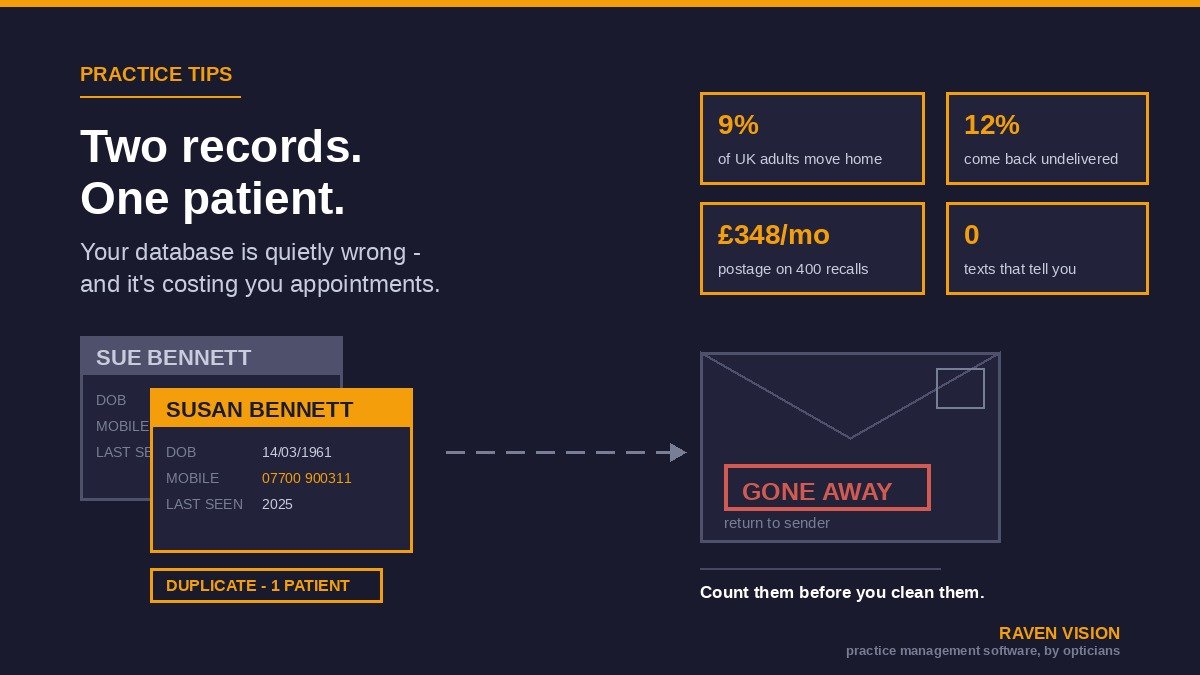
A transposed date of birth, a misspelt surname, an old address, a postcode that doesn’t match the records — any of these can bounce a claim or slow it down. These errors creep in when someone retypes details that already exist somewhere else in the building. Every time a detail gets keyed twice, you double the chance of a mismatch.
The interval rule caught you out
NHS sight tests have minimum intervals between them, and they vary by clinical reason and patient group. If a patient comes in earlier than the standard interval without a recorded clinical justification, the claim can be rejected as “too soon.” Practices lose real money here, usually because nobody flagged the previous test date at the point of booking.
The claim was simply late
There are time limits for submitting GOS claims. A claim that’s correct but submitted past the deadline is worth exactly nothing. When claims are batched up and submitted “when someone gets a chance,” the oldest ones are the ones at risk — and they’re invisible until they’ve already expired.
Fix it at the front desk, before the patient sits down
Almost every rejection above is decided before the optometrist has done anything clinical. The front desk is where claims are won or lost, so that’s where the tightening pays off most.
Make eligibility a booking-stage question, not a check-in scramble
When a patient books, that’s the moment to ask whether they’re claiming an NHS test and on what basis. Asking early does two things: it gives the patient time to bring evidence, and it gives you time to spot a problem before they’re standing at the desk expecting a free test. A patient who’s told at booking “lovely, just bring your benefit confirmation with you” is a patient whose claim won’t bounce.
Record eligibility evidence the moment you see it
Don’t rely on memory or a mental note that you’ll “log it later.” Capture the exemption reason and the fact that evidence was checked at the point it happens. If your system timestamps who recorded what, even better — that’s your protection if a claim is ever queried months down the line.
Stop typing the same details twice
If a patient’s name, date of birth and address already exist in your patient record, the GOS claim should pull from that record, not get retyped onto a form. This single change removes a whole category of rejection. It’s also the strongest argument for keeping patient data and claims inside one connected system rather than spread across a diary, a paper pad and a separate NHS portal. Our billing and claims tools work straight off the patient record for exactly this reason — the details are entered once and reused everywhere.
Flag the last test date when the appointment is booked
The person booking the appointment should be able to see, instantly, when this patient was last tested on the NHS. If that date is inside the minimum interval, you want to know now — so you can either move the appointment or make sure a clinical justification gets recorded. Finding out after the test, when the claim rejects, is the expensive way to learn this.
Tighten the clinical and dispensing handover
Some claim problems are clinical-record problems. The optometrist knows why an early retest was justified, or which additional services were provided — but if that reasoning never makes it onto the claim, the payment doesn’t follow.
Record the “why” while it’s fresh
If a sight test is clinically justified inside the normal interval — a patient with a sudden change in vision, a specific condition that warrants closer monitoring — that justification needs to be in the record, in the moment, in language that stands up to a query. A note written three weeks later from memory is worth far less, and may not be there at all.
Don’t let services get provided but not claimed
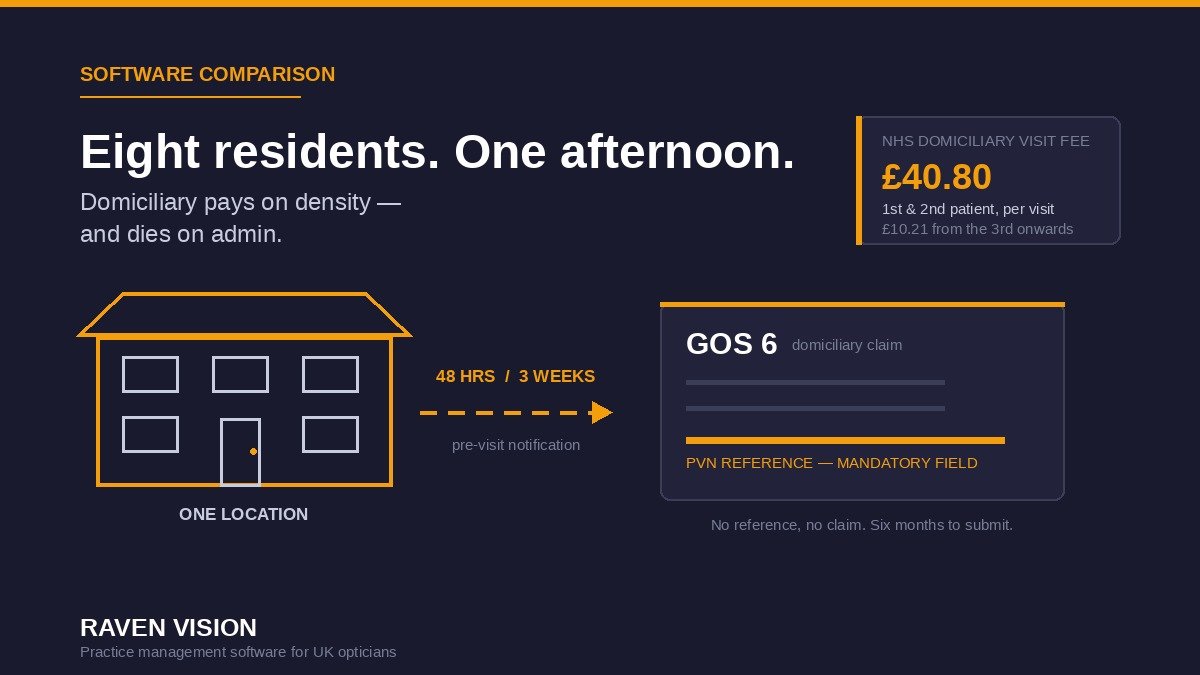
Domiciliary visits, repeat tests, additional services — these all carry their own fees and their own rules. The first and second patient seen at a domiciliary visit each attract £40.80, for example. When these get done but not properly logged, you’re effectively working for free. A quick end-of-day check that every service delivered has a matching claim catches most of this before it disappears.
Submit little and often, and watch what comes back
The fastest-paying practices treat claims as a daily rhythm, not a monthly panic.
Clear claims daily, not in a monthly batch
Submitting claims the same day, or at most the next morning, does three things. It keeps you well inside the submission deadline. It means errors get caught while the patient and the details are still fresh. And it smooths your cash flow, because money starts moving sooner instead of all arriving — or not arriving — at month’s end. A short daily habit beats a long monthly slog every time.
Reconcile the remittance against what you submitted
When payment comes through, someone needs to check it against what you actually claimed. If five claims went in and four came back paid, where’s the fifth? Was it rejected, queried, or just missed? Practices that never reconcile are quietly losing fees every single month and don’t know it. Practices that reconcile turn rejections into a short, fixable to-do list.
Keep a live view of what’s outstanding
You should be able to answer, at any moment, “what have we claimed, what’s been paid, and what’s still outstanding?” If answering that means digging through paperwork or logging into a separate portal and cross-referencing by hand, the answer is usually “I don’t really know” — and that’s where money leaks. Pulling claims, payments and patient records into one place is the difference between guessing and knowing. It’s the core of why we built RV’s integrated eGOS and claims tools around a single connected record rather than bolt-on modules.
A simple monthly claims routine that pays for itself
You don’t need a finance department. You need a short, boring routine that someone owns and actually does. Here’s a version that works for most independents.
Once a week, pull the list of submitted claims and check none are approaching their deadline unpaid. Once a week, reconcile the latest remittance against what you sent, and turn any gaps into a follow-up list. Once a month, look at your rejection reasons together — not to assign blame, but to spot the pattern. If half your rejections are eligibility-related, that tells you exactly where to tighten the front-desk script. If they’re interval-related, your booking process needs the last-test-date flag. The reasons point straight at the fix.
Over a quarter, this routine turns “we lose a bit on rejected claims, it’s just how it is” into a number you control. And for a practice running on £24.13 sight tests, recovering even a handful of lost claims a month is real money back in the till.
The bottom line
GOS claim rejections feel like an NHS admin headache you’re stuck with. They’re not. They’re the predictable result of details being entered twice, eligibility being checked loosely, intervals being missed at booking, and claims being submitted in a monthly rush. Fix those four things and the rejections largely stop — and the money you’ve already earned actually reaches your bank account, on time.
The practices that do this best aren’t working harder. They’ve just stopped letting claims live in five different places. When your diary, your patient records and your NHS claims all run off the same connected system, eligibility gets recorded once, last-test dates are visible at booking, and nothing gets submitted late because nothing gets forgotten.
That’s exactly what Raven Vision was built to do — by opticians who got tired of watching earned fees slip through the cracks. If you’d like to see how it handles GOS claims, eligibility checks and reconciliation in one place, see exactly what’s included and what it costs — it’s £149 a month per location, with three months free and no lock-in, so you can put these fixes to work without a big upfront bet.