

If you’re running an independent optician practice in the UK, chances are you’ve looked at practice management software at least once in the last year. Maybe you’re still on paper records (no judgement — we’ve seen it more than you’d think). Maybe you’re stuck on a system that’s been “good enough” since 2015 but is starting to show its age. Or maybe you’re opening a new practice and trying to work out what this is actually going to cost you.
Here’s the problem: getting a straight answer on pricing in this market is surprisingly hard. Some providers hide their prices entirely. Others quote a headline number but load up on setup fees, training charges, and per-user add-ons that triple the real cost within six months. A few offer “free trials” that require a 12-month commitment to unlock.
So we did the legwork. This is what practice management software actually costs for UK independent opticians in 2026 — the monthly fees, the hidden extras, and what you’re genuinely getting for your money.
What should practice management software actually do?
Before we get into pricing, it’s worth being clear about what a modern PMS should handle for an optician practice. At minimum, you need:
Appointments and scheduling — online booking, automated reminders, multi-practitioner diaries. Patient records — clinical history, prescriptions, previous dispensing, contact lens records. eGOS claims — submitting NHS claims electronically without the paper chase. Stock and inventory — frame tracking, lens ordering, supplier management. Billing and payments — invoicing, payment tracking, integration with card terminals. Reporting — practice performance, revenue breakdowns, recall compliance. And increasingly, patient communication — SMS reminders, recall messages, and marketing tools built in.
Any system that doesn’t cover all of these is asking you to bolt on extra tools (and extra costs) to fill the gaps. Keep that in mind as we go through the options.
The UK optician PMS market: what you’ll actually pay
We’ve pulled together pricing for the most common practice management systems used by UK independent opticians. Where providers don’t publish pricing, we’ve used figures from industry forums, practice owner conversations, and publicly available quotes. All prices are per location per month unless stated otherwise.
Optisoft — around £275/month
Optisoft has been around for decades and has a solid install base, particularly among larger independents and small chains. The system covers the core PMS functions well, though the interface shows its age in places. They’ve been running a promotional offer where new customers get 12 months free — which sounds generous until you realise you’re typically locked into a multi-year contract to access it. Setup and data migration fees can push your first-year cost above what you’d expect from that “free” headline.
XEYEX — around £353/month
XEYEX positions itself as a premium, cloud-native solution with strong clinical features and a modern interface. The price reflects that positioning. For a single-location independent practice doing reasonable volume, £353/month is a significant line item — that’s over £4,200 a year before you factor in any extras. The system is capable, but you’re paying a premium for features that many independents won’t fully utilise.
Optix — around £280/month
Optix sits in a similar bracket to Optisoft and offers a comprehensive feature set including eGOS, clinical records, and dispensing management. It’s well-regarded in the industry but the monthly cost puts it firmly in the mid-to-upper range. Additional modules or integrations may carry separate fees depending on your configuration.
Opticabase — around £144/month
Opticabase comes in at the more affordable end of the market. It covers the basics well and has gained traction among smaller independents who want a functional system without the premium price tag. However, some practice owners report limitations in reporting depth and customisation compared to pricier alternatives. Worth looking at if your needs are straightforward.
Blink — around £144/month
Blink offers a cloud-based system at a competitive price point. The platform handles appointments, patient records, and dispensing, though feedback from practices suggests the feature depth varies. Like Opticabase, it’s a solid option for practices that need the essentials without paying for enterprise-level capabilities they won’t use.
Vision Plus — from £47/month
Vision Plus starts at the lowest price point in the market, which makes it attractive for brand-new practices or those on very tight budgets. The “from” qualifier matters here — the base package is limited, and most practices end up on a higher tier once they add the modules they actually need. Still, even at higher tiers, it remains one of the more affordable options.
Ocuco — custom pricing
Ocuco targets larger groups and chains rather than single-location independents. Pricing is quote-based and typically involves a significant upfront investment plus ongoing fees. Unless you’re running multiple locations or have very specific enterprise requirements, Ocuco is probably not where you should be looking.
Raven Vision — £149/month
Raven Vision sits right in the sweet spot between budget and premium. At £149 per month per location, you get the full platform — appointments, patient records, eGOS claims, inventory management, billing, clinical notes, and reporting. No stripped-down base package that forces you to upgrade. No per-user fees. No setup charges.
What makes this worth flagging specifically: Raven Vision currently offers three months completely free, plus free data migration from your existing system, white-glove onboarding, and a 30-day money-back guarantee. There’s no contract lock-in either — if it’s not working for your practice, you leave. They’ll even build you a practice website with integrated online booking at no extra charge.
The costs nobody talks about
Monthly subscription fees are just the starting point. The actual cost of running practice management software includes several line items that rarely make it into the sales pitch.
Setup and migration fees
Moving your patient records, appointment history, prescription data, and stock information from one system to another is genuinely complex work. Some providers charge £1,000-£3,000+ for data migration. Others include it in the package but extend your contract term to compensate. A few — like Raven Vision — include it free, but this is the exception rather than the rule.
Training costs
Your team needs to learn the new system, and that learning curve has a real cost even if the training itself is “free.” Every hour your dispensing optician spends in a training session is an hour they’re not on the shop floor. Some providers charge separately for on-site training, remote training sessions, or access to training materials. Factor in at least 2-3 days of reduced productivity during the transition period.
Per-user or per-practitioner fees
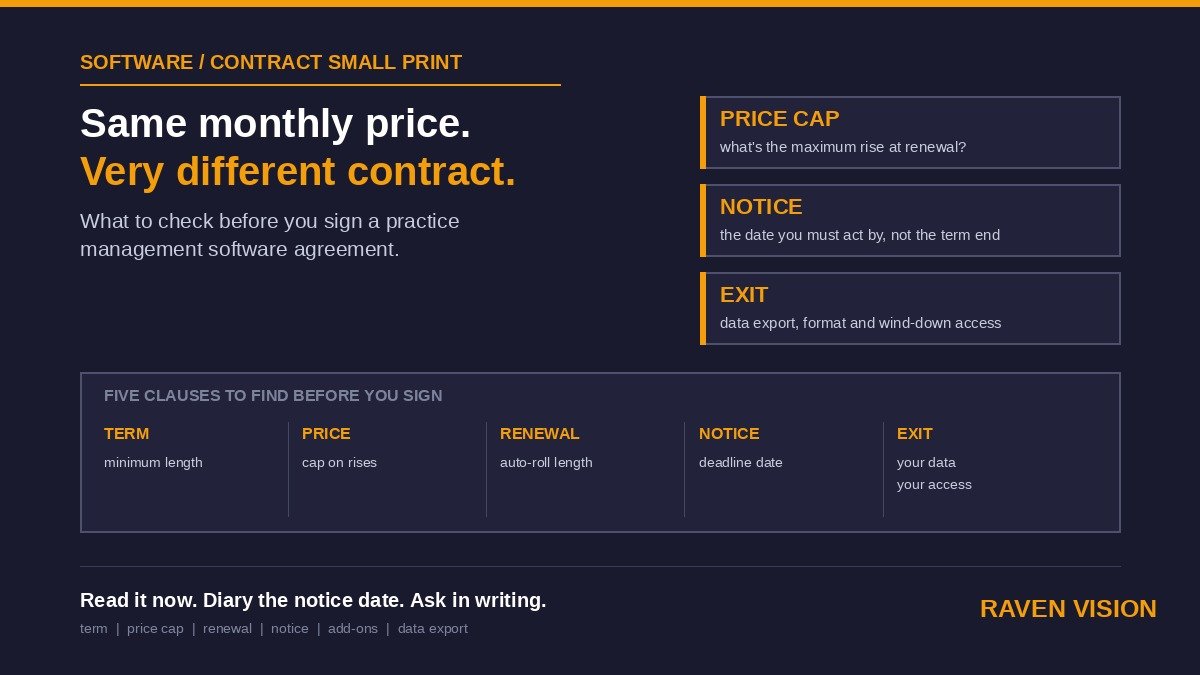
This is where pricing gets sneaky. A system that looks like £150/month might actually be £150 per user per month. If you’ve got two optometrists, a dispensing optician, two optical assistants, and a receptionist, your “£150/month” system is suddenly costing you £900. Always clarify whether pricing is per location or per user.
Hardware requirements
Cloud-based systems generally run on any modern computer with a browser — your existing equipment should work fine. On-premise or hybrid systems might require specific hardware, server infrastructure, or dedicated terminals. If a provider tells you that you need to buy new hardware to run their software, add that to your total cost of ownership.
Support and maintenance
What happens when something goes wrong at 4pm on a Friday and you’ve got patients in the waiting room? Some providers include unlimited support in their monthly fee. Others offer tiered support levels, with priority response times locked behind premium plans. A few charge per-incident for support calls. Check the support terms before you sign — cheap software with expensive support isn’t cheap.
Integration costs
Does the PMS integrate with your existing lens suppliers’ ordering systems? Your optical lab? Your accounting software? Your SMS platform? Every integration that isn’t included natively is either an add-on cost or a workaround that eats your team’s time.
How to actually compare: total cost of ownership over 12 months
Let’s do the maths on what a single-location independent practice with 4 staff members would actually pay over the first 12 months, factoring in the most common additional costs.
At the higher end — say, XEYEX at £353/month — you’re looking at £4,236 in subscription fees alone over a year. Add a £1,500 setup fee and £500 in training, and your first year costs around £6,236.
Optisoft at £275/month comes to £3,300 in subscriptions. Even with their 12-month free offer, the contract terms and migration costs mean your effective first-year spend likely lands somewhere between £1,500 and £2,500 once you account for everything.
Raven Vision at £149/month, with three months free, means you’re paying for 9 months in your first year: £1,341. Setup, migration, onboarding, and your practice website are all included. Your all-in first year cost is £1,341. That’s it.
The difference between the most expensive and least expensive full-featured option is nearly £5,000 in year one. For a single-location independent, that’s real money — money that could go into stock, marketing, equipment, or just keeping your margins healthy.
What to look for beyond the price tag
Price matters, but it’s not everything. A few things worth weighing up when you’re comparing options:
Is it built for UK opticians specifically? Generic healthcare software adapted for optics always has gaps. You want a system built around the way UK practices actually work — NHS GOS forms, UK-specific clinical workflows, frame catalogues from the suppliers you actually use.
Who built it? This matters more than people think. Software built by developers who’ve never been in a practice tends to miss the small things that make a big difference in daily use. Raven Vision, for example, was built by Shaukat — an optometrist with over 35 years in the industry who runs three practices himself and has lectured on optics at the University of Manchester. He built the system for his own practices first, then opened it up to the wider industry. That origin shows in the workflow design.
How responsive is support? Ask other practices who use the system. Online reviews help, but a direct conversation with someone who’s been using the software for 6+ months will tell you more than any sales demo.
Can you trial it properly? Not a 15-minute guided demo where the sales rep controls the screen. An actual trial where your team uses the system with your real workflows. Any provider confident in their product should let you do this.
The bottom line
Practice management software is one of those costs that’s easy to overpay for. The UK optician market has options ranging from under £50/month to well over £350/month, and the most expensive option isn’t necessarily the best fit for an independent practice.
If you’re a single-location independent looking for a full-featured PMS that won’t eat into your margins, it’s hard to argue with £149/month and three months free — especially when migration, onboarding, and a practice website are included at no extra cost.
Want to see if Raven Vision fits how your practice works? Book a demo — it takes 30 minutes, there’s no hard sell, and Shaukat will walk you through the system himself.