

Walk into any independent opticians in the UK and ask the owner what their succession plan looks like, and you’ll usually get one of three answers. A nervous laugh. A vague mention of “selling up in a few years.” Or, most commonly, silence.
This is the quiet crisis nobody in UK optometry is talking about properly. A huge slice of independent practice owners are over 55. Many are over 65. They’ve spent decades building businesses that are deeply tied to them personally — their patient relationships, their clinical decisions, their systems (often locked in their head), even their till float routine on a Saturday morning. And when it comes time to step back, they discover something uncomfortable. The practice isn’t really an asset. It’s a job that pays them. And jobs don’t sell.
That’s the thing nobody warns you about when you open your first practice. The decisions you make in your forties and fifties don’t just shape your day-to-day life. They shape what you can walk away with — or whether you can walk away at all.
Why succession is a real problem in UK optometry right now
The numbers tell a clear story. The Association of Optometrists has flagged for years that the average age of independent practice owners in the UK keeps climbing, while the number of new graduates choosing to open their own practice keeps falling. New optometrists today are far more likely to take a salaried role at a multiple — Specsavers, Boots, Vision Express — than to take on the financial and operational risk of running their own shop.
What that means in practice is that the buyer pool for an independent practice has narrowed. The big chains are still acquiring, yes, but they’re increasingly selective and increasingly tough on price. Other independents are buying too, but most are smaller operators who can only afford modest deals. And the steady supply of young optometrists looking to take over a list — the traditional internal succession route — has thinned dramatically.
Add to that the cost-of-living squeeze, rising rents, NHS fee pressure, and rapidly changing patient expectations around digital convenience, and you’ve got a market where practices that aren’t running cleanly become much harder to sell at a fair price. Owners who waited too long to systemise are finding themselves stuck.
What succession actually means (and why most owners get it wrong)
Succession isn’t a single decision. It’s a spectrum of options, and the path you can take depends almost entirely on how you’ve built the business in the years leading up to it.
Selling to a chain
Quick exit, often a clean cash-out. But you’ll typically be valued on EBITDA multiples that look modest compared to what you might have hoped, and you’ll have very little say in what happens to your team, your patients, or your shop fit afterwards. Chains pay for predictable revenue and clean financials. Anything messy gets discounted.
Selling to another independent
Often a better cultural fit. Local independents who want to grow regionally are a real buyer segment, and they tend to value the patient relationship more than a chain does. But valuations here can be lower in absolute terms, and finance can be harder for the buyer to secure unless your books are pristine.
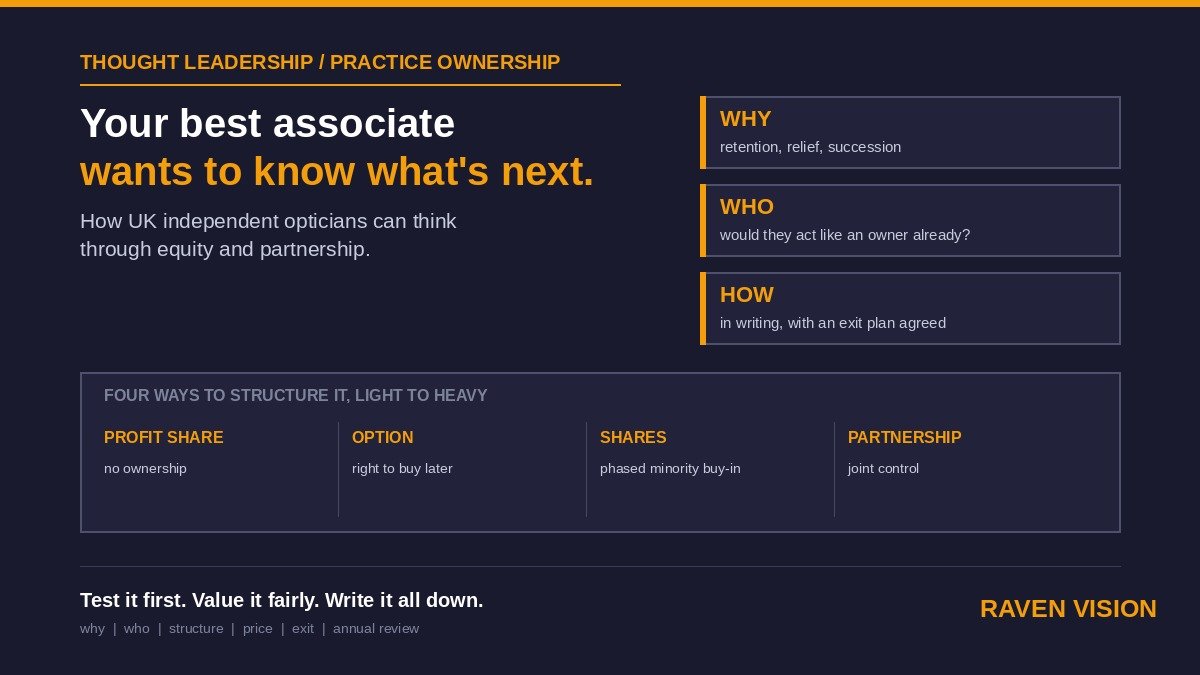
Internal succession (associate buyout)
The romantic version of succession, and the one most owners say they want. Take on a young optometrist, train them up, gradually hand over equity, ride into the sunset. It works — but only if you start the conversation years before you actually want to step back, and only if your associate genuinely wants to buy. Plenty of owners have wasted five years on an associate who quietly never intended to take over.
Family handover
Less common than it used to be. The idea that your kid will follow you into the practice was much more realistic two generations ago. Today, even in optometry families, the next generation often chooses a different path. If a family handover is genuinely on the table, you’re lucky — but you still need to handle it like a real business transaction, not a gift.
Step back without selling — the self-running practice
This is the option a lot of owners are quietly drifting towards: stay as the owner, but build the business so it runs without you doing every clinic, every payroll run, every supplier call. Income continues, you reduce your hours, eventually you sell from a position of strength rather than burnout. This requires the most operational discipline of any of the routes — but it also gives you the most flexibility.
The single biggest factor in your valuation: how dependent the practice is on you
Anyone who’s ever sold a small business will tell you the same thing. The number-one factor that determines what your practice is worth isn’t your turnover. It isn’t your patient list size. It isn’t your prime location. It’s owner dependency.
If a buyer looks at your practice and concludes that the moment you walk out the door, half the value walks out with you, they will discount the price hard. Because what they’re actually buying in that scenario is not a business — it’s the privilege of inheriting your job.
Owner dependency shows up in lots of ways. Most patients book with you specifically and won’t accept another optom. Your locums know nothing about your protocols. Your staff need you to authorise every refund, every supplier payment, every awkward decision. Your records exist mostly in your head. Your software is so old or so customised that nobody else can run it. Your supplier relationships are personal favours.
None of these are fatal on their own. But together they mean your practice can’t function without you. And practices that can’t function without their owner don’t sell well.
Five things to start fixing now — even if you’re ten years away from exit
The good news is that the work to make your practice sellable is the same work that makes it run better today. Every step here pays off whether you exit in two years or twenty.
1. Document everything that lives in your head
Start with the boring stuff. How do you handle a complaint about a varifocal that the patient says they can’t get on with? What’s the exact order in which staff should follow up on outstanding eGOS claims? How do you decide which lab to send a job to? Every routine decision you make on autopilot is a decision your future buyer or successor will need to make from scratch.
Aim for a simple operations manual — a Google Doc is fine to start. Don’t write it like a textbook. Write it like you’re explaining it to a new starter who’s good but new. The act of writing this stuff down often reveals shortcuts and inconsistencies you didn’t realise you had.
2. Build a clinical team that can stand on its own
If every difficult patient ends up at your chair, your associates and DOs will never develop the confidence to handle them. Worse, your patients will only ever trust you. That’s a personal compliment. It’s also a business problem.
Deliberately route some of your “harder” cases to other clinicians. Sit in on their patient conversations occasionally. Build clinical CPD time into the rota. The goal is a team where any reasonable patient could see any reasonable clinician and still get a great outcome.
3. Get your books and your systems clean
This is where most independents lose serious money at exit. Mixed personal and business expenses, paper-based stock records, frame inventory that nobody can fully account for, eGOS claim records spread across an old PMS and a spreadsheet — buyers will discount aggressively for any of this. Cloud accounting (Xero, QuickBooks Online), one source of truth for clinical and dispensing data, clean reconciliations every month. None of it is glamorous. All of it adds value.
This is also where modern practice management software earns its keep. A system that captures appointments, clinical records, eGOS claims, dispensing, and billing in one place gives a future buyer something they can actually evaluate. A binder of paper records and a desktop PMS from 2008 makes them nervous.
4. Diversify your revenue
Practices that rely heavily on one revenue stream — usually NHS sight tests with a bit of dispensing — are valued more cautiously than practices with multiple healthy income lines. Myopia management, dry eye, contact lens direct debit schemes, sports vision, low vision, even simple recall-driven private testing — each one you build adds resilience and value. Buyers pay more for businesses that aren’t reliant on any single fee schedule or patient type.
5. Know your numbers cold
You’d be astonished how many independent owners can’t tell you, off the top of their head, their average dispensing rate, their conversion from sight test to spectacles, their NHS-to-private revenue split, or their staff cost as a percentage of turnover. If you don’t know the numbers, you can’t grow the numbers. And if you can’t grow the numbers, you can’t tell a compelling story to a buyer about where the practice is heading.
Pick a small set of metrics — five is plenty — and review them every month. Most modern PMS platforms will surface these for you automatically if you set them up properly. The point isn’t to become a spreadsheet warrior. It’s to be the kind of owner who can answer any reasonable question about their practice in under a minute.
When should you actually start?
The honest answer is the one nobody wants to hear: ten years before you want to exit. Not because the work takes ten years — most of it can be done meaningfully inside two or three. But because some of the highest-leverage moves (training a successor, growing into multi-clinician routine, moving to a new PMS) take time to bed in and start showing up in the numbers a buyer cares about.
If you’re 55 and thinking about exit at 65, you’re already in the right window. If you’re 45, the right time to start is now, not in ten years’ time. And if you’re 35, the kindest thing you can do for your future self is build the practice on solid foundations from day one — clean systems, documented processes, a team that can run a clinic day without you. You won’t regret it.
The role of practice management software in all this
One of the most common things buyers ask in due diligence is, “What system do you use?” It’s a deeper question than it sounds. They’re really asking: can your data move? Are your patient records exportable? Is the financial reporting reliable? Can a new owner pick this up and run it from week one?
Old, locally installed software with no proper backups, no clean reporting, and no patient export path is a red flag. It tells the buyer they’ll have to migrate everything before they can really operate the business — and migration risk gets priced in hard.
Cloud-based, modern systems do the opposite. They reassure the buyer. They make handover smooth. They surface the metrics that buyers want to see. And critically, they make life easier for you in the years before you exit, not just at the moment of sale.
That’s why we built Raven Vision the way we did — Shaukat ran his own practices for thirty-five years, lived through the pain of bad PMS, and designed something that opticians would actually want to use. Cloud-based by default, built around real workflows, eGOS claims handled cleanly, dispensing and clinical records in one place. The kind of system that doesn’t fight you when you eventually want to step back.
Start with one thing
You don’t need to do all of this at once. You don’t need to overhaul the practice in a quarter. The owners who succeed at building a sellable, transferrable, team-led practice all started with one thing — usually documenting one process, or putting one number on the wall, or routing one type of patient to an associate. Then another. Then another.
If you’ve never thought seriously about succession before, start by writing down — just for yourself — what you’d want your exit to look like. Who buys it? When? At what price? Working back from that picture will tell you the work that needs doing.
And if your current systems are getting in the way of any of that — if your software is making it harder, not easier, to know your numbers and run a clean operation — that’s worth fixing too. Book a demo of Raven Vision and we’ll show you what a modern, cloud-based PMS looks like, including the £149 a month no-brainer offer with three months free, free data migration, and a free booking-integrated website. We built it inside real practices. It’s designed to make running yours easier today, and selling it easier later.