

Most UK independent opticians who open a second practice tell the same story afterwards. The first six months looked fine on the surface. The next six months drained their energy, their bank account, and — quietly — some of the standards they were proudest of in practice one.
That isn’t because expansion is a bad idea. It’s because most independents make the second-practice decision the same way they make the first: gut-led, opportunistic, often because a site became available or a competitor exited. Then they try to run two practices like two copies of one. It rarely works.
This is a long, careful look at when opening a second optician practice in the UK actually makes sense in 2026, when it doesn’t, and what has to be true in practice one before you sign anything in practice two.
The seduction of the second location
Independent opticians don’t usually expand because they planned to. They expand because something happened. A lease comes up in a town five miles away. A competitor retires and offers a soft handover. An associate hints they’d partner on a site. A landlord nudges them. Local demand starts spilling over and the diary in practice one stops keeping up.
Each of those can be a real opportunity. None of them, on its own, is a reason to expand. They’re triggers, not strategies.
The seduction is the leap in thinking that goes: practice one works, so two of them will work twice as well. The maths feels obvious — double the patients, double the revenue, dilute the overheads, build something worth selling. In reality, very few second sites hit those numbers in the first eighteen months, and the ones that do almost always rely on something owners didn’t plan for: a strong manager, a system that travels, and clean numbers from practice one.
What “ready” actually looks like
Here’s a quieter way to think about it. You’re not ready for a second practice when practice one is busy. You’re ready when practice one runs without you for a fortnight and the standards don’t drop.
That’s a higher bar than most owners realise. It means recall is happening on time without you chasing it. It means dispense conversations are converting at a consistent rate whether you’re in the consult room or on holiday. It means the front desk doesn’t quietly slip back into “we’ll call them when the boss is in” when you’re not there. And it means the numbers — daily takings, week-by-week eye test counts, dispense rate, contact lens base — sit in front of you on a Monday morning whether you’ve physically been in the practice or not.
If that’s not true today, opening a second site doesn’t fix it. It magnifies it. Whatever cracks exist in practice one show up in practice two, but louder, because you’re not there to paper over them.
The hidden maths most owners miss
A second practice doesn’t double your costs. It roughly multiplies them by 1.7 to 1.9, depending on how much you can share — accounting, ordering, recall admin, marketing, perhaps a roaming dispenser. So far, so encouraging.
What it does double, almost exactly, is your operational complexity. Two rotas. Two patient flows. Two stocks of frames. Two sets of dispense conversations that have to feel consistent to a patient who might visit either site. Two reception cultures that drift apart the moment you stop watching.
And — this is the part most owners discover too late — your own attention becomes the most expensive resource in the business. Time spent driving between sites, mediating staff issues across two teams, or untangling stock mismatches is time you used to spend in front of patients earning gross profit per hour. If your second-practice plan doesn’t include a credible answer to “who runs this when I’m not in the room?”, the numbers don’t pencil out.
Add to that: build costs that always overrun, opening months that almost always under-deliver on patient volume, and an eighteen-month payback that turns into thirty when growth is slow. None of this means don’t do it. It means do it with eyes open.
Three honest reasons to open a second practice
If you strip out the noise, there are really only three reasons to open practice two that hold up under pressure.
One: practice one is structurally full and you’re turning patients away. Not “busy”. Full. Diary booked three weeks out, recall slipping because there isn’t capacity to absorb it, dispense queue stretching, patients quietly going elsewhere because they can’t get an appointment. If that’s the picture, and you’ve already squeezed practice one’s capacity (longer hours, second test room, locum support, better workflow), a second site is a genuine release valve.
Two: you want to build something sellable. A single optician practice is a job with goodwill attached. A two- or three-practice group, with a manager structure and clean books, is a business with a multiple. If your real goal is to step back in five to ten years with something you can hand over, sell, or partly exit, then opening practice two — done properly — is a structural move toward that. We’ve written more on this in our earlier piece on succession planning for UK independent opticians.
Three: a specific clinical or commercial niche needs its own home. Sometimes practice one can’t physically house what you want to grow — a dedicated myopia management clinic, a dry eye suite, a serious sports-vision setup, a high-end frame gallery. If the niche has demand and your existing space dilutes it rather than showcasing it, a second site purpose-built around that offer can outperform a generic expansion by a long way.
Three reasons that sound good but rarely are
And then there are the reasons that get owners into trouble.
“A site became available.” Property opportunism is the most common reason independents expand and one of the worst. The right time to open a second practice is when you’ve decided you should, not when a landlord decides for you. A site is a vehicle for a strategy, not a substitute for one.
“My associate wants to grow.” Wanting to keep a talented optometrist is a real concern, but second sites built around an individual rather than a model tend to wobble when that person leaves — and over a ten-year horizon, they usually do. By all means create a path for them, but design the practice around the patient demand and the operating model first, not the personality.
“It’ll force me to get systems in place.” It won’t. It will reveal that you don’t have them, painfully and at scale. Owners often tell themselves the second site will be the forcing function — the discipline, the structure, the documentation. In practice, a second site without those things already in place burns cash faster than it builds them.
Choose your operating model before you choose your site
Independents often pick a property first and then ask how to run it. Reverse the order. The operating model is the strategic question; the site is downstream.
There are three models that actually work for UK independent opticians, and they each demand different things from you.
The clone. Practice two is a near-identical copy of practice one — same offer, same price points, same workflow, same brand feel. The benefit is speed and consistency; the risk is that you double the workload without adding anything distinctive. This works best when practice one has a clearly winning formula in a market with proven demand spillover.
Hub and spoke. One main practice carries the clinical heavy-lifting — OCT, fields, dry eye, contact lens fits — and a satellite handles routine sight tests, dispenses and collections. This model lets you concentrate capital equipment, share specialist staff, and use the smaller site as a community access point. It works well in towns where rents are uneven across catchments.
The specialist sibling. Practice two is deliberately different — a myopia clinic, a paediatric specialist, a premium boutique, a CL-focused practice. It shares a parent brand and back office but stands on its own as a clinical proposition. This is the most ambitious model and the one most likely to genuinely add value to the group, but it demands the clearest thinking upfront.
Whichever model you choose, write it down. Put it on one page. Test it against the next twenty decisions you make about the second site. If you can’t link a decision back to the model, you’re drifting.
What needs to be true in practice one first
Before you start looking at sites, audit practice one against five honest questions.
First, do you have a manager — by name, by job description, by capability — who can run a day, a week, and a month without you? Not an optometrist who also “keeps an eye on things”. A real manager, paid and trained for that role.
Second, can you see the practice’s numbers without asking anyone? Daily takings, weekly eye tests, dispense rate, recall completion, contact lens base, top revenue per hour by clinician — at your fingertips. If you can’t see practice one, you definitely can’t see practice two.
Third, is your workflow documented? Recall, dispense follow-up, glasses-ready notifications, walk-in handling, end-of-day cash and stock procedures. If everything lives in your head, it can’t be replicated.
Fourth, are your standards encoded into the system, not the people? A patient experience that depends on you being in the room isn’t a standard — it’s a charisma. We’ve written more on this dynamic in our piece on why your practice shouldn’t need you every day.
Fifth, is practice one profitable enough, on its own, to absorb a year of slow ramp at practice two without putting the group under stress? If practice one is running thin, practice two won’t save it. It’ll sink it faster.
The first twelve months — where second-site economics go wrong
Most owners model practice two’s economics on practice one’s mature figures. That’s the first mistake. A new site, even with a good catchment and a known brand, typically does 40–60% of mature volume in months one to six, and 60–80% in months seven to twelve. Mature figures arrive somewhere in year two if the model is right.
What this means practically is that practice two leaks cash for the first year. That’s normal. What separates the practices that come through and the ones that don’t is how rigorously the owner protects practice one during that period. The most common failure pattern looks like this: the owner moves their attention to the new site, practice one’s standards quietly slip, recall starts missing, dispense rate softens, and within nine months both practices are mid-table — when one strong site would have funded the other.
The discipline is the opposite of what feels natural. Spend more time in practice one during the second practice’s launch, not less. The new site needs systems, not the founder. The old site needs the founder to defend what made it work.
When the answer is “not yet” — the alternatives
If, reading this far, the answer is “not yet” — that’s not a failure. It might be the most valuable conclusion you reach this year. There are usually two or three moves that earn more, with less risk, before a second site makes sense.
Expanding capacity in practice one is the obvious first lever. A second test room, longer trading hours, a part-time additional optometrist, a tightened booking grid, a real online booking system, a recall workflow that doesn’t drop appointments. We’ve covered this in our piece on online booking and patient self-scheduling software.
Building out a specialist service inside practice one is the second. Dry eye, myopia management, OCT-led monitoring, paediatrics, sports vision — these add revenue per patient and gross profit per hour without the overheads of a second site. They also test, on familiar ground, whether you can build and lead a specialist proposition before betting a lease on it.
Buying a book of patients rather than a building is the third. In some markets, a retiring optician will sell records and goodwill without you taking on their premises. You merge that demand into practice one (or absorb it gradually with a locum day) and grow without the full capital cost of a second site. It’s not always possible, but it’s worth asking before you go shopping for property.
Where the right software fits in
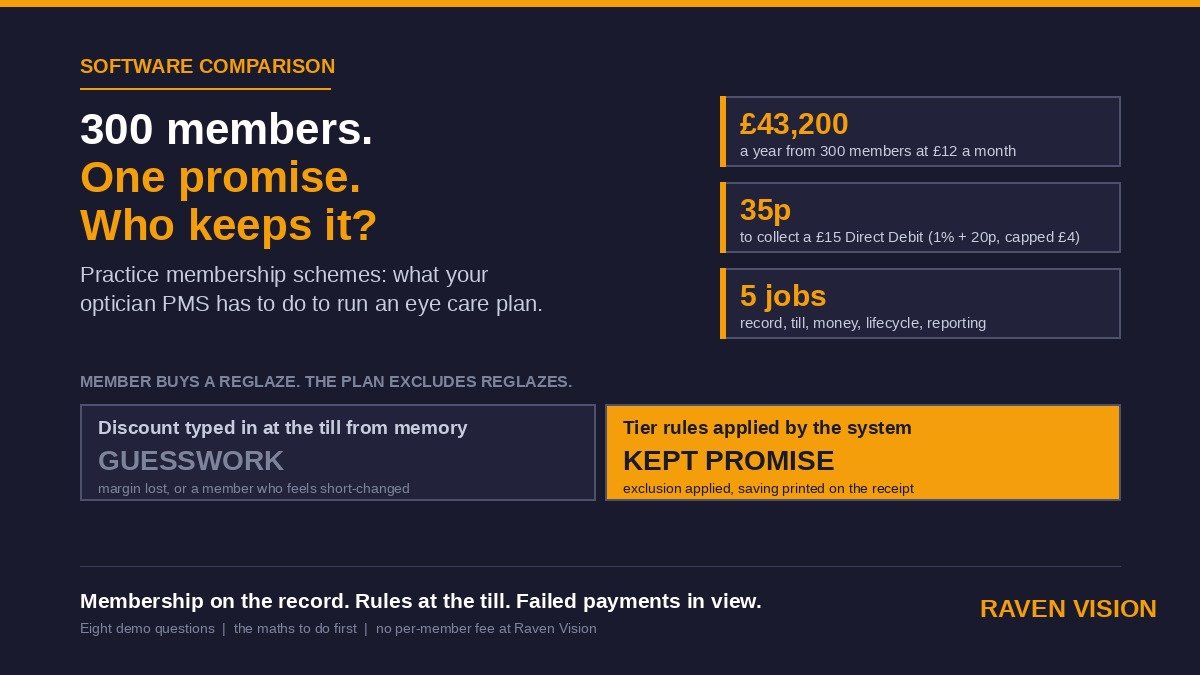
This is the part that tends to get under-thought. The practice management system you choose stops being a back-office tool the moment you have two sites — it becomes the spine of the group. Either it lets you see both practices in one view, run a single recall engine, hold patient records that follow the patient between sites, and report on the group as easily as on a single practice — or it forces you to run two parallel businesses that happen to share a name.
Most legacy optician software was never built for multi-site. Cloud-native systems were. Raven Vision was built inside a multi-practice group from day one — that’s where the design pressure came from. Patient records that move with the patient. Appointments and recall that look identical to a patient whether they’re at site one or site two. Reporting that consolidates across the group without anyone exporting spreadsheets. Stock and dispense flows that don’t quietly diverge.
If you’re seriously considering a second practice in the next twelve to eighteen months, the time to fix the software question is now, not at the point you’ve already signed a lease. The right system reduces second-site risk dramatically; the wrong one bakes it in.
A final, slightly uncomfortable question
Ask yourself this, honestly: do I want a second practice, or do I want what I think a second practice will give me?
If the underlying want is more income, there are usually faster routes inside practice one. If it’s status, a second site won’t fill that gap for long. If it’s a real, structural ambition to build a group with optionality — to sell, hand over, step back, or grow into a regional name — then a second practice, done in the right order, is one of the most rewarding moves an independent owner can make.
The independents who get it right almost always have one thing in common. They built practice one to a point where it didn’t need them daily, before they opened practice two. They made the strategic move from the position of strength, not from the moment of opportunity.
If you’re weighing this decision and want a second pair of eyes on the operational backbone — the systems, the data, the workflow that has to be right in practice one before practice two becomes a strength rather than a risk — book a demo of Raven Vision. We’ve sat on both sides of that decision, and it’s worth getting clear on before you sign anything.