
Walk into a Vision Express and the Eyecare Plan is on the wall before you’ve reached the frames. Twenty per cent off, a free advanced eye test, a free reglaze if the prescription shifts, and the company says over half a million people have signed up. Specsavers has been running direct debit packages for years. The multiples worked out a long time ago that a patient who pays you monthly doesn’t shop around every two years.
Plenty of independents have worked it out too. Eyeplan, the independently run scheme based in Somerset, has been putting membership plans into independent practices across the UK and Ireland for decades, and a lot of practices run their own version in-house. The proposition is simple: a small monthly payment buys unlimited eye examinations, OCT and retinal imaging included, a chunky discount on frames and lenses, accidental damage cover and priority appointments. One award-winning Yorkshire independent publishes its tiers on its website: £6.50 a month for children, £15 for adults, £19 with contact lens check-ups included, on an eighteen-month minimum term.
So the idea isn’t new and it isn’t hard to explain. What trips practices up is running it. A membership scheme is a promise you’ve made to a few hundred people about what they’ll pay and what they’re entitled to, every time they walk in, for years. Whether that promise gets kept on a busy Saturday depends almost entirely on your practice management software. This post is about what to look for.
A membership scheme is not a contact lens plan
Worth being clear about this first, because vendors blur it. A contact lens plan is a supply contract: the patient pays monthly, lenses turn up, aftercare’s included. We covered what the PMS needs to do for that in our contact lens plan and direct debit post, and most of it is about the lens record, reorders and the money.
A practice membership scheme is different. There’s usually no product going out of the door each month. What the patient is buying is a set of entitlements: examinations whenever they want them, imaging included, a percentage off dispensing, cover if they sit on their glasses. That means the software has to do something a contact lens module never has to do. It has to know, at every point of contact, which patient is a member, which tier they’re on, what that tier entitles them to today, and then apply it without anyone at the desk having to remember.
If your PMS can only do the direct debit bit, you’ve got half a scheme. The money comes in and the entitlements live in people’s heads.
The five jobs your PMS has to do for a membership scheme
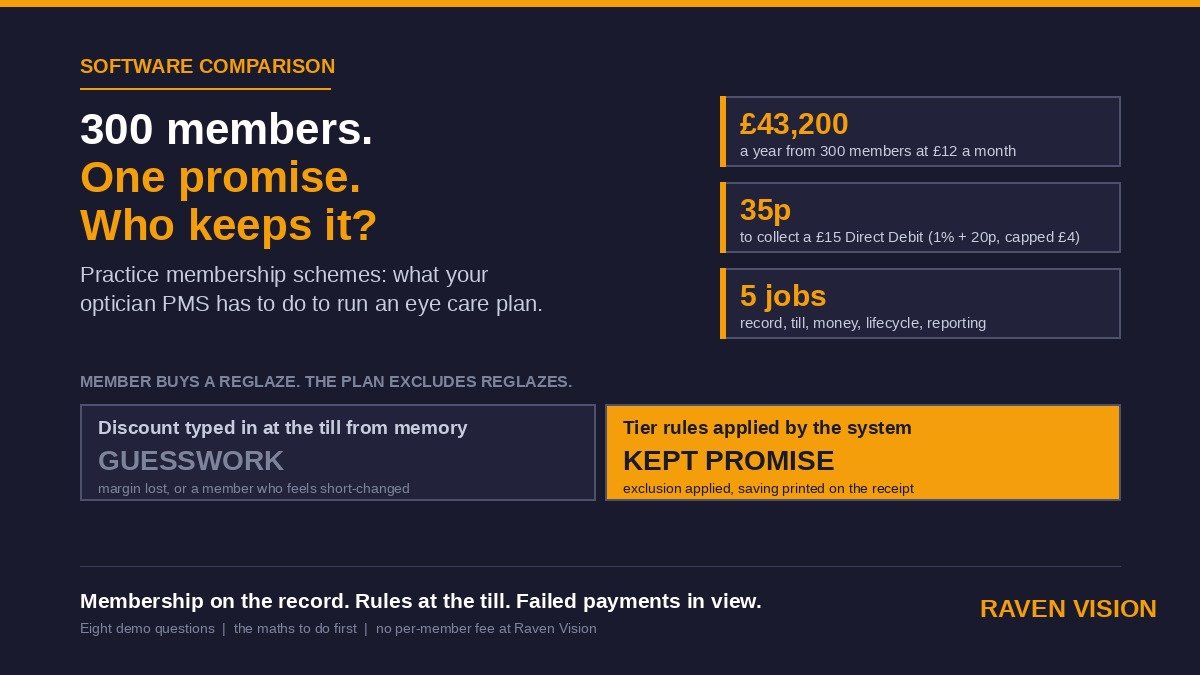
Strip it back and there are five things the software has to handle. Check each one against a live system, not a slide.
1. Hold the membership on the patient record where everyone can see it
Membership has to be a proper field on the record, not a note. Tier, start date, renewal date, minimum term end, payment status, who in the household is covered. And it has to surface on the screens people actually use: the diary when the receptionist opens the day, the record when the optometrist opens the chair, the till when the dispensing optician rings up. If the member has to say “I’m on the plan” to get their discount, the scheme is already leaking goodwill. A good patient record carries the plan status into every room.
2. Apply entitlements at the till automatically
This is where in-house schemes fall apart. The plan says 25% off complete spectacles, excluding reglazes and myopia control lenses. The receptionist covering for the DO doesn’t know that, guesses, and either gives the discount on a reglaze or forgets it on a full dispense. Both cost you: one in margin, the other in a patient who feels short-changed.
The software should know the rules of each tier and apply them at the point of sale: exam fee zeroed for members, imaging zeroed, the right percentage off the right product categories, and a clear line on the receipt showing what the membership saved them. That last part matters more than it looks. A member who sees “Eyeplan saving: £84.50” printed on the receipt is a member who renews.
3. Collect the money and tell you when it doesn’t arrive
Most schemes run on Direct Debit. Whether you use Eyeplan, GoCardless or a bank-provided facility, the PMS should either collect directly or reconcile against the collection report so that each payment lands on the right patient. Fees are lower than you’d think: GoCardless’s standard UK rate is 1% plus 20p per transaction, capped at £4, so a £15 membership costs you about 35p to collect.
The bit that separates good software from adequate software is failed payments. A bounced Direct Debit should raise a flag on the record, not sit in a report nobody opens until quarter-end. The receptionist should see “payment failed, two months” before offering that patient a free OCT scan. The billing side and the clinical side have to be talking to each other, which is the whole argument for one system rather than a PMS plus a spreadsheet plus a Direct Debit portal.
4. Handle the whole lifecycle, not just the sign-up
Sign-up is the easy bit. Over eighteen months a scheme throws up all sorts: a member moving tiers when they start contact lenses, a child ageing out of the kids’ plan, a household adding a partner, someone cancelling at month seven who owes back the discount they took at month two, someone pausing for three months because money’s tight. Every scheme’s terms have a clawback clause for early cancellation. Almost no practice enforces it, because working out what’s owed means digging through eighteen months of receipts.
Ask the vendor to show you a tier change, a cancellation with clawback and a paused membership on a live record. If any of those needs a manual note and a calculator, that’s how it’ll be done in your practice too, which means it won’t be.
5. Report on it as a business line
Recurring revenue is the most sellable income a practice has, and we’ve written before about why the patient list is the asset. A membership scheme turns part of that list into contracted monthly income, which any buyer or lender will value differently from walk-in dispensing. But only if you can show it. You want, in a couple of clicks: active members by tier, monthly recurring revenue, joins and cancellations this month, failed payments outstanding, average dispense value for members versus non-members, and exam frequency for members versus non-members. That last pair is the honest test of whether the scheme is doing what you hoped.
The maths that decides whether a scheme is worth running
Before you spend a demo on this, do the sums for your own practice. They’re not complicated and they’re worth doing on paper first.
Say 300 members at an average of £12 a month. That’s £3,600 a month, £43,200 a year, arriving whether or not anyone walks in. Collection costs at GoCardless rates come to roughly £100 a month. So far so good.
Now the cost side. Members get examinations included, and they’ll use them more often than non-members: that’s the point, but it’s also chair time you’re not charging for. If a member has an exam every year instead of every two, you’ve given away one private exam fee every other year per member, plus the imaging. Then the discount: 25% off a £350 average dispense is £87.50 you’d otherwise have taken, every time a member buys. Against that, members buy more often, buy more pairs, don’t price-shop and almost never lapse.
Run your own numbers: your private exam fee, your average dispense, your current recall return rate, and a realistic guess at how much more often members will come in. Most practices that have done this land somewhere sensible, which is why the schemes persist. But it’s your maths to do, and the important thing is that the software can then tell you whether reality matched the plan. If you can’t get the member-versus-non-member numbers out of your PMS, you’ll never know.
One related point: if you’re running a scheme, put the tiers and prices on your website. We made the case for publishing your prices last week, and a membership plan is the easiest price to publish because it’s a small monthly number that sounds like value rather than cost.
Eight questions to ask in the demo
Take these in, ask them in order, and insist on seeing each answer on a live record rather than hearing it described.
- Show me a member’s record. Where does the plan status appear on the diary, the clinical screen and the till?
- Ring up a complete pair for a member on your 25% tier. Did the discount apply itself, and what does the receipt say?
- Now ring up a reglaze for the same member. Did the exclusion apply itself?
- Show me a failed Direct Debit. Where does it surface, and what stops the desk offering that patient inclusive services?
- Move a member from the adult tier to the contact lens tier mid-term. What changed automatically?
- Cancel a member at month seven. Does the system calculate the clawback, or do I?
- Show me monthly recurring revenue and this month’s joins and cancellations.
- Is any of this an add-on module, a third-party integration, or a per-member fee on top of the licence?
Question eight is the one that changes the total cost. Some vendors price membership handling per active member. On 300 members that can quietly add more than the PMS licence itself.
Red flags
A few things that should make you pause. The vendor talks about “notes” or “alerts” when you ask where membership lives on the record: that’s a workaround, not a feature. The discount has to be typed in as a percentage at the till each time. Failed payments are only visible in the Direct Debit provider’s portal, not in the PMS. Reporting on members means exporting to Excel. And, the classic, the demo shows a sign-up flow but the presenter goes quiet when you ask about a cancellation.
None of these are dealbreakers on their own. Together they tell you the scheme was never part of how the software was designed, and you’ll be running it on goodwill and memory. That works right up until the person who holds the memory goes on holiday.
Where Raven Vision sits
Honest position. Raven Vision was built inside our co-founder Shaukat’s own practices, and those practices earn from patients who pay monthly. So membership and plan status sit on the patient record where the desk, the chair and the till all see them, discounts and inclusive services apply from the tier rather than from someone’s memory, failed payments flag on the record rather than in a separate portal, plan renewals and reminders run on the same recall engine as everything else, and the reporting shows recurring revenue alongside the rest of the practice. It’s all in the one £149 a month subscription with no per-member fee.
What we’d say against ourselves: if you’re already running Eyeplan and are happy with their collection and admin, the question is how well your PMS reconciles with it, not whether to replace it. Bring your current scheme terms to a walkthrough and we’ll show you exactly how they’d be set up, tier by tier, including the exclusions. If it doesn’t fit, we’d rather tell you in the demo than after you’ve migrated.
What to do this week
If you already run a scheme: pull up your last ten member dispenses and check whether the discount was applied correctly on every one. Then find out how many members have a failed payment right now. Those two checks tell you whether your software is running the scheme or your staff are.
If you don’t run one yet: do the maths above with your own numbers, sketch two or three tiers, and put the demo questions to whichever vendor you’re talking to before you commit to anything. Membership schemes are one of the few things an independent can offer that the online retailers can’t. They reward loyalty, they smooth cash flow, and they make your patient list worth more. But only if the software keeps the promise for you.
Want to see how it works? Book a walkthrough and bring your scheme terms, or look at what’s included at £149 a month. Three months free, migration included, no long contract.