
It’s 2:40 on a Thursday. The rep from one of your frame suppliers has been in the practice since two. There’s a case open on the dispensing table, forty frames laid out in neat rows, and your dispensing optician is holding one up to the light saying “ooh, that’s nice.” The rep agrees. It is nice. Six colourways, and if you take all six there’s an extra ten percent off.
Twenty minutes later you’ve bought thirty-eight frames. Not because you needed thirty-eight frames, but because they were nice, the rep was pleasant, and nobody in the room had a number in their head for what the practice could afford to buy this month. The invoice lands in three weeks. Some of those frames will still be on the board next September.
That scene plays out in independent practices across the UK every week, and it’s the single biggest reason stock rooms fill up with frames that don’t sell. It isn’t a supplier problem. Reps are doing their job, and most of them are good at it. It’s a buying problem. The practice walked into the appointment without a plan, and the person with a plan always wins the meeting.
This post is about fixing that. Not stock management in general (we covered frame stock management earlier this year, and what a PMS stock module should do in our inventory module comparison). This is specifically about the buying appointment: how to prepare for it, how to run it, and how to walk out having bought what you meant to buy.
Why the rep appointment is where stock problems start
Every frame in your stock room got there because somebody said yes to it. Dead stock isn’t an accident that happened later. It was decided in a buying appointment, usually one that ran on feel rather than figures.
Three things tend to go wrong in the room. First, nobody knows the number. There’s no agreed budget for the month or the quarter, so “can we afford it” is answered by gut. Second, nobody knows what’s already there. The rep shows a lovely rectangular acetate in tortoiseshell; the practice already has eleven rectangular acetates in tortoiseshell, four of which haven’t moved since spring. Third, the decision is made by whoever happens to be free, which means the range is shaped by whoever likes shopping most rather than by what actually sells.
Fix those three things and the appointment stops being a sales pitch and becomes what it should be: a stock replenishment meeting with a supplier you’ve chosen to work with.
Open-to-buy: the one number that changes everything
Open-to-buy is a retail term, and it’s worth stealing. It answers a single question: how much stock can we bring in this period without the board getting heavier?
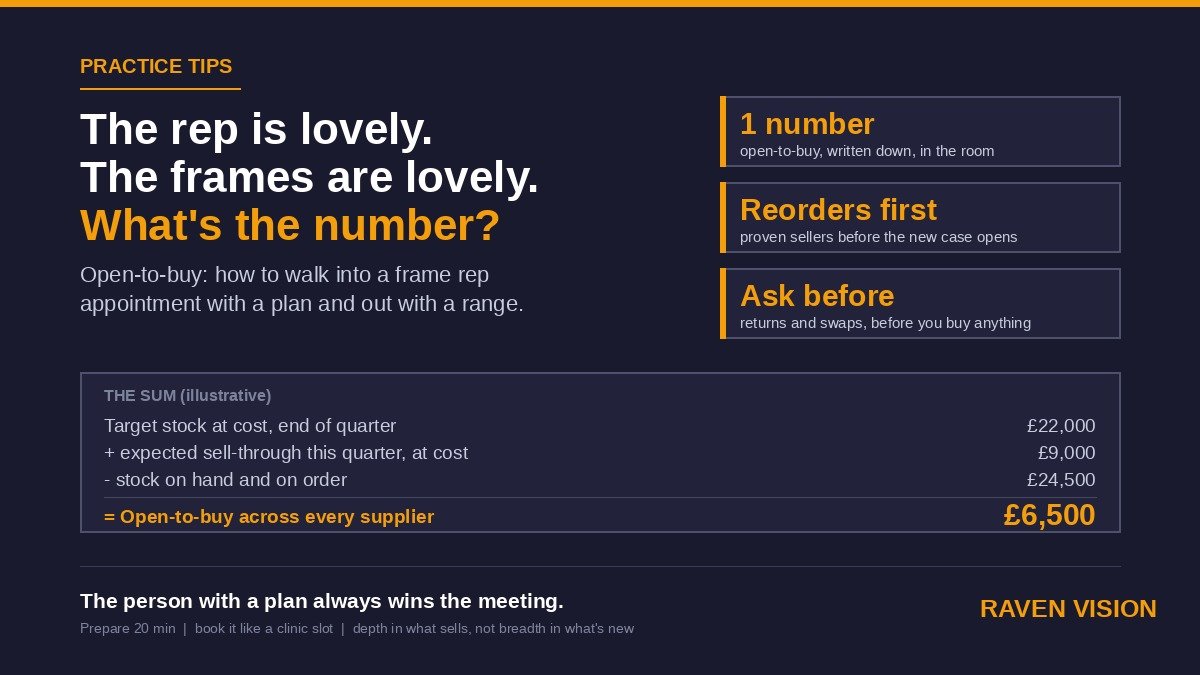
The maths is simple enough to do on the back of a job bag. Start with the stock value you want to be holding at the end of the period, at cost. Add what you expect to sell through during the period, at cost. Subtract what you’re holding now and anything already on order. What’s left is your open-to-buy.
A worked example
Say you’ve decided the board should carry about £22,000 of frames at cost. You’re currently holding £24,500, with nothing on order. Over the next quarter, based on the last few quarters, you expect to dispense roughly £9,000 of stock frames at cost.
Target £22,000, plus £9,000 expected sell-through, minus £24,500 on hand, equals £6,500. That’s the whole quarter’s budget across every supplier. Not per rep. Every rep.
(These figures are made up to show the sum. Yours will differ, and that’s the point: work it out for your own practice.)
The first time most owners do this calculation they discover their open-to-buy is smaller than what they spent with one supplier last month. That’s uncomfortable, and it’s exactly why the number needs to exist before the rep arrives.
Split it by supplier before anyone knocks
Once you have the quarter’s number, divide it. Look at what actually sold last quarter by supplier and give each one a share roughly in proportion. A supplier whose frames account for a third of your dispenses gets about a third of the budget. A supplier whose board hasn’t cleared in nine months gets a conversation, not a cheque.
Write the split down. When the rep is in the room and the frames are lovely, “we’ve got £1,400 with you this quarter” is a sentence that ends the negotiation before it starts. It’s not rude. Good reps respect it, because it tells them you’ll still be buying next quarter.
Before the appointment: twenty minutes of preparation
The buying decision is mostly made before the case opens. Here’s what to have in front of you.
The sell-through report for that supplier
Pull every frame you hold from that supplier and sort by days on the board. You want to see, at a glance, which models have sold multiple times (reorder candidates), which have sold once or never (don’t touch), and which have been sitting for more than six months (return or swap candidates). If your practice management software tracks stock properly this is a filter and a click. If it doesn’t, it’s an hour with a stock sheet, which is why most practices skip it, which is why they overbuy.
The gap list
Look at the board by category rather than by supplier. Men’s metal under £120. Ladies’ oversized acetate. Kids’ 46-eye. Rimless. Where are you thin? Where are you drowning? The rep will show you what they’ve been told to sell this season. Your gap list tells you what you actually need, and the two overlap less than you’d think.
Last quarter’s reorders
Anything you’ve reordered twice is a proven seller. Those go on the list before you’ve seen a single new model. Reorders are boring and they’re where the money is.
The number, written down
Your open-to-buy for this supplier, on a piece of paper, in the room. Not in your head.
Running the appointment
Book it, don’t let it happen. A rep who “was just passing” is arriving on their schedule, not yours, and you’ll be buying between patients with half your attention. Put buying appointments in the diary like a clinic slot, forty-five minutes to an hour, with the person who’s responsible for the range and one other person for a second opinion. If your appointment diary lets you block non-clinical time, use it, so the slot is protected from the front desk filling it.
Reorders first, new lines second
Open with the proven sellers. Get them written up before the new season case comes out. It’s much easier to say no to a new colourway when the order already has the frames you know will move.
Ask about the frames you don’t want anymore
Most suppliers will discuss swaps, returns or credits on slow lines, especially if you’re a regular buyer and the frames are in good condition. Some won’t, or will only do it within a window. Either way, ask, and ask before you buy, not after. “We’ve had these four models on the board since January and they haven’t moved. What can you do?” is a fair question. A supplier who wants your long-term business will find something.
Buy depth in what sells, not breadth in what’s new
The temptation with new lines is to take one of each colourway “to see what happens.” What happens is you end up with six single frames, each in one colour, and when the one that sells sells, you’ve got five orphans and a reorder. Better to pick two colourways you’d actually put on a face tomorrow and buy two of each. Depth in fewer lines beats one of everything.
Know when the discount is a cost
“Take twelve and it’s an extra ten percent” only saves money if you’d have bought twelve anyway. If you’d have bought six, the “discount” just cost you the price of six frames you didn’t need, plus the shelf space, plus the months of cash sitting in the stock room. Bulk pricing is a tool for the supplier’s sales target. Sometimes it aligns with yours. Often it doesn’t.
Agree the terms out loud
Delivery date, payment terms, return window, whether the rep or the office handles credits. Say it in the room and write it on the order. Disputes about returns nearly always come down to a conversation nobody wrote down.
After the appointment: closing the loop
The order goes in the system the day it’s placed, as stock on order, so the next rep’s open-to-buy calculation is honest. When it arrives, it gets booked in properly (barcode, supplier, cost, retail, category) the day it lands, not “when someone has a minute.” Frames that sit in a box in the back for a fortnight aren’t stock; they’re an invoice you can’t sell against.
Then, in three months, you look at what you bought and check it moved. That’s the loop. Buy, sell, look, adjust. Most practices do the first two and skip the third, which is how the same overbuying happens every season with slightly different frames.
Managing the relationship, not just the order
Reps talk to a lot of practices. The ones who run a tight, predictable buying process get better service: first pick on limited runs, honest advice about what’s actually moving in other practices nearby, quicker resolution on faults and returns. The ones who buy on impulse and then complain about dead stock get the sales pitch.
A few habits that make the relationship work for you. Keep your supplier count sensible; four or five suppliers you buy from properly beats a dozen you buy from occasionally, and it concentrates your spend where it earns you terms. Review each supplier once a year on sell-through, margin, faults and service, and don’t be sentimental about it. Tell reps your calendar: “we buy in March, June, September and December, forty-five minutes each” gives them something to plan around and stops the drop-ins. And say no clearly. “Not this quarter” is a complete sentence.
What your software has to show you at 1:55
Five minutes before the rep walks in, the person doing the buying should be able to see, on one screen:
- Every frame from that supplier with cost, retail, date booked in and date last sold.
- Which of those have sold more than once (the reorder list) and which haven’t sold at all in six months (the return list).
- Total stock value at cost, and stock currently on order, so the open-to-buy sum is live rather than a guess.
- Sell-through by category across the whole board, so the gap list is data rather than a feeling.
- Margin by supplier, because a frame that sells fast at a thin margin isn’t necessarily better than one that sells steadily at a fat one.
If any of that lives in a spreadsheet somebody updates on a Friday, the buying appointment is being run on last week’s guesses. Our inventory management module was built to answer exactly these questions, with stock-on-order and sell-through visible without exporting anything, and dispense data flowing straight through from the billing side so the numbers are the numbers.
A rule of thumb on stock turn
One benchmark that gets quoted a lot in optical retail is that a healthy frame board turns over roughly three times a year. Treat it as a direction rather than a target; a boutique practice with a premium board will turn slower than a high-volume one and be perfectly healthy. What matters is that you know your own number and it’s moving the right way. If your turn is closer to once a year, the answer is almost never “buy more frames.” It’s buy fewer, buy better, and get the slow ones off the board.
Where Raven Vision fits
Shaukat, our co-founder, has run independent practices for over thirty-five years and still sees frame reps in his own three practices. He built the stock side of Raven Vision because he was tired of buying on feel and finding out nine months later what it had cost him. So sell-through, stock on order, supplier-level margin and the return list are things you can see before the appointment, not reconstruct after.
The software is £149 a month per practice, with the first three months free, free data migration from your current system, and no long contract. Pricing is on the website, not behind a form. If you’d like to see how the stock module handles a real rep visit, bring last quarter’s supplier list to a walkthrough and we’ll build the open-to-buy sum live from your numbers. Book a walkthrough here, or have a look at pricing first.
Start with the next appointment
You don’t need to overhaul anything to make the next rep visit better. Work out one number, your open-to-buy for that supplier. Pull the sell-through list. Write the reorders down first. Ask about returns before you look at the new case. Then buy what you meant to buy.
Do that four times and you’ll have a buying process. Do it for a year and you’ll have a lighter, faster-turning board, more cash in the bank, and reps who arrive knowing exactly what you’re there to do. That’s the difference between a practice that buys frames and a practice that manages a range. The frames are just as nice either way.