
There’s an eight-year-old in your chair this afternoon. First pair, minus one, mum a bit surprised. You’ll do one of two things in the next ten minutes, and whichever one you do will still be shaping your practice in 2036.
Most of the writing about myopia management is clinical: which lens, which drop, what the trial data says. That matters, and it’s not what this piece is about. This is about what offering myopia management does to the shape of an independent practice over a decade. Who walks through the door, how often, what they pay for, what the practice is worth at the end of it. Because the honest answer is that it changes almost everything, and most owners decide it on the basis of one lens rep’s visit.
Two practices in 2036
Picture two independents on similar high streets. Same footfall, same GOS contract, same tired grumble about the sight test fee. In 2026 one of them starts talking to every myopic child’s parents about progression, and builds a proper service around it. The other keeps prescribing single vision, which is entirely defensible and still the NHS standard of care.
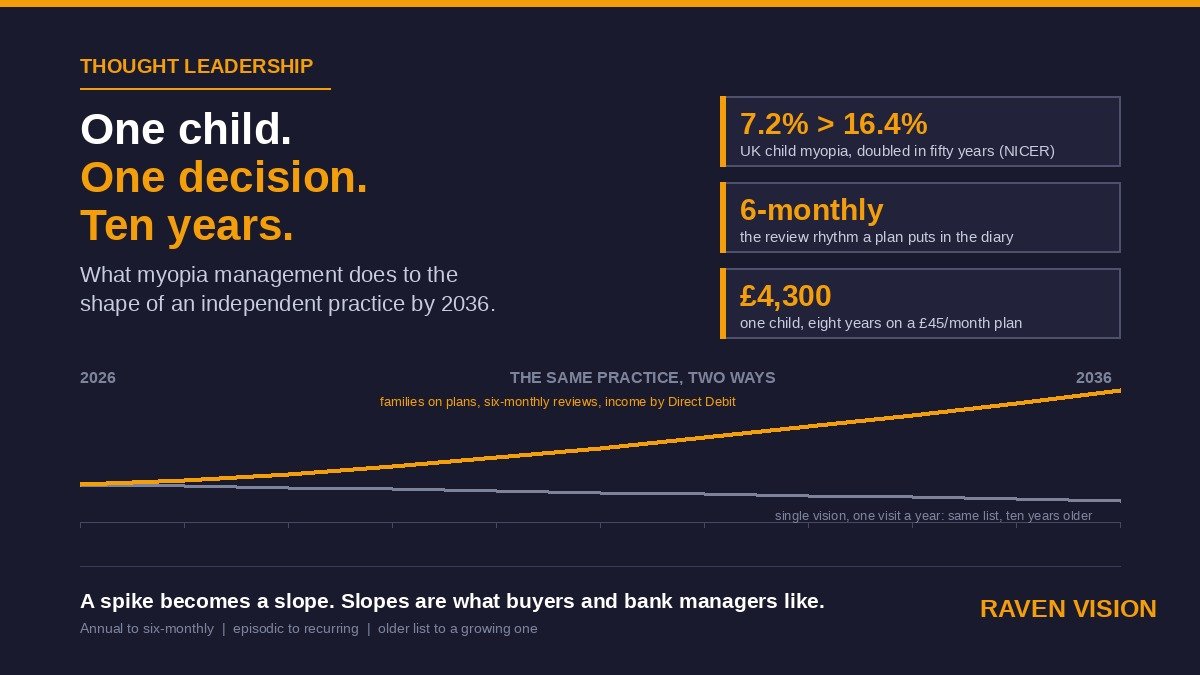
Ten years on, the first practice has a few hundred families on its books who came in for a child and stayed for everyone. Its diary has a steady band of six-monthly reviews that don’t depend on a recall letter landing. A chunk of its income arrives by Direct Debit whether or not anyone bought a frame that month. When a buyer looks at it, they see recurring private revenue and a young patient base.
The second practice is fine. It’s also older. Its patients are the same people it had in 2026, ten years further into presbyopia, and the children it saw once went somewhere else when their prescriptions started moving. Nobody made a mistake. One practice just made a decision the other didn’t.
The numbers underneath the decision
You don’t need a global epidemic to justify this, but it helps to know the trend isn’t a fashion. The Northern Ireland NICER study, part-funded by the College of Optometrists, found myopia in UK children aged 10 to 16 has more than doubled in fifty years, from 7.2% to 16.4%, and that children are becoming myopic younger. Between six and thirteen, a myopic child progresses by around a quarter of a dioptre a year on average. The Holden projections that everyone quotes put roughly half the world’s population myopic by 2050, with close to a billion people in the high-myopia bracket, which is where the glaucoma, retinal detachment and myopic maculopathy risk lives.
Closer to home, the ground moved twice in the last year. In November 2025 the MHRA licensed the first low-dose atropine drop for slowing childhood myopia, for children aged three to fourteen with between -0.50 and -6.00 and progression of half a dioptre a year or more. It’s private only, and NICE has a technology appraisal on the books that’s been waiting for ministerial sign-off. And in March 2026 the Welsh Optometric Committee published a position statement proposing an all-Wales myopia management service, delivered without a financial barrier at the point of care. Their survey work suggests at least half of Welsh practices already offer myopia management in some form.
So the market is real and growing, the clinical toolkit just got a licensed pharmaceutical option, and at least one UK nation is openly discussing state funding. That’s the backdrop. Now the part nobody puts in the brochure.
What myopia management does to the shape of a practice
A practice is a set of relationships with a rhythm. Most independents run on a two-year rhythm for adults and a one-year rhythm for children, with a dispense hanging off some of those visits. Myopia management breaks that rhythm on purpose, and the consequences compound.
The rhythm goes from annual to six-monthly
A child on a myopia plan is seen every six months, sometimes more often in the first year. That’s not a recall you hope they answer. It’s a review that’s part of what the family is paying for. Over an eight-year treatment window, that’s sixteen or more contacts with the same family instead of eight, and every one of them is a moment where the parent’s own eyes, the sibling’s squint and the grandparent’s cataract get mentioned. The practice that’s already written about becoming the family practice through children’s eye tests knows this. Myopia management is that idea with a Direct Debit attached.
Your patient base gets younger without you marketing to the young
Independents worry, rightly, about a loyal base that retires together. We’ve covered the case for winning under-40 patients before, and most of it comes down to removing friction. Myopia management does something different. It brings you thirty-something parents as a by-product of treating their child, and it brings you the child as a patient who, if you do the job well, has no reason to leave at sixteen. You’re not chasing a younger demographic. You’re growing one.
The revenue mix tilts towards private and recurring
This is the bit that changes the business rather than the diary. A conventional independent’s income is mostly GOS fees plus dispensing, which means it’s mostly episodic. Someone comes in, something is sold, the till goes quiet until they come back. A myopia plan, whether it’s £19 a month at the accessible end or £49 a month for daily disposables plus reviews, is income that arrives on the first of the month. The practices we’ve seen do this well end up with a line on the P&L that behaves like a membership scheme: predictable, collected automatically, and reported as its own business unit rather than lost inside “contact lenses”.
Your kit list and your skills list both grow
You can start with spectacle lenses and a good conversation. A full service means cycloplegic refraction as routine, axial length measurement as the thing you actually track, and someone in the building who’s comfortable with the evidence base and can say what they don’t know. That’s a capital decision and a training decision, and it has the same character as any clinical specialism: you’re buying capability that the person walking in can’t get from a website. The College’s own position is that every practitioner should be able to discuss the risks and benefits even if they’re not delivering the intervention. Read that carefully. It means the floor has moved. Not offering it is fine. Not being able to talk about it isn’t.
Your practice value changes, quietly, every month
When we looked at how UK practices are valued, two of the five things that move the multiple were recurring revenue and the age profile of the patient list. Myopia management improves both without you ever thinking about the sale. A buyer in 2036 who sees two hundred children on plans, half of them with a parent who’s now a private patient, is looking at transferable earnings, not goodwill that walks out with you.
The maths, done straight
Let’s be honest about the numbers, because the rep won’t be. Suppose in year one you enrol forty children at an average of £45 a month. That’s £21,600 a year before lens cost, before the chair time for two reviews a year each, and before the parent who cancels in month seven. The lens cost is real. On daily disposable myopia control lenses it’s a meaningful share of the fee. On spectacle lenses at £250 to £320 a pair it’s a chunk up front and then quieter. The chair time is real too: eighty review slots a year is two full clinic weeks you’re not selling to anyone else.
Against that, put the alternative. The same forty children, corrected with single vision, would have come in once a year and maybe bought a frame. Call it £150 to £200 a year each, so £6,000 to £8,000. The uplift is roughly two to three times, and that’s before the parent, the sibling and the second pair of sunglasses for the child who’s now outside more because you told them to be.
Now stretch it over ten years. A child enrolled at eight and reviewed until sixteen is eight years of fees. At £45 a month that’s just over £4,300 from one child, plus whatever the family spends. Do that with forty new children a year for a decade, with a realistic drop-off, and you’ve built a business inside your business that’s worth more than the till receipts suggest. These are your numbers to run with your own lens costs and your own fee. The point isn’t the exact figure. It’s that the shape of the money changes from a spike to a slope, and slopes are what buyers and bank managers like.
Three things that could change the ground under you
Ten-year decisions deserve ten-year risks, so here are the ones that matter.
The multiples are already there. Specsavers rolled myopia management out to every UK and Ireland practice in 2023. If your pitch is “we’re the only ones who do this”, you’re three years late. Your pitch is continuity, the same clinician at every review, and a practice that measures axial length rather than just re-refracting. That’s the independent’s version, and it’s the one that holds.
The NHS might fund some of it. If NICE eventually recommends low-dose atropine, the NHS is obliged to fund it, and Wales is already sketching a service without financial barriers. That could look like a threat to a private plan. It’s more likely the opposite: a state-funded drop still needs someone to prescribe, measure, review and fit the spectacles. The practices with the kit, the records and the reputation will be the ones commissioners and parents go to. Just don’t build a business model that only works if nobody else ever pays for the drops.
The evidence keeps moving. The Cochrane living review is a living review for a reason. Modalities will be added, some will fall back, and the child you enrol in 2026 might be on something different by 2030. So build the service around measurement and the relationship, not around one product. A practice that owns the axial length history and the family’s trust can change lens brand in an afternoon. A practice that sold “the MiSight plan” has a harder conversation.
The decision most owners actually face
It’s rarely whether. It’s how far.
Level one is the conversation: every myopic child’s parent hears about progression, the options and the evidence, and you refer or signpost if you don’t deliver. That’s the College’s floor, and it costs you nothing but the confidence to say it. Level two is spectacle-based management with a structured review schedule and a proper record. Modest kit, real commitment, and enough to build the six-monthly rhythm. Level three is the full service: contact lens options, axial length, atropine where indicated, and a clinician who’s made it their thing. That’s the version that reshapes the practice, and it’s the version that overlaps with everything we said about specialism.
The mistake is to hover at level one while telling yourself you’re at level two. If the review isn’t in the diary and the measurement isn’t on the record, you’re not managing myopia, you’re mentioning it. Parents can tell the difference, and so can the practice’s numbers.
What it asks of your systems
Here’s where a decade-scale decision meets Tuesday morning. A child on a plan needs to exist in your software as a child on a plan, not as a patient with a note in a free-text box. That means a recall interval that’s six months and not the default two years, set from the plan rather than remembered by whoever booked them out. It means axial length sitting on the patient record as a number you can trend, so the review is “here’s the graph” rather than “let’s see”. It means the plan status visible at the desk, so reception knows the family’s fee covers the review and the till doesn’t try to charge for it. And it means the Direct Debit and the failed payment living on the same record as the clinical history, because the parent who lapsed in month seven is a clinical conversation before it’s a finance one.
We built Raven Vision inside Shaukat’s own practices, and children on plans were one of the things that made the old system creak. So the recall engine runs off the plan and the clinical record, not off a global default. Plan membership sits on the patient, applies at the till, and shows up in reporting as its own line, so you can see what the myopia service earns, how many families it brought in, and what those families went on to spend. If you’ve already got a service running on spreadsheets and a good memory, the question at a demo isn’t whether the software has a myopia module. It’s whether it lets you see the ten-year shape you’re building.
The ten-year question
Back to the eight-year-old. Whatever you say to that parent, you’re going to say it a few hundred times over the next decade. Say it well, and you’ve built a practice with a younger list, a steadier income and a clinical identity that a multiple can imitate but not replace. Say nothing, and you’ve kept a good practice exactly where it is while the ground under it ages.
If you’re weighing this up, book a walkthrough and bring your last twelve months of children’s exams. We’ll show you what a plan-based service looks like on the record, in the diary and in the numbers, in about half an hour. Raven Vision is £149 a month per location, with three months free, your data migrated and no long contract. The decision about myopia management is yours. We’d just like the software to stop being the reason you put it off.