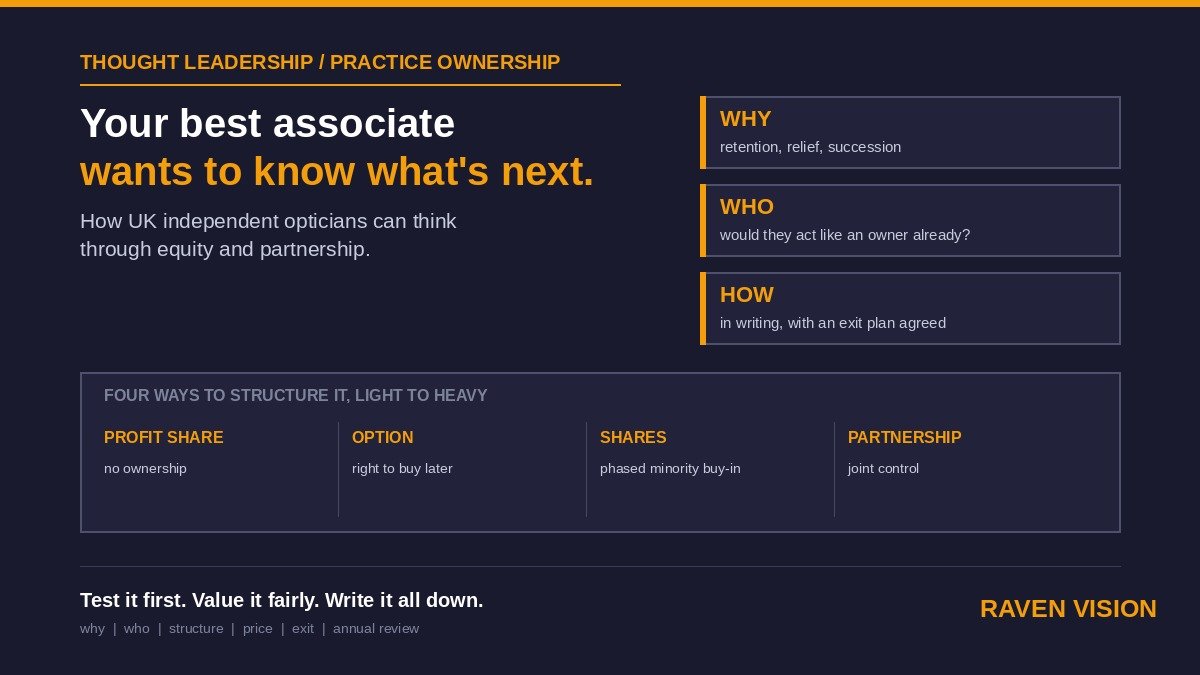

Sooner or later, the best clinician in your practice asks the question. Sometimes it’s said out loud over a coffee. More often it hangs in the air after a good year: “Where do I go from here?” If you’ve got an associate who’s sharp with patients, reliable with the diary and clearly not planning to leave, that question deserves a proper answer. “We’ll see” isn’t one.
Offering someone a stake in your practice is one of the biggest decisions you’ll make as an owner. Done well, it solves succession, cover and burnout in one go. Done badly, it costs you a friend, a clinician and a chunk of the business. This piece is about how to think it through before you say a word to anyone.
Why Owners Consider It in the First Place
Nobody offers equity out of generosity. There’s always a practical reason underneath, and it helps to name yours honestly.
The most common one is that you’re tired. You’ve been the fixed point in the business for years, and the thought of stepping back a day or two a week is very attractive. We’ve written before about why a practice shouldn’t need you every day, and a committed partner is one of the few structural fixes that actually holds.
The second is retention. Good optometrists and dispensing opticians have options, and a fair salary only goes so far. A stake gives someone a reason to stay that a pay rise can’t. If you’ve been living with locum dependency or a revolving door in the clinic room, that matters.
The third is succession. If you’re ten or fifteen years from stepping away, an internal buyer who already knows the patients, the equipment and the quirks of the building is worth more than a stranger with a bank loan. Our piece on succession planning covers the wider picture. A gradual handover to someone inside is often the smoothest version.
If your reason is “I can’t afford to pay them more, so I’ll give them a bit of the business instead”, stop there. Equity isn’t a substitute for pay. It’s a shared bet on the future, and it only works when both people can afford to make it.
Who Actually Deserves a Stake
Being good at the job isn’t enough. Plenty of excellent clinicians would hate being a business owner, and offering them a share can turn a happy associate into a resentful partner.
The four things worth testing first
Before you think about percentages, ask whether they’d behave like an owner already. Do they think about the diary, or only their own column in it? Do they mention costs, stock and staffing without being asked? Do they stay calm when something goes wrong, or do they hand it back to you? And are they still going to want this in five years, when the novelty has worn off?
Then the harder one. Do you actually get on? A partnership is a long, close relationship with money in the middle. If you find yourself avoiding certain conversations with this person now, equity will make them worse, not better.
Try it before you commit to it
You don’t have to jump from associate to co-owner overnight. Most sensible arrangements build in a runway. Give them real responsibility first: ordering, rotas, a clinical lead role, a say in hiring. Watch how they handle the parts of ownership that aren’t glamorous. Six to twelve months of that tells you more than any interview.
The Ways You Can Structure It
There isn’t one right model. What suits a two-chair practice with a single owner looks nothing like a three-site group. Broadly, the options run from light to heavy.
A profit share or bonus, with no ownership
The lightest version. The associate gets a slice of profit above an agreed level, but owns nothing. It’s simple to set up and simple to unwind. The downside is that it rewards short-term thinking and gives them no real security, so it’s a retention tool rather than a partnership.
Options or a right to buy later
You agree now that they can buy a stated share at a stated price or formula at a future date, subject to conditions. It lets you test the relationship while fixing the price ahead of any growth. It does need careful drafting, because “a fair price later” is where most disputes start.
Selling shares outright
The cleanest version of real ownership. They buy a minority holding, usually funded out of their own pocket, a loan, or dividends over time. Commitment is highest here because they’ve put their own money in. Cash is the obstacle for most associates, so expect a phased purchase rather than a single cheque.
A full partnership or joint ownership
Equal or near-equal control. It works when two people genuinely share the load and the vision. It fails, painfully, when one of them wants to sell and the other doesn’t, so it needs the strongest paperwork of all.
A practical note: the tax treatment of these routes differs a lot, and some are far more efficient than others depending on how your practice is set up. That’s not a job for a search engine. Get advice from an accountant who knows optical businesses, and a solicitor who has drafted shareholder agreements, before you promise anything in writing.
The Price Question Nobody Wants to Raise
How much is a share worth? You probably don’t know, and neither does your associate. That’s the first problem.
Valuation is the point where friendly conversations get awkward. You’ve built the business for years, and a number on a page can feel either insultingly low or unreasonably high depending on which side of the table you’re sitting. If you haven’t already, read our guides on what your practice is worth and think about getting an independent valuation before you start negotiating.
Agree the method as well as the number. If they’ll buy in over time, will the price be fixed today, or recalculated each year using a formula? Fixed favours the buyer if the practice grows. A moving formula favours you. Neither is wrong, but whichever you pick, both of you need to have chosen it knowingly.
What Goes Wrong: The Five Traps
1. Vague promises
“We’ll sort you out eventually” is the most expensive sentence in practice ownership. If it isn’t written down, it doesn’t exist. And when memories differ in three years’ time, you both lose.
2. No exit plan
What happens if they leave? If you want to leave? If one of you falls seriously ill? If they resign and set up ten minutes down the road? Every one of these needs an answer before anybody signs, including how shares get bought back and at what price.
3. Confusing role with ownership
A minority partner isn’t automatically a decision-maker on everything. Decide who has the final say on hiring, spending, pricing and clinical standards, and write it down. Unclear control is where partnerships rot quietly.
4. Ignoring the regulatory and contract side
A change in who owns the business can affect more than the share register. Check what it means for your professional registration position, your NHS arrangements, your lease, your supplier agreements and any contact lens or finance schemes you run. Speak to your solicitor and the relevant bodies early, not after the deal is agreed.
5. Treating it as a one-off event
The signing isn’t the end. A partnership needs regular, scheduled conversations about performance, pay, drawings, investment and whether each of you still wants what you agreed. Put a review in the diary every year, and hold it even when things are going well.
Make the Numbers Visible Before You Talk
Here’s the practical bit owners skip. If your partner is going to share the risk, they need to see how the practice really performs, and you need to be able to show it without spending a weekend in spreadsheets.
Before the first serious conversation, pull together a clean picture: revenue by service, dispense rate, contact lens income, recall and retention, no-shows, and what each clinician’s chair generates. If those figures are scattered across paper diaries, an old desktop system and the owner’s memory, the negotiation will run on opinions instead of evidence. It’s the same reason we keep saying your patient list is the real asset: valuing a share means knowing what’s actually in the business.
This is one place a modern practice management system pays for itself. When the diary, patient records, dispensing and billing sit in one patient management system, the figures you need already exist and nobody has to reconstruct them. It also makes a handover more credible. A buyer or partner is far more comfortable putting money into a practice they can see clearly.
A Simple Way to Start the Conversation
You don’t need a term sheet to begin. You need a frank chat and a few decisions of your own first. Here’s a sequence that works.
Start with yourself. Write down why you want to do this, what you’re prepared to give up, and what you absolutely won’t. Decide your ideal timeline, and where you’d draw the line on control.
Next, get the basics checked: a rough valuation, and a short meeting with your accountant and solicitor. You’re not committing to anything. You’re finding out what’s possible.
Then talk to your associate, and start with their goals rather than yours. What do they want from the next five years? Some will light up. Some will politely say they’d rather keep it simple, and that’s useful to know too. Better to hear it in a chat than after you’ve spent thousands on legal fees.
Finally, if you both want to go ahead, agree the outline in a short written summary, then let the professionals turn it into proper documents. And keep paying attention to how the practice runs day to day, because a partnership is only as good as the business underneath it.
Where This Leaves You
Bringing in a partner isn’t for every owner, and it doesn’t have to be your endgame. Some practices are better off staying single-owner with well-paid associates and a clear succession route. But if you’ve got someone good, someone who plainly wants to build something, ignoring the question costs you too. Good people don’t wait forever.
Whichever way you go, the practice needs to be in shape to be shared: clear numbers, tidy records, and a system that doesn’t live in one person’s head. That’s what we built Raven Vision for. It came out of real practices, and it costs £149 a month per location with three months free to try it properly. Have a look at the pricing page and the current offers, then book a demo and see how your figures would look before your next big conversation.
This article is general information for practice owners, not legal, tax or financial advice. Take proper professional advice before agreeing any ownership arrangement.