
Somewhere in your practice there’s a rota, and somewhere on that rota there’s a day — maybe two, maybe three — covered by a locum. It started as a stopgap. Someone left, or went on maternity leave, or you opened a Saturday clinic and didn’t want to commit to a hire until you knew it would fill. That was eighteen months ago. The stopgap is still there, and by now it doesn’t feel like a stopgap at all. It feels like how the practice works.
This post is about that arrangement — what it actually costs, why the day rate is the least of it, and how to tell when a sensible piece of flexibility has quietly become a structural weakness in the business. It isn’t an argument against locums. Good locums keep this profession running, and there are moments when a locum is precisely the right answer. It’s an argument against locum dependency — a different thing, with a different price tag.
One in five optometrists now works as a locum
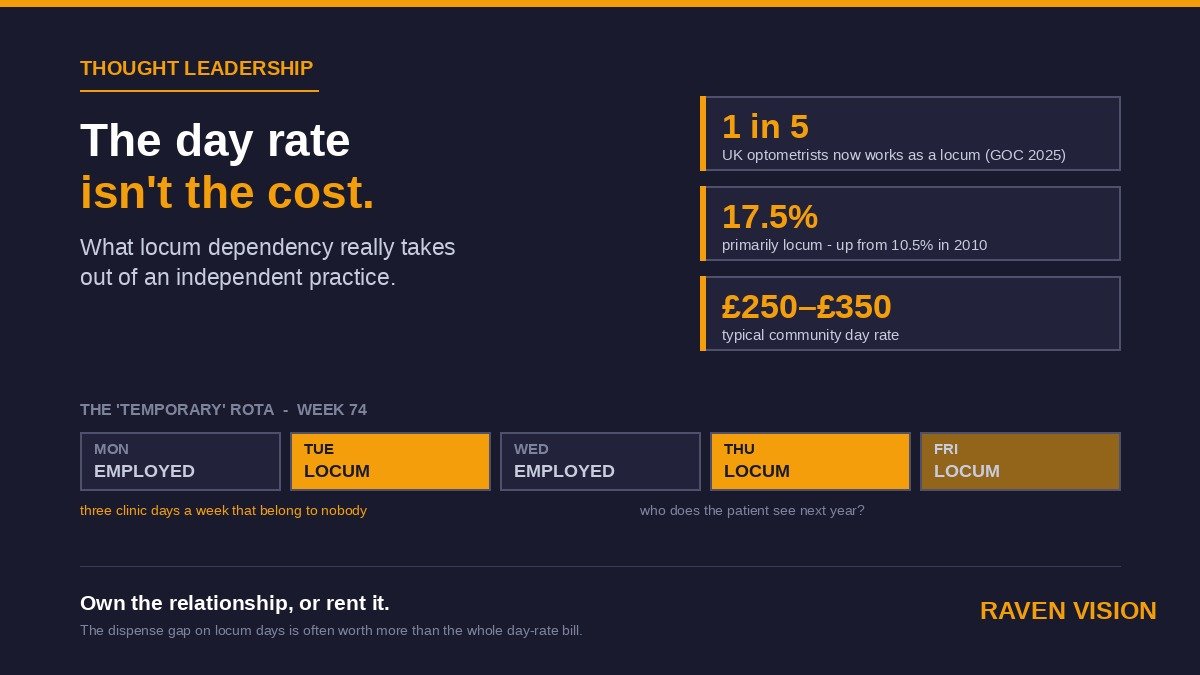
Start with the shape of the workforce, because it explains why this crept up on so many practices at once. The General Optical Council’s 2025 Workforce and Perceptions Survey — more than 3,700 registrants responded — found that around one in five now works as a locum. The College of Optometrists’ workforce research tells the same story over a longer arc: 17.5% of optometrists described themselves as primarily locum practitioners, up from 10.5% in 2010. In Scotland, Optometry Scotland reported a vacancy rate above 10% in 2025, with locum cover making up roughly a fifth of the weekly workforce.
In other words: the profession restructured itself around flexible working, and practices restructured themselves around the profession. None of that is anyone’s fault. But it means the question facing an independent owner is no longer “should I ever use a locum?” — you will — it’s “how much of my practice runs on people who, structurally, aren’t part of it?”
The day-rate maths looks fine — that’s the trap
Run the spreadsheet and locum cover often looks perfectly rational. Community locum rates typically sit somewhere between £250 and £350 a day depending on region, with most averages landing near £300. Two days a week at £300 across 50 weeks is £30,000 a year — for two days of qualified cover, no employer’s National Insurance, no pension contributions, no holiday pay, no sick pay, no recruitment fees.
Set that against an employed optometrist — the AOP’s salary data puts the median employed salary around £52,000, call it £60,000 once you add on-costs — and the per-day arithmetic is closer than most owners expect. Five days employed costs roughly £12,000 per weekly day per year; the locum costs £15,000 on the same basis. A gap, but not a scandalous one.
And that’s exactly the trap. The spreadsheet compares the one cost that’s easy to see. Everything that actually erodes a locum-dependent practice happens in columns the spreadsheet doesn’t have.
Where the real cost hides: the dispense
An independent practice doesn’t make its margin in the testing room. It makes it in the handover — the thirty seconds where the clinician walks the patient to the dispensing area, explains what they’ve found, and frames what the right lenses will do about it. When that handover is done by someone who knows the dispensing team, believes in the practice’s recommendations, and will be there when the patient collects, it converts. When it’s done by someone who finishes at five and may never see this patient again, it often doesn’t happen at all.
Owners feel this before they measure it. The practice is “busy but flat” — clinics full, revenue static. If you pull dispense rate by clinician from your practice management system and compare locum days against employed days, the gap is frequently the single largest hidden cost in the business. A ten-point difference in dispense rate on two clinic days a week is worth more than the entire annual day-rate bill — in either direction.
This is not a criticism of locums’ professionalism. It’s structural. You cannot pay a day rate for ownership of an outcome. Ownership is what employment, done well, is for.
Continuity is the product an independent sells
Ask patients why they use an independent rather than a multiple and the answer, in one form or another, is always the same: they know me there. Continuity is the differentiator. It’s the thing the chains, with their rotating clinic models, find hardest to copy — and the thing that justifies your pricing.
A locum carousel gives that advantage away. If a patient sees a different name at every visit, the experience converges on exactly what they’d get on the high street, minus the high-street convenience. The GOC’s 2025 survey carries a warning here too: locum respondents were more likely to report difficulty providing patients a sufficient level of care over the previous year, and felt less comfortable raising patient safety concerns than employed colleagues. Again — structural, not personal. Someone working in a different practice every week, on systems they half-know, with no standing in the team, is simply not positioned to deliver the continuity you’re charging for.
What a locum carousel does to records and recall
Every clinician records differently. Employed teams converge on a house style; a rotating cast never does. Some locums write comprehensive notes, some write the minimum, and each one lands their own habits in your patient records. Eighteen months later you have a database where the depth and structure of the clinical record depends on who happened to be in the chair — which makes clinical audit harder, makes handovers riskier, and quietly corrodes the recall engine underneath your revenue.
Recall is where this bites hardest. A recall system runs on what’s captured at the end of the test: the reason to come back, the interval, the flag for the service the patient should be offered next. An employed optometrist writes those with next year in mind, because they’ll be there next year. A locum has no reason to — and usually no way of knowing what your recall system can even do. The result is recall that fires on schedule but says nothing, to patients whose next visit nobody actually planned.
What it does to the value of your practice
If you ever intend to sell — or borrow against the practice, or bring in a partner — locum dependency shows up in the price. Buyers pay for transferable earnings, and the two questions any serious buyer asks are: does the income depend on the owner, and does the clinical capacity survive the sale? A practice where testing is delivered by an employed team scores well on the second question. A practice where it’s delivered by whoever the agency sent scores badly, because the buyer inherits a cost line, not a team — and a patient base bonded to nobody.
We’ve written before about what actually moves a practice valuation and why a practice that needs you every day is worth less. Locum dependency is the same defect wearing a different coat: the practice looks staffed, but nothing about that staffing transfers.
When locum cover is exactly the right call
None of this means locums are a mistake. There are five situations where a locum is the correct answer, and pretending otherwise would be dishonest:
Sickness and emergency cover, obviously — a cancelled clinic costs more than any day rate. Maternity and parental leave, where the return date is real and the arrangement genuinely temporary. Holiday cover in a small team. Testing demand — running a Saturday clinic with a locum for three months to find out whether it fills is cheaper than hiring for it and being wrong. And the regular fixed-day locum: the same person, every Tuesday, for years. That last one barely counts as dependency at all, because it preserves the thing that matters — the patient sees a familiar face, the team knows how they work, the records have one consistent author. Continuity doesn’t strictly require an employment contract. It requires the same person.
Five signs the temporary arrangement became the business model
The trap closes slowly, so it helps to name the signs. First: the “temporary” line on the rota is over a year old and there’s no hire in progress. Second: the appointment diary is built around locum availability rather than patient demand — you open clinics when you can get cover, not when patients want to come. Third: reception can’t tell a booking patient who they’ll see. Fourth: your dispense rate on locum days sits visibly below employed days — or worse, you can’t split the number by clinician at all. Fifth: nobody in the building can say who is responsible for what happens to a patient after the test.
Three or more of those and you’re not using locums. You’re being held up by them.
Getting out — and running locums well until you do
If you’re reducing dependency
Start with the numbers, not the job advert. Pull revenue per clinic day and dispense rate by clinician for the last six months; know what the gap is actually costing before you decide what a hire is worth. Then look at the locums you already use — the fastest route out of the carousel is often converting a good regular locum to employment or to fixed permanent days, because they already know your patients.
And if you’re recruiting into the open market, sell what the multiples can’t. The GOC’s survey found only 55% of registrants satisfied in their role, down from 62% two years earlier, with 48% of optometrists saying standard testing times are too short for safe care. Independents can offer the exact things that data says the profession is starving for: sensible testing times, clinical autonomy, a specialism to develop, a team small enough to matter in. That’s a genuinely competitive offer — we’ve covered how to build it.
If you’re keeping locums
Then run them properly. A one-page induction covering your recall philosophy, referral pathways and dispensing handover. Their own named login to the practice management system — never a shared one — so the audit trail means something. Record-keeping standards agreed before the first clinic, not corrected after it. A two-minute end-of-day handover to whoever owns the patient afterwards. And the same one or two locums wherever possible, because half the cost of locum cover is the carousel, not the cover.
The question underneath the rota
The locum-dependency trap is really a question about what kind of business you’re building: a practice that owns its clinical capacity, or one that rents it. Renting is sometimes right — for a season, for a test, for a Tuesday. But the practices that compound — the ones that convert well, recall well, retain patients for decades and eventually sell well — own the relationship between clinician and patient, and everything in this post follows from that one design choice.
Raven Vision was built inside that choice. Shaukat, our co-founder, is an optometrist of 35+ years who runs three practices of his own — practices that use locums when it makes sense and can see, in the reporting, exactly what each clinic day produces. That’s what the software is for: dispense rate by clinician, revenue per day, recall that runs on the structured record rather than on any one person’s memory, and named logins with role-based access so every locum day leaves a clean audit trail. It’s £149 a month per location, with free data migration, no setup fee and no lock-in — and if you’d like to see what your own locum days actually look like in the numbers, book a walkthrough and bring last month’s rota with you.