
The collection went well. The frames fit, the varifocals settled, the patient’s happy. She pays, thanks the dispenser, and walks out — straight past the sunglasses stand by the door, holding the one pair of glasses she’ll rely on for every waking hour of the next two years. Driving into low sun. Nine hours a day on a screen. That fortnight in Portugal. One pair, for all of it.
Nobody offered her a second pair. Not because the practice doesn’t sell them — because nobody’s job was to mention it, at the moment it would have made sense.
That’s the multi-pair problem in most UK independent practices. It isn’t a demand problem. It’s a system problem, and this post is about fixing the system.
Most of your patients own one pair — and the numbers say they shouldn’t
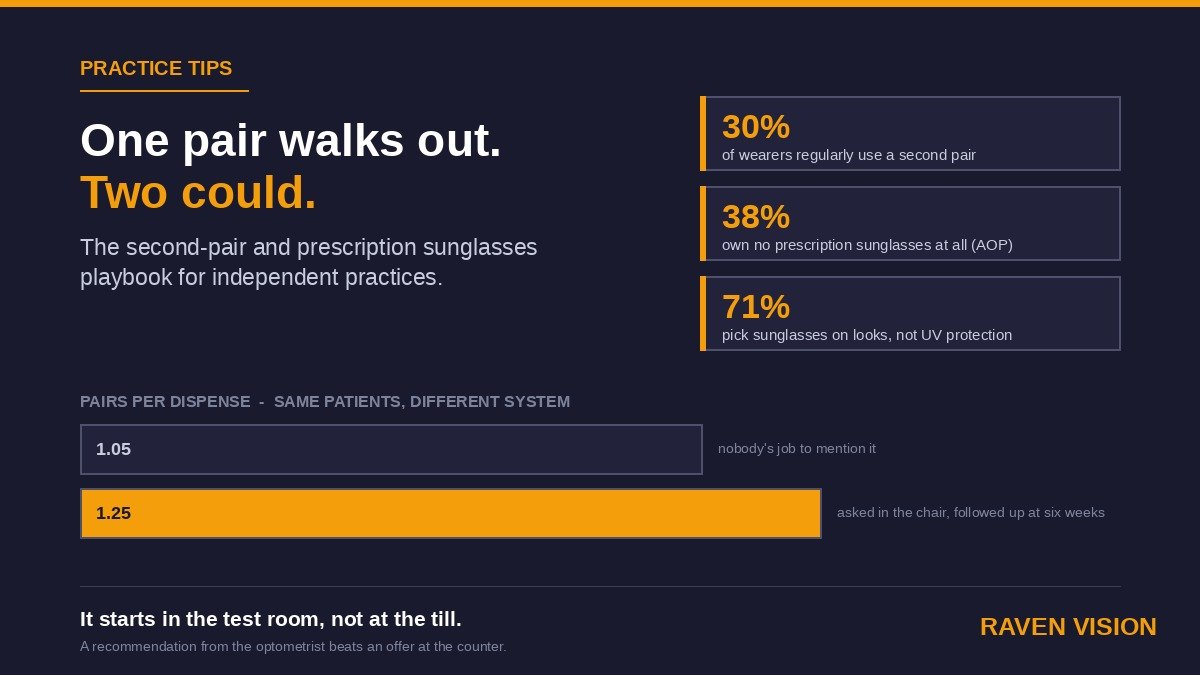
Consumer research reported by Optician suggests only around 30% of prescription lens wearers regularly wear two pairs — and multiple-pair ownership skews heavily towards older patients. Everyone else is running their entire visual life through a single frame.
The sunglasses figures are starker. An Association of Optometrists survey of 2,000 people found that 38% of UK adults who wear prescription spectacles don’t own prescription sunglasses at all. And when people do buy sunglasses, 71% say looks come first — UV protection barely features in the decision. A separate Met Office survey found only 43% of UK adults own sunglasses they know offer UV protection.
Put those together and the picture is clear: the majority of the patients already sitting in your chair have a genuine, unmet need for a second pair — and most of them have never had it framed as anything other than an upsell.
Why second pairs don’t sell themselves
Three things kill the second pair, and none of them is price.
First, timing. The multi-pair conversation usually happens — if it happens — at the till, after the patient has just committed a few hundred pounds. That’s the single worst moment to introduce more spend. The decision fatigue is real and the answer is nearly always “maybe next time.”
Second, staff discomfort. Dispensing teams in independents are, on the whole, allergic to feeling like salespeople. That’s a strength — it’s why your patients trust you and not the multiple down the road. But it means an unstructured “would you like a second pair?” never gets asked, because it feels like flogging.
Third, the discounting reflex. When the second pair does come up, it’s often as a panicked “we can do 50% off a second pair” — which trains patients to expect the discount, guts the margin, and still doesn’t answer the only question that matters: what would the second pair actually do for you?
The fix for all three is the same. Stop treating the second pair as an add-on at the till and start treating it as a clinical recommendation that begins in the test room.
The offer starts in the test room, not at the till
The strongest multi-pair practices don’t have better closers at the dispense desk. They have optometrists who surface the need during the examination, so the dispenser is completing a recommendation rather than starting a pitch.
It takes three lifestyle questions, asked naturally during history and symptoms: How much of your day is on a screen? Do you drive much — any trouble with glare or night driving? What do you do outside work — anything outdoors, any sport? The answers go on the record, and the optometrist closes the loop with one sentence: “For the amount of driving you do, I’d want you in a polarised prescription pair for the car — I’ll note that for the dispensing team.”
That sentence changes everything. It’s a clinical opinion from the person the patient came to see, not a retail offer from the person taking payment. We’ve written before about how much revenue leaks in the walk from the test room to the dispense desk — the optometrist-to-DO handover is exactly where the second pair lives or dies. If the recommendation isn’t captured somewhere the dispenser can see it, it evaporates.
This is where your practice management system earns its keep: lifestyle answers and the optometrist’s recommendation belong in structured fields on the patient record, visible at the dispense desk — not scribbled on a till receipt or held in someone’s head between rooms.
Four second pairs that solve real problems
“A second pair” is too vague to sell. These four aren’t.
Prescription sunglasses
The obvious one, and still the most under-dispensed. The 38% figure above is your market. The pitch isn’t fashion — it’s function: driving glare, light sensitivity, UV damage that accumulates for decades. We covered the clinical case in our piece on UV protection and eye health — and no, it isn’t a summer-only conversation. Low winter sun on a wet road is worse glare than anything August produces.
Occupational and screen-specific pairs
A varifocal wearer spending all day on dual monitors is compromising every hour. Occupational lenses set for intermediate and near distances are a genuinely better tool for the job — and for many patients, someone else will pay for them (more on that below).
The spare pair
Unglamorous, essential. Ask any patient who’s sat on their only glasses on day two of a holiday. For single-pair wearers with a strong prescription, a spare isn’t a luxury — it’s continuity of vision. A budget frame with their current Rx does the job and keeps the price gentle.
The activity pair
Cycling, golf, sailing, gardening, DIY. Wraps, impact-rated safety specs, dedicated readers for the music stand. These come straight out of the lifestyle questions — you can’t recommend what you never asked about.
Let someone else pay: the DSE opportunity
Here’s the angle almost no independent uses. Under the Health and Safety (Display Screen Equipment) Regulations 1992, an employer must pay for an eye test for any employee who regularly uses screens for work and asks for one — and if the test shows the employee needs glasses specifically for screen distance, the employer must pay for a basic pair too.
Most office workers have no idea. Which means every working-age patient who answers “most of the day” to your screen question is potentially entitled to an employer-funded eye test and an employer-funded pair of screen glasses — leaving their own budget free for the pair they actually want to be seen in.
Practical version: a small printed card at the dispense desk — “Did you know your employer may have to pay for this?” — and a one-line email template the patient can forward to HR. It costs you nothing, positions the practice as being on the patient’s side, and quietly funds a second pair.
Price it properly — packages beat panic discounts
The blanket “50% off second pairs” is the lazy option, and it’s expensive. It anchors the second pair as a discounted afterthought and gives away margin on patients who’d have bought anyway.
Better: build two or three fixed-price packages and present them as products, not percentages. A “complete pair two” price for a spare from a defined frame range. A polarised prescription sunglasses package at a clean number. An occupational pair bundle. Fixed prices are easier for staff to say out loud, easier for patients to evaluate, and they protect the value of your first-pair dispense — which, as we’ve argued in the dispense rate guide, is the number your whole retail side stands on.
One more pricing note: present the second pair price at the same time as the first, not after it. “With the polarised pair for the car, you’re at £X for both” lands very differently from asking for more money once the wallet is already closed.
What to say: three scripts that don’t feel like selling
Words matter, and unscripted teams default to silence. Three lines that work because they’re recommendations, not offers:
From the optometrist, in the chair: “You mentioned the glare on the motorway — I’d want you in a polarised prescription pair for driving. I’ll flag it for the team out front.”
From the dispenser, at frame selection: “Mr Khan, the optometrist has recommended a screen-distance pair for your desk work — shall we sort both today so you only make one trip?”
From reception, at collection: “While you’re here — your prescription’s on file, so if you ever want the sunglasses version, it’s a ten-minute job to order. Here’s the price with your frame.”
None of those is pushy. All of them are specific, tied to something the patient said, and delivered by the right person at the right moment.
Measure pairs per dispense, or nothing will change
You can’t manage what you don’t count, and most practices genuinely don’t know their multi-pair rate. The metric is simple: pairs dispensed divided by dispensing patients, tracked monthly, split by clinician and by dispenser. A practice dispensing 1.05 pairs per patient has a system problem. Getting to 1.25 on the same patient flow is a meaningful chunk of revenue with zero extra marketing spend — these are patients already in the building.
Two supporting numbers: what proportion of dispenses include prescription sunglasses (watch it seasonally — if it flatlines in winter, the team has stopped asking), and the attachment rate on the specific packages you’ve built, so you know whether the pricing is landing.
Your stock has to back the story too. If the recommendation is polarised prescription sunglasses and the sunglasses stand is three dusty frames from 2023, the conversation dies at the point of proof. A tight, current range — tracked properly through your inventory system so you know what actually sells — beats a big stale one every time.
The second visit second pair
Not every patient will say yes on the day, and that’s fine — as long as “no” today doesn’t mean “never.” The prescription is valid for two years. The lifestyle notes are on the record. That’s a follow-up waiting to happen.
Six weeks after collection, as part of aftercare contact: “How are the new glasses settling in? By the way, your prescription’s on file — if the driving glare’s still bothering you, the polarised pair we discussed is a quick order.” Segment it properly — only patients whose records show the recommendation — and it reads as attentiveness, not marketing. This is exactly the kind of targeted, record-driven contact a proper recall system should be doing for you automatically, rather than blasting the whole database with a generic newsletter.
Done well, the second-visit second pair also smooths the revenue curve: it turns a two-yearly transaction into two or three touchpoints per cycle, each of them useful to the patient.
Make it a system, not a push
Here’s the whole playbook in one paragraph. Ask three lifestyle questions in the chair and record the answers. Have the optometrist make the recommendation clinically, in the room. Hand it over in a structured field the dispenser can see. Offer named packages at fixed prices, presented alongside the first pair. Use the DSE regulations to bring the employer’s money into the room. Track pairs per dispense monthly, by clinician. Follow up the “not todays” at six weeks through segmented recall. None of it requires a single salesy sentence — every step is either clinical advice or basic attentiveness.
Raven Vision was built inside working practices — our co-founder Shaukat is an optometrist with 35 years in the chair, and he still runs three of his own — so the software assumes you’ll want lifestyle fields on the patient record, dispense reporting split by clinician, an inventory that tells you which sunglasses actually sell, and recall segments precise enough to follow up one recommendation without spamming everyone else. It’s £149 a month per location, with free data migration and no lock-in. If you’d like to see what your multi-pair numbers could look like with the system doing the remembering, book a walkthrough — bring last month’s dispense figures — or have a look at the pricing first. Either way: count your pairs per dispense this month. The number will annoy you, and that’s the point.