
Your new optical assistant starts on Monday. You’ve got a full diary, a rep coming in at two, and the dispensing optician who normally shows people the ropes is off sick. So you hand over a till key, point at the frame wall and say “you’ll pick it up as you go.”
They do pick it up. Slowly, and with a few expensive mistakes along the way: a wrong PD written on a job bag, a patient told their glasses would be ready Thursday when the lab said the following week, a contact lens trial booked in the wrong slot. Nobody’s fault, really. Nobody told them how any of it was supposed to work.
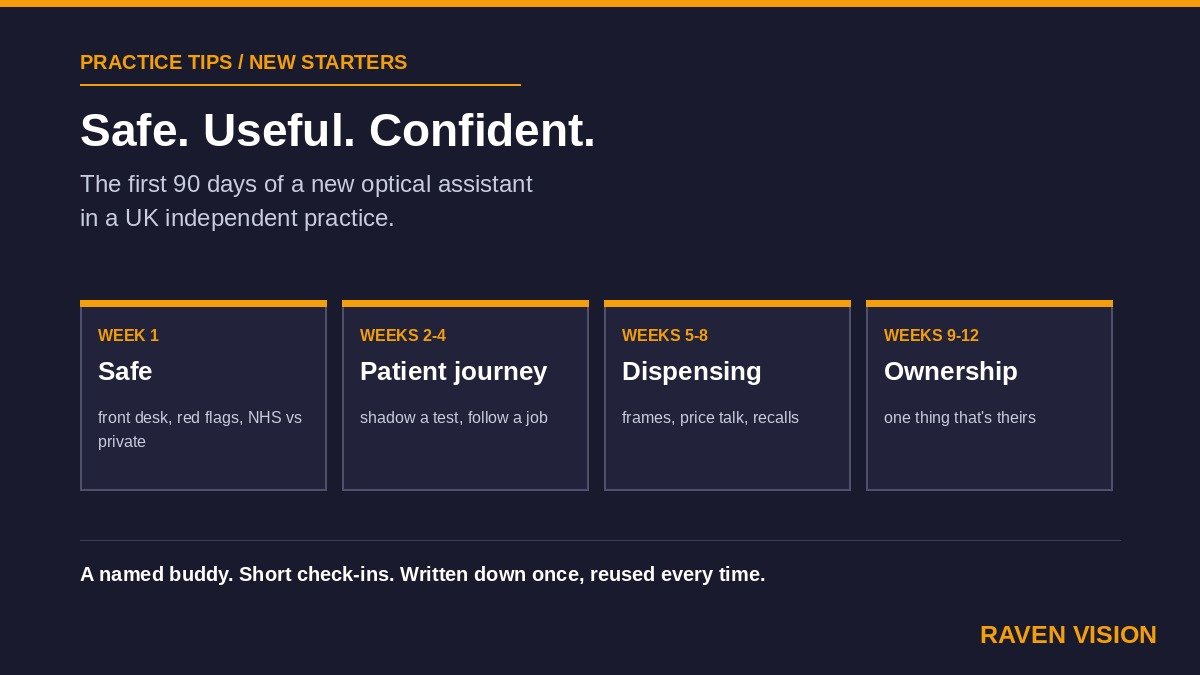
This is a plan for the first 90 days of a new optical assistant in an independent practice. It’s built for a small team where there’s no HR department and no training budget, just you and whoever’s in that day. (If you’re thinking about the bigger picture of finding and keeping good people, we covered that in how to attract and keep great staff. This piece is about what happens after they’ve said yes.)
Why the First 90 Days Decide Whether They Stay
Most people who leave a job in its first few months don’t leave because of the pay. They leave because they felt lost, felt like a nuisance for asking questions, or realised nobody had thought about what they were there to do. In a practice with four or five staff, losing someone after three months hurts more than it would in a big business. You’ve spent the time training them, and you start again from zero.
There’s a second reason. Patients can’t tell the difference between a new starter and an experienced member of the team. They just see someone from your practice. If that person is unsure, vague about prices or fumbling with the diary, the patient’s trust in you takes the hit, not in the assistant.
So the goal of the first 90 days isn’t “get them up to speed”. It’s “make them safe, then useful, then confident”, in that order.
Before Day One: The Boring Bit That Makes Everything Easier
A good first day starts the week before. It takes about an hour, and it stops the awkward scene where the new person stands around for forty minutes while you find a login.
Sort the practical stuff
Have the following ready before they arrive:
- A system login with the right level of access, set up and tested, not “we’ll do it this morning”.
- Uniform or dress code, a locker or hook, and somewhere to put their bag.
- A one-page list of who’s who, with names, roles and which days each person works.
- Their rota for the first four weeks, with the quiet sessions marked, because those are where the real teaching happens.
- A named buddy. One person who’s in the building most of the days they are.
The buddy matters more than any document. A written checklist can’t answer “what do I say when someone asks if it’s NHS?” at 11:20 on a Tuesday. A colleague can.
Tell the rest of the team
Say it in the huddle: who’s starting, what they’ll be doing, what you’d like everyone to do to help. If you run a morning huddle, that’s the natural place. People are far kinder to a newcomer when they’ve been asked to be.
Week One: Safe, Not Fast
Don’t try to teach everything. Teach what stops them hurting a patient or the business, and let the rest wait.
Day one: orientation and the front door
Walk the building. Show them where the fire exits are, where the first-aid kit lives, and how the alarm works. Then spend the morning with them on reception, watching, not doing. Have them sit next to whoever’s on the desk and listen to how calls get answered and how patients are greeted.
By the afternoon, let them greet patients and book in with someone beside them. The rule for week one: they shouldn’t be the last line of defence for anything.
The three things they must be able to do by Friday
Pick a short list and be firm about it. For most practices it’s these:
- Greet and book in a patient, and spot when something needs a clinician straight away (a painful red eye, sudden flashes or a curtain over the vision, a head injury).
- Take a booking over the phone without making a mess of the diary.
- Explain, in plain English, the difference between an NHS sight test, a private one and a voucher, and when each applies.
That last one deserves real time. It’s the question patients ask most, and the one new staff get wrong most. Write the three-sentence answer down together and let them practise saying it out loud.
Learning the system
This is where an easy-to-use practice management system earns its keep. A new assistant who has to memorise twelve screens before they can book an appointment will be scared of the computer for a month. One who can see the day’s diary, find a patient and take a booking in the first morning will relax. If you’re still choosing, the appointment management side is the part to test with a total beginner, not just the owner. Ask a friend who’s never seen it to book a patient and see how far they get without help.
Weeks Two to Four: Learning the Patient Journey
Once they’re safe on the front desk, widen the circle. The best way to do it is to follow a patient through the whole visit, from the phone call to the collection of their glasses.
Shadow a full sight test
Ask the optometrist if your new assistant can sit in on a handful of appointments, with the patient’s agreement. They won’t understand the clinical side and they don’t need to. What they’ll learn is how long things take, what gets said at the end of the test, and what the patient expects next. It also changes how they talk to patients on the desk. Someone who’s seen what a visual field test feels like explains it better than someone reading from a leaflet.
Follow the job through the lab
Pick two or three real orders and track them from the dispensing table to the lab and back. Show them how the job bag gets filled in, what the lab needs to see, and what a late or wrong job looks like. This is where tracking matters. When someone asks “where are my glasses?”, your assistant should be able to find the answer in thirty seconds, not shout across the practice. We wrote about order tracking and turnaround times if you want a way to set that up.
Let them handle the small stuff
By week three, give them real jobs with limits. Simple adjustments, fitting a nose pad, cleaning and returning a pair. Our guide on walk-in repairs and aftercare is a good starting point for what’s safe to hand over and what should go to a dispenser. Small wins early build the confidence that makes the harder bits stick.
Weeks Five to Eight: Dispensing and the Money Conversation
This is the stretch where good assistants either grow or stall. It’s also where practices tend to go quiet, because the new-starter excitement has worn off and everyone’s busy.
Frames, fit and what to say
Teach frame selection by sitting beside a dispenser and watching, then by being watched. Cover face shape and fit, but spend longer on listening. A good assistant asks what the patient does all day before picking up a single frame. That’s a habit, and it’s taught by example.
Then the awkward bit: talking about price. Plenty of new starters freeze here, because they don’t want to sound pushy. Give them the actual script you use, the honest one. “Here’s what that comes to. Here’s the cheaper option and what you’d be giving up.” If you’ve got a clear approach to pricing transparency, this is much easier, because the numbers aren’t a secret and nobody’s embarrassed to say them.
Contact lenses, if you offer them
If your practice has a contact lens base, add the basics of the teach and the aftercare cycle in this block. The first 30 days workflow is a decent model for what a new assistant should understand, even if they never run a teach themselves.
Recalls and records
Show them how the recall list works and why it matters. A patient who isn’t recalled is a patient who’s quietly drifting to someone else, and the assistant who understands that will check the recall box without being asked. A system that handles recalls properly takes some of the memory work off everyone. And a clean patient management record is a habit you want in place before bad ones form.
Weeks Nine to Twelve: Ownership
By now your assistant can do most of the job. The final month is about turning someone who follows instructions into someone who notices things.
Give them a small area to own
Choose one thing, small but real. Keeping the frame wall tidy and priced correctly. Chasing uncollected glasses. Checking the contact lens stock sheet on Fridays. Whatever it is, let it be theirs, and don’t re-do it behind their back. People stay where they’re trusted with something.
Handle the awkward moment together
Sooner or later a patient will be unhappy, and your new starter will be in the line of fire. Don’t wait for it. Talk through how you handle patient complaints, who to fetch, what not to promise, and when to say “let me get someone who can sort this properly”. Knowing they’ve got backup takes most of the fear out.
Check-Ins That Actually Work
None of this works without conversation. You don’t need a formal review system. You need a short, regular check-in, put in the diary so it doesn’t slide.
A simple pattern: end of week one, end of week four, end of week eight, and a proper sit-down at week twelve. Fifteen minutes each. Ask the same few questions every time:
- What’s gone well this week?
- What’s confused you or felt harder than it should?
- Is there anything you’ve been unsure about but haven’t liked to ask?
That third question does the heavy lifting. It’s where you’ll hear “I never really understood how the voucher thing works” a month before it becomes a problem.
Write down what you say you’ll do afterwards, and do it. Nothing wrecks trust faster than a check-in where nothing changes.
Common Mistakes Owners Make
A few that come up again and again:
- Throwing them in the deep end on a Saturday. Saturday is the busiest day and the worst for learning. Start them midweek.
- Teaching everything at once. Three new things a day is plenty. Choose them.
- Leaving it all to one person. If your buddy’s ill, the plan shouldn’t collapse. Write it down so anyone can pick it up.
- Skipping the “why”. People remember procedures better when they know the reason. “We confirm the name and date of birth because we’ve had two patients with the same surname” sticks. “Always check ID” doesn’t.
- Forgetting the thank-you. Say it when they do something well. It costs nothing.
Make It Repeatable
The real payoff comes the second time. If you write the plan down once, as a simple checklist with the first-week must-dos, the four-week journey and the check-in dates, the next new starter gets the same good start without you reinventing it. It also means a locum or part-timer can follow it when you’re not there.
Keep it to two sides of A4. If it’s longer, nobody will read it.
Let the Software Carry Some of the Load
A practice system won’t train your team for you, and it shouldn’t try. But the right one makes the plan easier to run: a diary a beginner can read at a glance, patient records that show the next step, and tools that stay out of the way. At Raven Vision we built the system inside working practices, so we’ve watched plenty of new starters get their first week on it. That experience shaped how simple we kept the day-to-day screens.
If you’d like to see how it feels in the hands of someone who’s never used it, we’ll show you. Raven Vision is £149 a month per location, with three months free to start, and you can see everything we charge on one page. Book a demo, hand your newest team member the mouse, and see how far they get.