
A patient collects their new varifocals eleven days after ordering. They’re delighted. Another patient collects theirs after nine days and leaves quietly annoyed.
Same practice. Same lab. Two days faster for the unhappy one. The difference wasn’t turnaround — it was that the first patient was told two weeks and the second was told “should be about a week.”
That’s the whole spectacle turnaround problem in one paragraph. Two weeks is roughly the industry norm in the UK, because most practices order lenses to prescription after the sale and send the job out to a third-party lab. Patients have largely accepted that. What they haven’t accepted is being told one thing and experiencing another, then having to ring you to find out where their glasses are.
The good news is that this is one of the most fixable problems in an independent practice. You don’t need in-house glazing or a new supplier. You need a visible order board, one honest promise, and the discipline to speak first.
Why turnaround matters more than the average suggests
Speed is being used as a weapon against you. Online and hybrid retailers now advertise same-day dispatch and 24-hour prescription glasses, and some labs holding stock single vision can glaze in under an hour. You’re not going to beat that on raw speed for a simple single vision job, and you shouldn’t try.
But here’s what most owners miss: patients rarely leave over the number of days. They leave over the experience of waiting without information. A fortnight where you texted on day three and day nine feels shorter than eight days of silence followed by a call the patient had to make themselves.
There’s a commercial edge to this too. Every day a job sits in limbo is a day your money is tied up in a frame and a pair of lenses you’ve paid for and can’t invoice in full. If you’ve already read our piece on cutting uncollected spectacles, this is the stage before that one. Slow, silent ordering is what creates the drawer full of uncollected jobs in the first place. A patient who’s stopped expecting a call stops turning up.
The five places a spectacle order goes quiet
When practices tell me their turnaround is unpredictable, it’s almost never the lab. It’s one of five gaps, and usually more than one.
1. The gap before the order even leaves
The dispense finishes at 4:40pm on a Thursday. The order gets placed Friday afternoon, or Monday morning if Friday was busy. Nobody logged the delay, so the two-week clock the patient is counting started two working days before yours did.
This is the single most common hidden day-loss and the easiest to fix. Orders go out the same day they’re taken, full stop, or there’s a named person who clears the ordering queue at a fixed time each afternoon.
2. The supplier black hole
The job’s been ordered. Where is it? For most practices the answer lives in someone’s memory, an email confirmation, or a supplier portal that nobody checks unless a patient rings. Multiply that across several suppliers — frames from one, lenses from another, specialist lenses from a third — and you’ve got a genuinely time-consuming problem. Around three-quarters of opticians say hunting through supplier catalogues is a real time sink, and the same fragmentation makes tracking a placed order just as awkward.
3. The arrival nobody logs
The box arrives at 10am during a busy clinic. It goes behind the desk. It’s opened at 3pm, or the next morning. The patient could have been texted five hours earlier. Small, invisible, and it happens most days in most practices.
4. The failed check at the bench
The job comes back, gets verified, and something’s wrong — wrong axis, wrong base curve, a scratch, a frame that’s shipped in the wrong colourway. Now you’re reordering, and the patient’s original promise date is already gone. If nobody tells them, that’s the moment trust breaks.
5. The remake nobody explained
Worst of all: the patient collects, can’t get on with the lenses, comes back, and the whole cycle restarts — except now they’re comparing this experience against the version they imagined when they handed over three hundred pounds.
The remake problem is mostly a measurement problem
Remakes deserve their own section, because they’re the biggest single destroyer of turnaround and the one most practices treat as bad luck.
The numbers are worth knowing. Industry figures suggest roughly 15% of spectacle lens orders end up needing a remake, while well-run opticals get that down to around 5%. On the clinical side, UK research published in Ophthalmic and Physiological Optics found patient dissatisfaction with new spectacles in about 2.3% of eye examinations — which works out at more than half a million rechecks a year across the UK. A separate systematic review put pooled non-tolerance at around 2.1%.
The cause is the uncomfortable bit. Only about 15–17% of those cases were down to a patient failing to adapt to an accurate prescription. Somewhere between 72% and 83% came back to errors in refractive measurement. That’s not a lab problem or a patient problem. That’s ours.
And each one costs more than the lens. An hour to ninety minutes of combined staff time per remake is a fair estimate — the recheck, the reorder, the apology, the second collection appointment, the goodwill discount you end up offering. Ten remakes a month is most of a working week gone, and none of it is billable.
So if you’re serious about turnaround, start upstream:
- Log every recheck and remake with a reason code. Not “patient unhappy” — why. Refraction, measurement, lab error, frame fit, patient adaptation, patient changed their mind.
- Review the codes monthly. Patterns show up fast, and they’re usually specific: one lens design, one supplier, one measurement, one clinician’s high-cyl prescriptions.
- Double-check heights and centration on every progressive dispense, and have a second pair of eyes on anything above a certain add or cyl.
- Record the conversation, not just the numbers. A note saying the patient does two hours of close work in poor light at the end of every day is what stops the third recheck.
A tight handover between the test room and the dispense desk does more for your remake rate than any lab change you could make.
Set one promise and then measure it
Most practices don’t have a turnaround time. They have a range that shifts depending on who’s talking and how the day’s gone. “About a week to ten days.” “Usually a fortnight, but sometimes quicker.”
Pick one promise per job type and make it slightly pessimistic. Single vision stock: three to five working days. Standard progressives: seven to ten. Complex, specialist or tinted: ten to fourteen, and say so at the point of sale. Then beat it. A patient told fourteen days who collects on day nine tells people about you. A patient told seven who collects on day nine does the opposite.
Four numbers tell you whether the promise is real:
- Order-to-ready days, by job type. Your actual average, not your feeling about it.
- On-time rate. What percentage of jobs are ready by the date you gave the patient? Anything under 90% and your promise is fiction.
- Inbound chase calls per week. “Are my glasses ready yet?” is a direct measure of how badly you’re communicating. Every one of those calls is a failure you paid staff time to handle.
- Remake and recheck rate. Track it monthly against that 5% target rather than the 15% norm.
If pulling those four numbers means opening a spreadsheet, a supplier portal and a paper daybook, that’s your real finding. Data you can’t see doesn’t get managed.
Build an order board the whole team can read
Every practice that’s got a grip on turnaround has one thing in common: anyone on the team can answer “where is Mrs Ahmed’s order?” in under fifteen seconds, without asking a colleague or ringing a supplier.
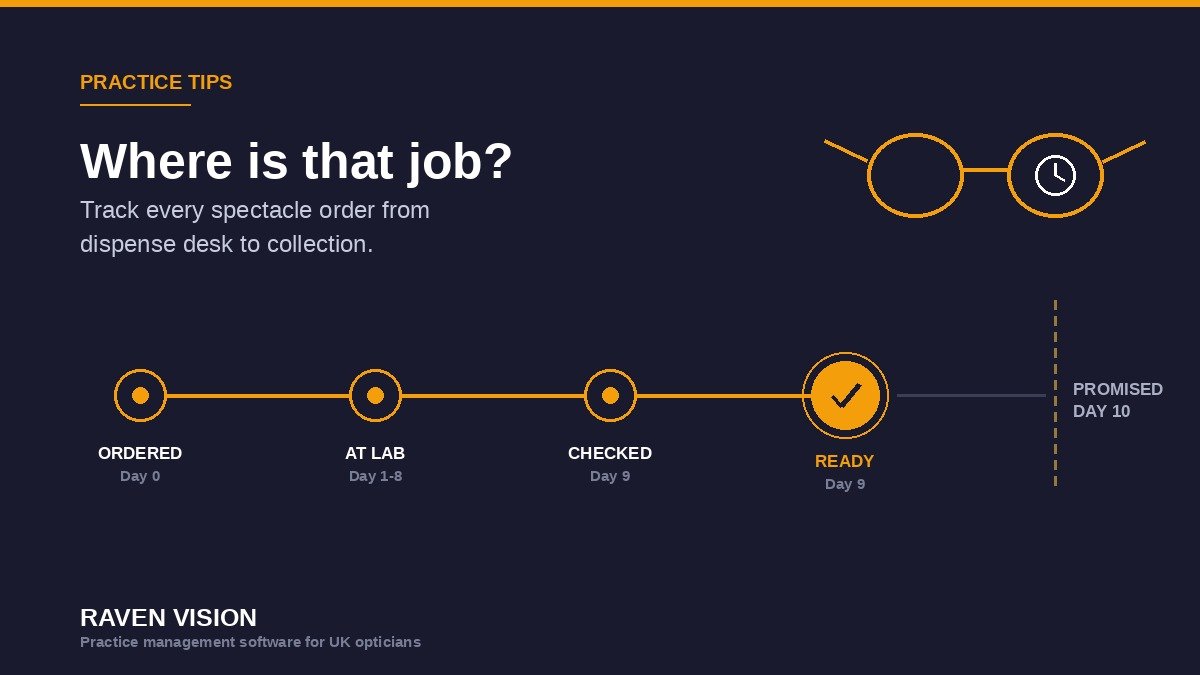
That means one live list of open jobs, in the system your team already works in, with a status on every one. Six statuses cover almost everything:
- To order — dispensed, not yet placed. This list should be empty by end of day.
- Ordered — placed with the supplier, with the date and expected return.
- Overdue — past expected return. This is the list somebody chases, not the patient.
- In, awaiting check — arrived, not yet verified.
- Ready — verified, patient notified, waiting on collection.
- Reorder / remake — with a reason code attached.
Then give it an owner and a rhythm. One person opens the board each morning, works the overdue list before the first clinic, and clears the “to order” queue before close. Ten minutes twice a day. Practices that skip the rhythm end up with a beautiful board nobody looks at, which is worse than no board — because now everyone assumes it’s accurate.
Keep the whole thing attached to the patient record rather than living in a separate tracker. When the order, the clinical notes, the measurements and the balance owed all sit in the same place, a complete patient record answers the question instantly and whoever picks up the phone sounds like they run the place.
Speak first, especially about bad news
Three messages, and you’ll eliminate most of your chase calls.
At the point of order: a confirmation with the job, the promised date and what happens next. Written, not verbal — patients remember what they can re-read.
When it’s ready: same day it’s verified, not the next morning. Include what to bring, the balance due, and how long a collection takes. Vague messages produce no-shows at collection.
When it slips: the day you know, not the day the patient asks. This is the one everybody dodges, and it’s the one that earns the most trust. “Your lenses have been delayed at the lab — I’ve chased them this morning and I’ll have a firm date for you by Thursday. I’m sorry, that’s frustrating.” Patients forgive delays. They don’t forgive discovering a delay themselves after eleven days of silence.
Doing this manually is a job nobody wants. Doing it automatically — triggered off the status change, with the practice’s name and a real phone number on it — costs nothing per patient and makes a two-week wait feel managed. An automated patient communication engine should handle order updates as naturally as it handles recalls, because to the patient they’re the same thing: your practice being on top of their care.
Where the software has to carry weight
Ordering discipline is a habit, but habits fail without the right tooling. A practice management system should be doing four specific things here.
It should hold the order on the patient record, with the frame, the lens spec, the measurements, the supplier and the dates, so nothing needs re-keying and nothing lives in a second system. It should let you see open jobs as a working list you can filter and sort by status and age, so overdue jobs surface themselves instead of being remembered. It should tie into frame and lens stock, so a frame going out on a job leaves your shelf count and you’re not selling something you’ve already committed. And it should connect to the money — deposits taken, balance outstanding, collection ready — so the billing side reflects reality without a separate reconciliation at month end.
That’s why Raven Vision was built inside working practices rather than in a product meeting. Shaukat runs three of his own and has been an optometrist for over thirty-five years, so the job board, the patient record, stock and billing were designed as one flow rather than four modules that need stitching together — because chasing the same order across four screens is exactly the problem we were trying to get rid of.
A one-week plan
Monday. Write down every open job on one sheet, oldest first. Note the promised date next to each. You’ll find two or three that have been quietly forgotten — deal with those today, with a phone call each.
Tuesday. Agree one promised turnaround per job type, write it on a card at the dispense desk, and brief the team. Everyone says the same number.
Wednesday. Set the rhythm. Name the person who clears the ordering queue before close and works the overdue list each morning. Put it in the rota, not in someone’s head.
Thursday. Write the three messages — order confirmation, ready-to-collect, delay — as templates. Short, warm, specific.
Friday. Start logging remake reasons. One line per remake. Diarise a review for four weeks’ time.
None of that costs money. All of it compounds.
The practices that win on turnaround aren’t the fastest
They’re the ones where nothing goes quiet. Where the patient knows the date, hears from you before they’d think to ring, and finds out about a delay from you rather than from your silence.
Complaints across UK optics actually fell last year, and charges made up under 5% of enquiries to the Optical Consumer Complaints Service. Price isn’t what patients get upset about. Being left in the dark is.
You can’t out-sprint a same-day online glazing operation. You can be the practice that keeps its word, every job, and that turns out to be the more durable advantage.
If chasing spectacle orders across suppliers, spreadsheets and someone’s memory is eating your week, that’s a software problem as much as a process one. Raven Vision brings patient records, orders, stock, communication and billing into one system for £149 per month per location — with free data migration, hands-on onboarding and no lock-in contract. See what’s included in the current offer, or check the pricing and book a walkthrough with Shaukat.