
A patient sits down in your chair. Fifty-four, first sight test in six years, reading glasses from a garage forecourt. You take a history. Somewhere on the form there’s a box that says Smoker: Y/N. He says yes, about ten a day, and you tick the box and move on to the autorefractor.
That tick is the most important piece of clinical information you’ll collect all morning, and in most practices it does absolutely nothing.
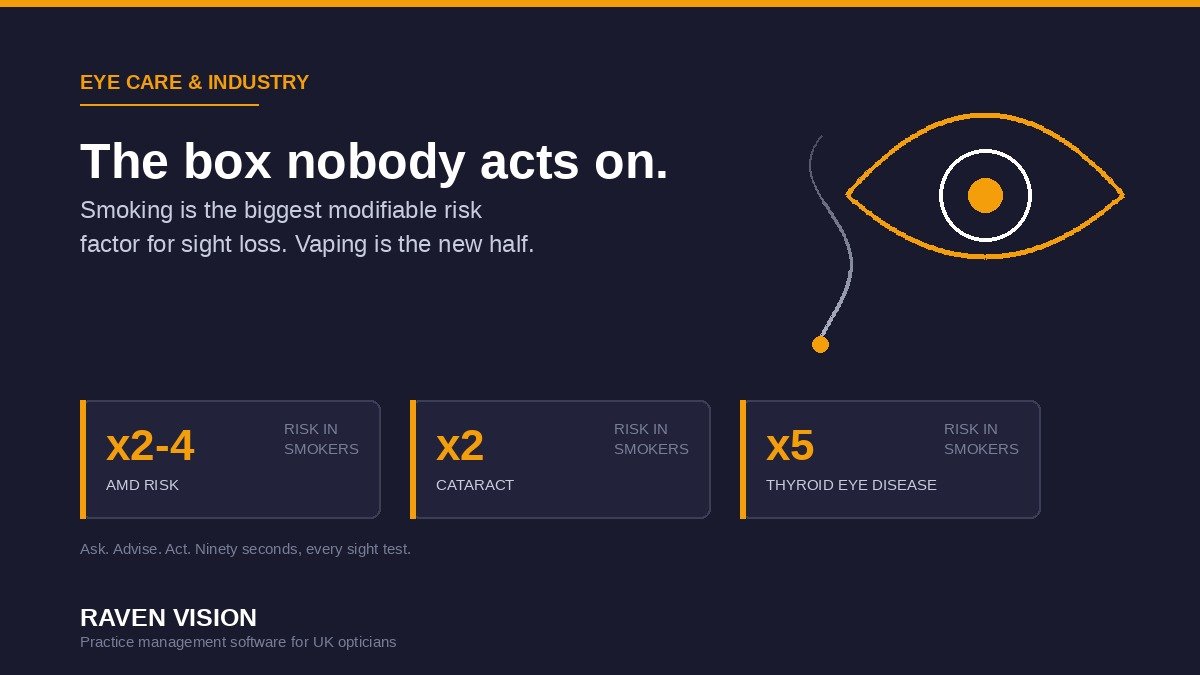
Smoking is the biggest modifiable risk factor for sight loss in this country. Not screens. Not diet. Not UV. And the person best placed to say so out loud isn’t the GP that patient sees once every three years — it’s you, sitting eighteen inches from his face, with a picture of his macula on the screen behind you.
Then there’s the newer version of the same conversation. Roughly 5.5 million adults in Great Britain now vape, and about 400,000 of them never smoked in the first place. They’re turning up with gritty, tired eyes and no idea the two things might be connected. Most of us aren’t asking. Most of us were never trained to.
What smoking actually does to the eye
Most patients know smoking causes lung cancer and heart disease. Almost none of them know it causes blindness. UK survey work at a tertiary eye centre has repeatedly found that patients — including patients already sitting in an eye clinic — badly underestimate the link. That knowledge gap is your opening.
Age-related macular degeneration
Smokers are between two and four times more likely to develop AMD than non-smokers, and they develop it earlier — by as much as five and a half years. For a condition where the dry form still has no cure, “earlier” is not a small word. It’s the difference between losing central vision at 78 and losing it at 72.
It’s also the one AMD risk factor a patient can do something about. They can’t change their age, their genes or their ethnicity. They can change this.
Cataract
People who smoke are around twice as likely to develop cataract, and there’s a clear dose relationship — smoke more than twenty a day and the risk climbs to roughly three times that of a non-smoker. Cataracts also appear earlier and tend to progress faster.
This one’s useful in the chair precisely because cataract is visible. You can show a patient their own lens changes on the slit lamp and connect it to the twenty-a-day habit in the same sentence. Abstract risk becomes their eye.
The ocular surface
Smoke is a direct irritant and it destabilises the tear film. Smokers report more dry eye symptoms, and tobacco smoke shortens tear break-up time. If you’ve got a patient in your dry eye clinic who has failed on three different lubricants and can’t work out why, and they smoke, you’ve probably found the reason nobody has mentioned to them.
Thyroid eye disease
This is the association most patients — and plenty of clinicians — have never heard, and it’s the most dramatic of the lot. Smokers with Graves’ disease are roughly five times more likely to develop thyroid eye disease than non-smokers with the same condition. Risk of diplopia rises with consumption: about 1.8 times at one to ten a day, 3.8 at eleven to twenty, and 7.0 above twenty. One study found smoking status predicted a severe disease course and the development of optic neuropathy with odds ratios of 6.57 and 10.0 respectively.
Smoking also makes treatment work less well — it blunts the response to steroids and orbital radiotherapy, and increases the risk of the eye disease worsening after radioiodine. If you have a patient with known thyroid disease who smokes, that’s not a general health chat. That’s a specific, evidence-backed clinical warning that belongs in your record and in your referral letter.
Everything else
Add to the list: worse diabetic retinopathy outcomes, increased uveitis risk, delayed corneal healing and higher rates of contact lens–related complications. There isn’t a structure in the eye that smoking leaves alone.
The vaping question you’re now getting asked weekly
Vaping sits in an awkward place, and pretending otherwise doesn’t help. For a smoker, switching to a vape is substantial harm reduction — that’s the basis of the NHS Swap to Stop approach. For a never-smoker, picking one up is taking on risk they didn’t previously have.
The ocular research is fairly consistent. E-cigarette use disrupts tear film quality and stability, and vapers report moderate-to-severe dryness at higher rates than non-users. Imaging studies have found significant meibomian gland loss in e-cigarette users compared with controls, with glands irregularly distributed and less hyperreflective — which matters, because gland dropout doesn’t grow back. Acrolein, an aldehyde byproduct of heating the liquid, has been implicated in the immune mechanisms behind chronic dry eye, and there’s evidence of effects on corneal nerves.
There’s the blunt mechanical risk too: device battery explosions causing thermal and chemical ocular injury, and accidental splash of e-liquid, which is a real chemical eye injury and should be treated as one.
Two practical consequences. First, “do you vape?” needs to be its own question on your history and symptoms, sitting next to the smoking question rather than folded into it — a patient who quit cigarettes two years ago and vapes daily will happily tick “non-smoker” and tell you nothing. Second, vaping belongs in your dry eye assessment protocol alongside screen use, medication and blepharitis. Meibography on a 26-year-old with unexplained gland dropout is a conversation worth having carefully.
What you shouldn’t do is tell a smoker who has switched to vaping that they’ve achieved nothing. They’ve reduced their risk considerably. The honest message is: better than smoking, not the same as neither, and the goal is eventually neither.
The uncomfortable bit: we know this and we still don’t say it
A UK national survey of optometrists found that while most assess smoking status and discuss risk, only around 22% actually advise smokers to quit. The barriers people reported were lack of knowledge and training (81%) and lack of time (65%). Only one UK optometry school was found to provide practical skills training in delivering evidence-based cessation interventions.
So it’s not that the profession doesn’t care. It’s that most of us were never taught how to say it, and we’re frightened of the awkwardness — the patient who bristles, the appointment running eight minutes over, sounding preachy in a room where we’ve just sold them a frame.
Set that against how little it actually takes. Very brief advice — three minutes or less — has moderate-certainty evidence for significantly increasing self-reported abstinence at six months or more. Three minutes. Not a counselling session. A structured thirty to ninety seconds that ends in an offer.
Why your chair beats almost anywhere else for this conversation
Think about what you have that a GP doesn’t. Time in the room — twenty to thirty minutes, with a patient who isn’t there about a crisis. A visual: fundus image, OCT scan, slit lamp view of their own lens. And a relationship measured in decades, because the same family comes back every two years.
People who have shrugged off ten warnings about their heart will go quiet when you say the word “blindness”. That’s not a trick — it’s a genuine risk nobody has ever framed for them in terms of their eyes, and sight loss consistently ranks near the top of the health outcomes the British public fears most.
You’re not trying to be a stop smoking service. You’re trying to be the moment somebody finally connects the two things.
The ninety-second version: ask, advise, act
Here’s a structure that fits inside a normal sight test and doesn’t require anybody to become a behaviour change specialist.
Ask (10 seconds)
Two separate questions, asked neutrally, every time, of everybody: “Do you smoke at all?” and “Do you use a vape?” Never assume. Ask ex-smokers when they stopped — risk falls after cessation, but AMD risk in particular takes years to approach that of a never-smoker, so an ex-smoker of eighteen months is still a higher-risk patient and should be monitored accordingly.
Advise (30-40 seconds)
Make it specific to their eyes and specific to what you can see. Not “smoking is bad for you.” Something more like:
“I want to mention something about the smoking, because it’s directly relevant to what I’m looking at here. Smoking roughly doubles the risk of cataract and it’s the biggest changeable risk factor for macular degeneration — that’s the condition that takes central vision, the vision you read and drive with. It also tends to bring both on earlier. The good news is it’s the one risk factor on your list you can actually do something about, and the risk starts coming down once you stop.”
Then stop talking. Don’t fill the silence with more statistics.
Act (20-30 seconds)
The bit almost everybody skips. Advice without an offer is just a telling-off. “Would you like me to point you towards the free NHS stop smoking service? They’re much more effective than going it alone, and it takes me thirty seconds to give you the details.”
Have the details to hand — your local service’s number, the NHS Better Health postcode finder, and whether your area runs Swap to Stop. Print it, don’t recite it. Note in the record that advice was given and an offer made.
If they say no, say “no problem at all”, move on, and ask again in two years. Nobody quits because of one conversation. People quit after the seventh or eighth, and you have no idea which number you are.
The three things patients say back
“My nan smoked until she was 92 and had perfect eyesight.” Agree with them. “Some people do get away with it — it’s a risk, not a certainty. I can’t tell you which group you’re in, which is rather the problem.” Don’t argue with the anecdote; you’ll lose.
“Is it too late for me to bother?” No — and this is the single most valuable thing you can tell them. Risk falls after cessation across cataract, AMD progression and thyroid eye disease outcomes. Former smokers do better than current smokers. Stopping at 60 is still worth doing.
“But I’ve switched to vaping, so I’m fine now?” Give them the honest answer. Big improvement on smoking, genuinely. Not risk-free — there’s growing evidence of tear film disruption and meibomian gland loss, so if the eyes feel gritty that may well be why. And the destination is stopping both.
Making it routine instead of heroic
Anything that depends on the clinician remembering, on a good day, when they’re running on time, doesn’t happen. Systems happen. Here’s what to build.
Separate, mandatory fields. Smoking status, pack-years or daily consumption, vaping status, and quit date if applicable — as structured fields on the record, not free text buried in a history note. Structured means searchable. Free text means invisible.
A flag the clinician sees before the patient sits down. If your patient record can surface “smoker, 20/day, family history of AMD” at the top of the screen when the patient’s notes open, the conversation gets prompted rather than remembered.
Risk-adjusted recall. A 55-year-old smoker with early drusen isn’t a routine two-year patient. Being able to filter your list and pull those patients back on a tighter interval — and to run a targeted recall to smokers over 50 who haven’t been seen in three years — turns a data field into a clinical service.
An audit you can actually run. Once a quarter: what proportion of patients have a recorded smoking status, and what proportion of recorded smokers have an advice-given note? If you can’t pull those two numbers in under five minutes, that’s a software problem, not a staff problem.
The waiting room does some of the work. One good poster about smoking and sight loss, plus a small stack of local stop smoking service cards on the dispensing desk, means some patients raise it before you do. Those are the easiest conversations you’ll ever have.
Brief the whole team. Ten minutes at a staff meeting on why you’re asking about vaping now, what the front desk says if someone asks, and where the referral cards live. Consistency is what makes it feel like a service rather than one optometrist’s hobby horse.
Where the software either helps or gets in the way
None of the above is hard. It’s just impossible if your system fights you.
What you need is specific: structured lifestyle fields you can define and make mandatory; those fields visible at a glance rather than four clicks deep; the ability to segment your patient base by them; recall intervals set by risk rather than one blanket rule; and reporting that shows whether any of it’s actually happening. If adding a “vaping status” field means a support ticket and a three-week wait, you’ll never add it, and the conversation never becomes routine.
That’s one of the reasons Raven Vision was built the way it was. Shaukat, our co-founder, is an optometrist with 35+ years in practice and three of his own, and he built the system inside those practices before it went anywhere near another business. Customisable clinical fields, flags that surface on the record, segmentable recall and reporting you can run yourself on a Tuesday afternoon exist because he needed them in his own consulting room. It’s £149 a month per location, all in, with free data migration and no lock-in.
A four-week plan
Week one — find out where you stand. Run a report on how many active patient records have a recorded smoking status. In most practices the answer is dispiriting. That’s your baseline.
Week two — fix the fields. Add or separate smoking and vaping status, consumption and quit date, and make them mandatory on the history and symptoms. Agree the exact wording so everyone asks the same way.
Week three — write the script and stock the referral. Draft your thirty-second advice paragraph in your own words. Find your local stop smoking service, get the referral route, print the cards. Check whether your area runs Swap to Stop.
Week four — run it, then look at the numbers. Ask, advise, act on every patient for a fortnight, then pull the report again. Set a date to repeat it in three months.
No new equipment, no new room, no fee to set. Just a question you were already half-asking, finished properly.
The point
You will not personally make many people stop smoking, and that’s not a fair measure of this. The job is to make sure no patient leaves your practice without knowing that the thing in their pocket is the leading modifiable cause of the sight loss they’re most afraid of — and knowing exactly where to go if they ever decide to do something about it.
Some of them will be on their seventh conversation about it. Somebody has to be the one that lands.
Want to see how flexible clinical fields, risk-based recall and self-service reporting work in practice? Raven Vision is practice management software built by an optometrist inside working UK independent practices — £149 per month per location, free data migration, no lock-in. Book a demo and see the current offer, or check exactly what’s included.
This article is general information for practitioners and is not clinical guidance. Follow College of Optometrists Clinical Management Guidelines and your own professional judgement in every case.