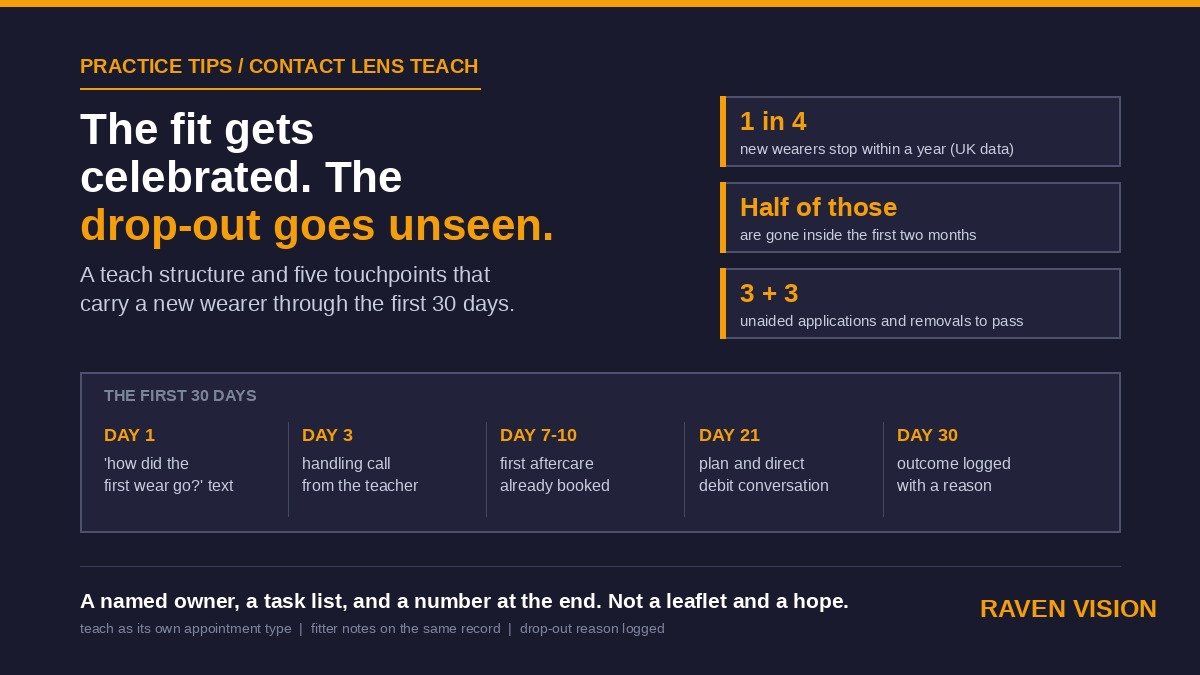

Ask most independent practices how their contact lens service is doing and you’ll get a number for new fits this year. Ask how many of those people are still wearing lenses, and the room goes quiet. The fit gets celebrated. The quiet drop-out six weeks later doesn’t get noticed at all, because nobody’s looking for it.
That’s the gap this post is about. Not the fitting, which your optometrist or contact lens optician already does well, and not the long-term aftercare cycle, which we’ve covered before. It’s the bit in between: the teach appointment and the first thirty days of wear. That short window decides whether a trial becomes a direct debit or a box of unopened lenses in a bathroom drawer.
The number nobody tracks: where new wearers actually go
The best UK data we have comes from a 2017 chart review by Sulley and colleagues, who looked at 524 new wearers across 29 UK practices. Roughly a quarter of them had stopped wearing lenses within a year. That figure alone should get your attention, but the timing is the real story: of everyone who dropped out, close to half did so within the first two months, and a quarter didn’t make it past month one.
The two reasons that came up most were poor vision and handling problems. Not cost. Not comfort, mostly. Vision and handling. Both of which are fixable, and both of which are most fixable in the first few weeks, when the patient is still motivated and still expecting to hear from you.
So if you fit forty new wearers a year and you’re typical, ten of them are gone by the following summer, and around five of those left before you’d even have thought to check in. That’s five direct debits, five sets of annual aftercares, and five people who now tell their friends contact lenses “didn’t work for them.” All of it happening in the fortnight after they walked out with a trial pack and a smile.
Why the teach is a retention appointment, not an admin slot
In a lot of practices the teach is treated as the tail end of the fit. It gets squeezed into whatever gap exists, it’s done by whoever’s free, and the goal is to get the lens in and out once and hand over a leaflet. Job done, next patient.
Flip that around. The fit is a clinical event. The teach is a confidence event. The patient leaves the fit believing lenses are possible for them. They leave the teach either believing they can do this on their own on a Tuesday morning with the kids shouting, or quietly deciding they can’t. Everything after that, the direct debit, the years of aftercares, the second modality, rests on that belief.
Which means the teach deserves a proper slot, a proper structure and a proper owner. It’s one of the highest-value appointments in your diary, and most practices don’t have it as a distinct appointment type at all. If it isn’t a named slot in your appointment diary with its own length and its own resource, you can’t protect it, and you can’t measure it.
Who can do what: the rules in two paragraphs
Quick regulatory reminder, because it shapes how you staff this. Fitting contact lenses is a protected function under the Opticians Act. Only a registered optometrist, contact lens optician, doctor, or a trainee under proper supervision can fit, and that includes anything that involves assessing the patient or exercising professional judgement. The College of Optometrists is clear that you can’t delegate any of that to unregistered staff.
Teaching handling is different. The College’s guidance allows the instruction of patients in the application, removal and care of lenses to be delegated to suitably competent support staff, provided the registrant stays on the premises to step in if needed. Explaining care, wear time, cleaning and what to do if something goes wrong is a statutory part of the fit, and written information has to go with it. So a trained dispensing optician, optical assistant or receptionist can run the teach, as long as someone registered is in the building and the clinical decisions stay with the fitter. That’s the model most successful independents use, and it frees clinical time without cutting corners.
Building a teach appointment that actually works
Thirty to forty-five minutes. Booked as its own appointment type. Run by a named person who’s been trained and signed off to do it. Here’s a structure that holds up.
Before the patient sits down
The teacher should already know the patient’s name, the lens, the modality, the prescription, why they wanted lenses in the first place, and anything the fitter flagged. That last one matters. “Nervous about touching the eye” or “wants them for football on Saturdays” changes how you run the session. If the fitter’s notes live in a patient record the teacher can open on the same screen, that handover takes ten seconds. If it’s a sticky note, it gets lost.
Lay out the room properly: mirror at the right height, good light, tissues, clean surface, a bin, and the actual solution and case the patient is going home with, not the trial-pack sachets.
The handling half
Hand washing first, every time, and narrate why. Then demonstrate application once on yourself or a model eye, slowly, and let the patient try. Don’t rush to help. The point is for them to succeed unassisted, even if it takes twelve attempts. Most people get application within a few tries; removal is where the confidence wobbles, so give removal at least as much time and make sure they’ve done it themselves at least twice before you move on. If they only manage it once, that’s not a pass, that’s a fluke.
Set a simple bar: three successful applications and three removals, unaided, on each eye. If they hit it, great. If they don’t, book a second teach rather than sending them home with a “you’ll get the hang of it.” That sentence is where a lot of your dropouts start.
The talking half
Wear schedule for the first week, in hours, written down. Cleaning and case hygiene, demonstrated not described. What normal feels like on day one versus what’s a problem. The red-eye rule, spelled out: if it’s red, painful, light-sensitive or your vision drops, lenses out and ring us, that day. Give them the practice number, the out-of-hours advice, and their lens specification. Then get them to tell it back to you. If they can’t explain when to take the lens out, the leaflet isn’t going to save them.
The leaving bit
Book the first aftercare before they leave the room. Not “we’ll be in touch.” In the diary, on a date, with a time. And tell them, plainly, that you’ll message them in a couple of days to see how the first few wears went. People who know a check-in is coming push through the awkward first week. People who think they’re on their own give up on it.
The first thirty days: five touchpoints
This is the bit most practices skip entirely, and it’s where the retention gain is. None of it needs a clinician. All of it needs a system that reminds the right person on the right day.
Day one: the “you did it” message
A short text the evening of the teach. Friendly, human, one question: “How did the first wear go?” It costs nothing and it tells the patient the door’s open. A surprising number reply with a problem they’d otherwise have sat on.
Day three: the handling check
A call, ideally from whoever ran the teach. Two minutes. Are you getting them in and out? How long are you wearing them? Any redness? If handling has fallen apart, book a second teach that week. If vision’s the issue, flag it for the fitter, because that’s a clinical adjustment, not a confidence one, and it’s the top reason people give up.
Day seven to ten: the first aftercare
The one already in the diary. This is where the fitter reviews fit, vision and ocular health, tweaks anything that needs it, and confirms the lens. If the practice has done the day-one and day-three touches, this appointment is mostly good news. If it hasn’t, this is often the first anyone learns the patient stopped wearing them a week ago.
Day twenty-one: the decision conversation
By now the patient knows whether lenses fit their life. This is when someone should talk about ongoing supply, the direct debit plan, and what the monthly figure covers. Do it as a conversation, not an invoice. If they’ve hit any snags, sort them first. Nobody signs a direct debit for something that isn’t working.
Day thirty: close the loop
Either they’re on a plan with their next aftercare booked, or they’re not, and you know why. Both are fine. What isn’t fine is not knowing. Log the outcome against the patient: converted, still trialling, dropped out with a reason. That reason field is where your service improves over time.
The three things that quietly kill a trial
Vision that’s “nearly” right. A new wearer with slight blur at the end of the day doesn’t complain, they just stop. If the fitter isn’t asked about vision until the first aftercare, and that aftercare’s at three weeks, you’ve lost them. Ask about vision at day three, and route the answer to the fitter the same day.
Handling that was never really nailed. One assisted removal in a bright, calm teach room isn’t the same as a solo removal at 11pm after two glasses of wine. The three-and-three rule exists for this. Be honest about who really passed.
No named owner after the teach. The fitter thinks the front desk is following up. The front desk thinks the fitter is. Nobody is. Every new wearer should have one person whose job it is to see them through to day thirty, and that person should have a task list, not a memory. This is the same problem we described in the optometrist-to-DO handover post: the drop always happens at the join between two people.
What to log, so you can actually see the leak
You can’t fix a dropout rate you can’t see. Four things, all of which should live in the patient record rather than in a spreadsheet someone updates when they remember.
First, a trial status on the record: new fit, in teach, trialling, converted, dropped. Second, a teach outcome: passed the three-and-three, or booked a second teach. Third, dated follow-up tasks for day one, three, twenty-one and thirty, assigned to a person, that sit on their to-do list until they’re done. Fourth, a drop-out reason when it happens: vision, handling, comfort, cost, lifestyle, other.
Once that’s in place, one report tells you everything. New fits this quarter, teach pass rate, thirty-day conversion, and the reasons for the ones you lost. If handling is your top reason, retrain the teach. If it’s vision, talk to the fitter about the day-three check. If it’s cost, look at how the plan’s being presented on day twenty-one. It’s the same discipline as your recall system: a defined trigger, a defined owner, a defined outcome, and a number at the end that tells you whether it worked.
Where Raven Vision fits, and where it doesn’t
Raven Vision was built inside working practices, and the CL teach workflow is one of the places that shows. The bits that matter here: a dedicated teach appointment type with its own length and staff resource in the diary, so it stops being squeezed; fitter notes visible to whoever runs the teach, on the same record; follow-up tasks that generate automatically from the fit date and land on a named person’s list; SMS templates for the day-one and day-three touches sent from the record; and the CL plan and direct debit set up from the same screen when the patient says yes on day twenty-one. The trial status and drop-out reason are fields on the record, which means the quarterly report is a filter, not a project.
Against ourselves: if you fit fewer than a dozen new wearers a year and your team already does this from a whiteboard, you don’t need software to fix it, you need the whiteboard to keep working. And if your current system can already generate dated tasks from a fit and log an outcome, use it. The workflow is the point. The software just stops it depending on someone’s memory.
The full picture of how we handle contact lens services, from fitting through plans and aftercare, is in the earlier post on contact lens services for independent practices. This post is the thirty-day slice of that.
Start with your last ten trials
Before changing anything, pull the last ten new wearers you fitted. Ring each one. Are they still wearing lenses? If not, when did they stop, and why? It takes an hour and it’ll tell you your real thirty-day conversion, not the one you assumed. Most practices that do this find they’re losing two or three in ten, and that at least one of those was fixable with a phone call in week one.
Then build the teach as a proper appointment, put the five touchpoints on someone’s task list, and check the number again in three months.
If you’d like to see how the teach slot, the automatic follow-up tasks and the CL plan set-up work together in Raven Vision, book a demo and we’ll walk through it with your own patient flow. Pricing is £149 a month, with the details on the pricing page. Either way, ring those ten patients this week. The number will tell you what to do next.