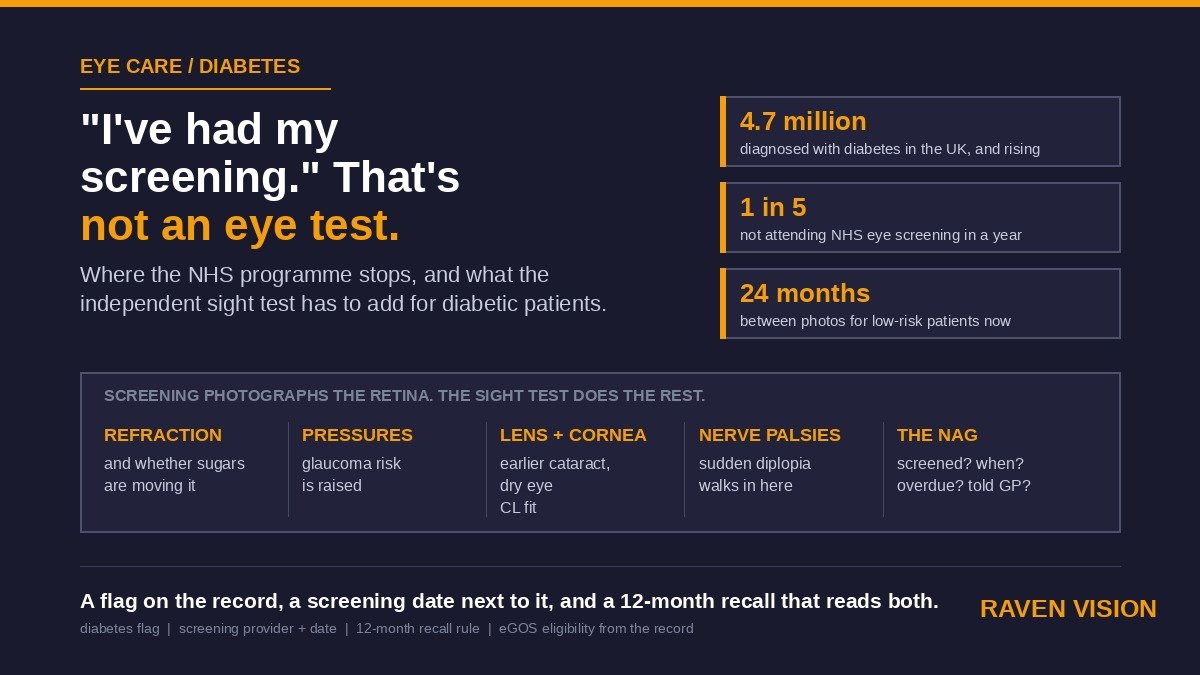

“I don’t need my eyes looked at, love. I had my diabetic screening in March.”
Every front desk in the country has heard that one. It’s said kindly, it’s said with total confidence, and it’s wrong in a way that matters. The patient has been photographed, not examined. Nobody has refracted them, nobody has checked their pressures, nobody has looked at the front of the eye, and nobody has asked whether the blurry mornings they’ve been putting up with are their sugars or their lens. They’ve done what the NHS asked of them and they think that’s the whole job. It isn’t, and the person best placed to tell them so is the independent optician they’ve been walking past for years.
This post is about diabetic eye care in UK independent optician practices: where the screening programme stops, what the sight test has to add, what the College actually expects of you, and how to make sure the diabetic patients on your list don’t quietly fall between the two.
Screening is not an eye examination, and your patients don’t know that
The NHS Diabetic Eye Screening Programme does one thing and does it well. It photographs the retina of everyone with diabetes aged 12 and over, grades the images for retinopathy and maculopathy, and refers the ones that need treating. Since it went national in England in the 2000s, diabetic retinopathy has stopped being the leading cause of certifiable blindness in working-age adults. That was the Liew, Michaelides and Bunce paper in 2014, comparing 1999–2000 with 2009–2010, and it’s one of the quieter public health wins of the last twenty years. Inherited retinal disease took the top spot; diabetes dropped to second.
So the programme works. What it doesn’t do is anything else. A screening appointment doesn’t measure refraction, doesn’t check intraocular pressure, doesn’t assess the cornea or the lens in any detail, doesn’t look for the extraocular muscle palsies that diabetes can throw up, and doesn’t talk to the patient about how they’re actually seeing. It’s a photograph and a grade. The College of Optometrists is clear on the division: retinal screening for the complications of diabetes is part of the national programme, not part of the GOS sight test. The two are complementary. Neither replaces the other.
The problem is that “I’ve been screened” and “my eyes have been checked” sound identical to a patient. They’re not the same thing, and the gap between them is where cataracts get missed for two years, where glaucoma goes unnoticed in a population that’s more at risk of it anyway, and where somebody drives on a prescription that’s a dioptre out because their HbA1c has been all over the place.
The numbers behind the waiting room
Diabetes UK’s latest figures put the diagnosed population at over 4.7 million people, up by more than 150,000 registrations in a single year, with almost 1.3 million more thought to have type 2 and not know it. Add the estimated 6.9 million at increased risk and you’re past 12 million adults living with diabetes or prediabetes. Roughly one adult in five.
Translate that to a typical independent with, say, 6,000 active patients skewed towards the over-50s, and you’re looking at several hundred people on your books with a diagnosis, plus a decent handful who’ll get one in the next few years. That’s not a specialist clinic. That’s Tuesday.
Then look at screening uptake. Nationally it sits somewhere around 78%, against a minimum standard of 75% and an “achievable” target of 85%. Put the other way round: about one diabetic patient in five isn’t attending screening at all in a given year. Younger adults are the worst attenders. Some of those non-attenders are in your chair once every couple of years for their glasses. You may be the only clinician who looks at their fundus.
What changed in October 2023, and why it makes your sight test more important, not less
From October 2023, NHS England started moving people at lower risk of retinopathy onto two-yearly screening instead of annual. “Lower risk” means two consecutive screens with no retinopathy at all. The change was phased in over two years on the recommendation of the UK National Screening Committee, after a large study showed it was safe, and it brought England into line with Scotland, Wales and Northern Ireland, where extended intervals were already in place.
Clinically the evidence supports it. Practically it means the well-controlled patient who used to get photographed every twelve months now goes twenty-four between images. If they’re also the patient who thinks screening is the eye test, they can go two years without anyone looking at their eyes at all. The BMJ’s commentary at the time raised exactly this worry about treatment delays in the interval. The sight test is the thing that fills that gap, and the College’s guidance sets out how.
What the College expects of you with a diabetic patient
The guidance on examining patients with diabetes mellitus is short and worth having on the wall of the consulting room. You should ask whether the patient is being screened in an NHS programme and when they were last screened. You should encourage them to attend, and tell them plainly if you think they’re overdue. You should not describe what you do as “screening” unless it’s a quality-assured scheme that meets national standards, and even if you offer dilated fundus photography or OCT, you must make it clear it’s not an alternative to the NHS programme. You don’t need to dilate purely to look for retinopathy where a screening programme is in place, though you dilate for any other clinical reason as normal.
That’s it. It isn’t asking you to duplicate the programme. It’s asking you to be the safety net and the nag. Both of those need one thing you can’t do from memory: a record of who’s diabetic, who screens them, and when.
The diabetic sight test, done properly
Most of what follows you already do. The point is doing it deliberately, and recording it in a way the next person can act on.
The history questions that actually change the exam
Type of diabetes and how long they’ve had it. How it’s managed: diet, tablets, insulin, and increasingly the GLP-1 injectables, which are now common enough that you should be asking about them by name, because rapid improvements in control can temporarily shift a refraction. Whether they know their last HbA1c, and whether it’s been stable or lurching. Blood pressure, because hypertensive retinopathy sits alongside the diabetic kind. Who screens them, where, and when the last letter came. And the one nobody asks: has anything about their vision been fluctuating day to day?
Five minutes of that and you know whether you’re refracting a stable patient or one whose lens is currently swollen with glucose.
Refraction with a caveat written on it
A patient with poorly controlled or recently changed diabetes can swing a dioptre or more over a few weeks as their lens hydration follows their blood sugar. If the history says control has just been tightened, or they’ve been unwell, or they’ve started a new drug, be careful about issuing a new prescription that day. Tell them why, record the caveat, and bring them back in six to eight weeks when things have settled. A remake because you prescribed on a wobbly Tuesday is an expensive way to learn this.
Beyond the retina
Cataract comes earlier and progresses faster in diabetes, and the screening photograph won’t tell anyone that. Dry eye and reduced corneal sensitivity are common, and matter enormously if the patient wears contact lenses. Third, fourth and sixth nerve palsies can present as a sudden diplopia with a diabetic patient in your chair before they’ve thought to see their GP. Glaucoma risk is raised, and in advanced retinopathy neovascular glaucoma is a genuine emergency. Then there’s the neuropathy angle: a patient who can’t feel their feet is a patient whose falls risk climbs sharply if their vision is also out of date.
None of that is exotic. It’s the routine eye examination, done with a specific patient in mind.
When you see something
New vessels on the disc or elsewhere, a vitreous haemorrhage, or clinically significant macular oedema go straight to the hospital eye service on an urgent referral, the same route you’d use for flashes and floaters or a pressure that worries you. Background retinopathy in a patient who tells you they’re not being screened is a different action: encourage them to attend, write to the GP so they’re re-registered with the local programme, and record that you’ve done both. If your area runs a CUES or MECS pathway, some of this can stay in primary care. Know which route your commissioner wants before you need it.
The patient who doesn’t know yet
Almost 1.3 million people in the UK have type 2 diabetes and no diagnosis. Some of them are sitting in your chair complaining that their reading glasses “stopped working” over the summer, or that their vision is fine some days and hopeless on others. Some of them have a bit of early lens change at 48 with no family history and no obvious reason. A few will show you a dot haemorrhage you weren’t expecting.
An optometrist who says “I’d like your GP to check your blood sugar, and here’s a letter explaining why” has made a diagnosis that will change the course of that person’s life. It happens in independent practices every week, and it almost never gets written down as the win it is. Log it. It belongs in the narrative when someone asks what your practice is for.
The record and the recall: where practices actually fail
Here’s the honest failure mode. The clinical care is usually fine. What goes wrong is everything around it. The diabetes is mentioned in a free-text box from 2019 and never made it to a flag. Nobody recorded who screens the patient or when. The recall interval is whatever the default was, which is probably two years, when the sight test intervals memorandum agreed between the profession and the NHS gives patients with diabetes a twelve-month interval. And the GOS claim went in with the wrong eligibility reason, which is one of the tidier ways to get a claim bounced.
Four things fix most of it.
First, a proper diabetes flag on the patient record, not a note. Something the front desk can see when the patient rings, and something you can report on. Second, three fields alongside it: type, screening provider, and date of last screen. Third, a recall rule that reads the flag and sets twelve months automatically, so the interval stops depending on whoever was on the desk that day. Fourth, a query you can run once a quarter: every patient flagged diabetic whose last recorded screening is more than two years ago, or blank. That list is an afternoon of phone calls, and it’s the most direct thing an independent practice can do for the one-in-five who aren’t attending.
In England, diabetes also makes the patient eligible for an NHS-funded sight test, so the annual visit costs them nothing and costs you nothing to encourage. Put it in the recall letter in those words.
Where Raven Vision fits, and where it doesn’t
We built the patient record inside working practices, so the diabetes flag is a flag, with the type, the screening provider and the last screening date sitting next to it where the clinician and the desk can both see them. The recall engine reads that flag and applies the interval you’ve set for diabetic patients rather than the practice default, and the same record drives the integrated eGOS claim so the eligibility reason on the form matches what’s in the notes. The report that pulls “diabetic, no screening date in 24 months” is a saved filter, not a project.
Against ourselves: if you’ve got forty diabetic patients and a practice manager who remembers all of them, a column in a spreadsheet does this job. Software earns its place when the number’s in the hundreds and the person who remembered everything goes on holiday.
What to say, at the desk and in the chair
At the desk, when the patient says they’ve been screened: “That’s good, keep going to it. Screening photographs the back of the eye for diabetic changes. It doesn’t check your prescription, the pressure in your eyes, or the front of the eye, and diabetes affects all of those. With diabetes you’re entitled to an NHS sight test every year, so there’s nothing to pay.” Short, true, and it turns a refusal into a booking more often than you’d think.
In the chair, at the end: “Your retina looks healthy today from what I can see, but that isn’t a screening and it doesn’t replace it. Your screening’s due in [month]. I’ve put a note on your record and we’ll be in touch in a year, sooner if anything changes. If your vision starts swinging around from one day to the next, ring us, don’t wait for the appointment.”
Then write it down. All of it.
Start with the list you already have
This week, pull every patient on your system with any mention of diabetes: flags, notes, GOS eligibility codes, anything. Count them. Count how many have a screening date recorded. Count how many are on a two-year recall when they should be on one. The gap between those three numbers is the size of the job, and in most practices it’s bigger than the owner expects.
If you’d like to see how a diabetes flag, a twelve-month recall rule and an eGOS claim behave when they’re built on the same record, book a demo with the Raven Vision team. It’s £149 a month, and the pricing is on the website so you don’t have to sit through a call to find that out. Bring your diabetic patient count. We’ll show you the report first.