
Dry eye disease is one of those conditions that’s been quietly growing for years, and it’s now impossible to ignore. Between screen-heavy lifestyles, an ageing population, and patients who are genuinely more clued up about their eye health than ever before, the demand for dry eye management is massive — and it’s only going up.
For independent opticians in the UK, this presents a real opportunity. Not just to help more patients (though that matters enormously), but to build a dedicated service that generates consistent revenue, strengthens patient loyalty, and sets your practice apart from the multiples down the road.
If you’ve been thinking about adding a dry eye clinic to your practice but aren’t sure where to start, this guide walks through everything — from the clinical pathway to the business case, equipment choices, and how to actually get patients through the door.
Why Dry Eye Clinics Make Sense for UK Independents Right Now
Let’s start with the numbers. Research suggests that somewhere between 5% and 33% of the global adult population suffers from dry eye disease, depending on how you define it. In the UK, conservative estimates put it at around 15-20% of adults over 50. That’s a significant chunk of your existing patient base who are probably already symptomatic — they’re just not being systematically identified and managed.
Most of these patients are currently managing their symptoms with off-the-shelf artificial tears from Boots. Some have mentioned it during a sight test and been given a quick recommendation. Very few are getting the kind of structured, ongoing care that actually resolves their symptoms long-term.
That gap is your opportunity.
Unlike NHS sight tests, dry eye clinics operate as a private service. You set the pricing, you control the patient journey, and you’re not constrained by GOS fee structures that haven’t kept pace with inflation. A well-run dry eye clinic can generate £150-£300 per patient assessment, with ongoing management generating repeat visits and product sales throughout the year.
Building Your Clinical Pathway
Before you invest in any equipment, map out your clinical pathway. This is the backbone of your service — it determines what you offer, how you charge, and how patients move through your practice.
Initial Assessment
Your initial dry eye assessment should be thorough enough to justify the fee and differentiate your service from a five-minute chat at the end of a sight test. A solid initial assessment typically takes 30-45 minutes and includes:
A detailed symptom history using a validated questionnaire like the OSDI (Ocular Surface Disease Index) or SPEED questionnaire. These give you a baseline score you can track over time — which is brilliant for demonstrating treatment effectiveness to patients.
Tear film assessment including tear break-up time (TBUT), Schirmer’s test, and lid margin evaluation. If you have access to meibography, even better — being able to show patients images of their meibomian glands is incredibly powerful for explaining their condition and securing buy-in for treatment.
Assessment of contributing factors: medication review, screen time habits, environmental factors, contact lens wear, and any systemic conditions like rosacea or autoimmune disorders that could be driving symptoms.
Grading and Treatment Planning
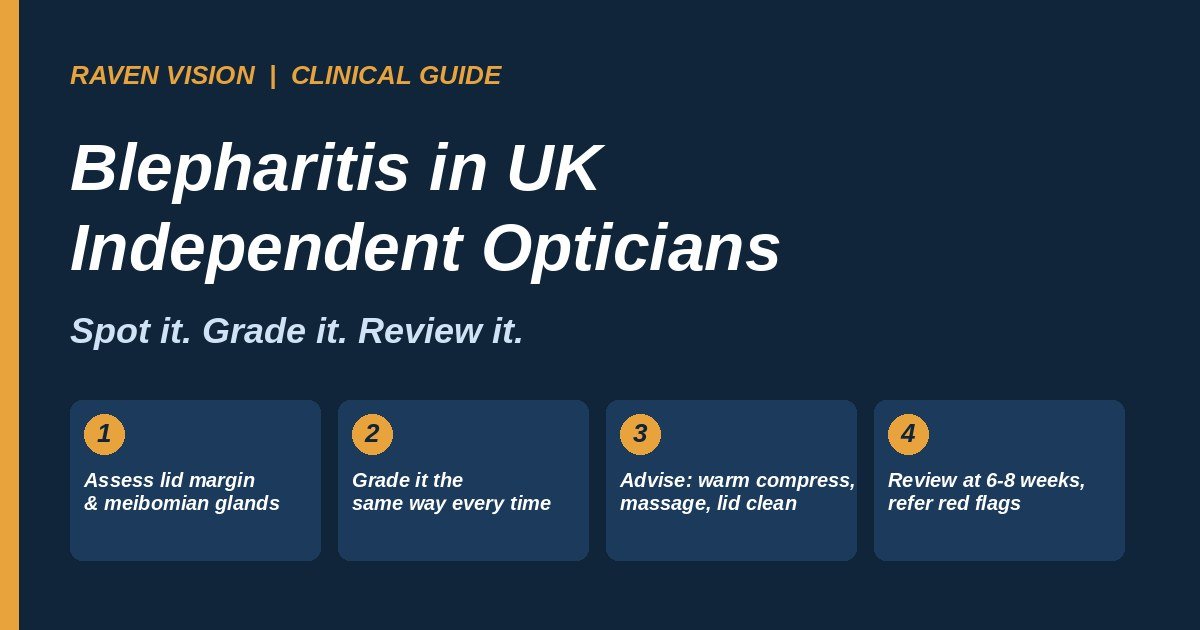
Grade the severity — mild, moderate, or severe — and build a treatment plan around it. This is where you move beyond “try these drops” and into genuine clinical management:
Mild: Lifestyle modifications, optimised artificial tear selection (preservative-free, lipid-based, or hyaluronic acid depending on the subtype), lid hygiene routine with heated eye masks and lid wipes.
Moderate: Everything above, plus in-practice treatments like intense pulsed light (IPL) therapy or thermal pulsation (LipiFlow or similar). Consider anti-inflammatory drops — you’ll need a prescribing optometrist or a referral pathway to an IP optom.
Severe: Combination therapy, punctal plugs, scleral lens referral, and potentially onward referral to ophthalmology for cases that don’t respond to your management.
Follow-Up Structure
This is where the recurring revenue comes in. A typical dry eye patient should be reviewed at 4-6 weeks after initial treatment, then every 3-6 months for ongoing management. Each follow-up is a billable appointment, and it also gives you a natural touchpoint to re-score their symptoms (showing them their improvement) and adjust treatment.
Setting up these review pathways becomes much simpler when your appointment scheduling system lets you book follow-ups directly and send automated reminders. Nothing kills a dry eye clinic faster than patients forgetting to come back.
Equipment: What You Actually Need vs What’s Nice to Have
There’s a wide spectrum of equipment investment here, and it’s easy to get carried away. Here’s a pragmatic breakdown.
Essential (Under £2,000)
You can start a credible dry eye clinic with relatively modest investment. A good slit lamp (which you already have), fluorescein strips and lissamine green for staining assessment, Schirmer’s test strips, a validated symptom questionnaire, and a quality heated eye mask for in-practice demonstrations.
Add a meibomian gland evaluator (like the Meibomian Gland Evaluator by TearScience) for around £200, and you’ve got a solid foundation.
Mid-Range (£5,000-£15,000)
A dedicated meibography device transforms your consultations. Being able to show patients their own gland dropout on screen is worth its weight in gold for patient education and treatment compliance. Devices like the Oculus Keratograph or LipiView fit this bracket.
Thermal pulsation devices for in-practice meibomian gland expression are another step up. These treatments typically cost patients £400-£800 per session and have strong evidence behind them.
Premium (£20,000+)
IPL devices, advanced imaging systems, and combination platforms. These make sense once your clinic is established and generating consistent volume. Don’t start here — build the caseload first.
Pricing Your Dry Eye Service
Pricing is one of those things that independent practice owners consistently undervalue. You’re providing a specialist clinical service, and your pricing should reflect that.
Here’s what the market looks like across UK independent practices running successful dry eye clinics:
Initial comprehensive assessment: £75-£150. This covers your time (30-45 minutes), use of diagnostic equipment, and the treatment plan. Some practices charge £95-£120 as a sweet spot — enough to convey expertise without creating a barrier to entry.
Follow-up appointments: £45-£75 for a 20-minute review with symptom re-scoring and treatment adjustment.
In-practice treatments: IPL sessions at £150-£250 each (typically sold as a course of 3-4), thermal pulsation at £400-£800 per session, and lid debridement at £50-£100.
Product sales: Premium artificial tears, lid care kits, heated eye masks, and omega-3 supplements. Margins on these products are typically 40-60%, and they reinforce the treatment plan between appointments.
Don’t be afraid of these numbers. Patients who are genuinely suffering from dry eye — and have been let down by generic advice — are willing to invest in a solution that works. Your job is to demonstrate clear value through thorough assessment, proper explanation, and measurable outcomes.
Getting Patients Into Your Dry Eye Clinic
You can build the best dry eye service in the country, but it won’t matter if nobody knows about it. Here’s how to fill those appointment slots.
Mine Your Existing Patient Base
This is your single biggest source of dry eye patients, and it requires almost zero marketing spend. Start by screening every sight test patient for dry eye symptoms. A simple two-question screen at pre-test — “Do your eyes ever feel gritty, tired, or watery?” and “Do your symptoms get worse with screen use or in air-conditioned environments?” — will flag a surprising number of candidates.
If your patient records system allows you to tag patients with specific conditions or flags, you can also run a search through existing records to identify patients who’ve previously mentioned dry eye symptoms. A targeted recall letter or email to these patients can kickstart your clinic from day one.
Train Your Whole Team
Your dispensing opticians and reception staff are the front line. Train them to recognise when a patient mentions symptoms — “my eyes are always watering,” “I can’t wear my contacts as long as I used to,” “my eyes feel tired by the afternoon” — and to confidently recommend a dry eye assessment.
This isn’t about upselling. It’s about identifying patients who need help and directing them to the right service. Frame it that way with your team, and they’ll be far more comfortable making the recommendation.
Local Marketing
A dedicated page on your practice website explaining your dry eye service, what it involves, and what patients can expect is essential. Make it easy to book — if your website has an online booking system linked to your appointment diary, even better.
Social media posts showing your equipment, explaining common dry eye myths, and sharing patient testimonials (with consent) build awareness gradually. You don’t need to go viral — you need the 50-year-old woman in your town who’s been suffering for three years to find you when she finally searches “dry eye treatment near me.”
Local GP surgeries are another referral source worth cultivating. Many GPs see dry eye patients regularly and would happily refer to a local optician offering specialist management rather than prescribing yet another course of artificial tears.
Managing the Business Side
Running a dry eye clinic alongside your main practice requires some operational discipline. You need dedicated appointment slots (don’t try to squeeze assessments into sight test gaps), proper stock management for your dry eye product range, and clear billing processes.
This is where having a practice management system that handles private services smoothly becomes genuinely important. You need to be able to book dedicated clinic slots, track product sales alongside clinical appointments, manage follow-up recalls automatically, and pull reports showing your clinic’s revenue and patient volume.
If your current system treats everything as a variation of a sight test, you’ll find yourself fighting it constantly. A system built for the way modern independent practices actually work — with a mix of NHS, private clinical, and retail activity — makes a noticeable difference to how smoothly things run day to day.
Common Mistakes to Avoid
Starting too big. You don’t need £30,000 of equipment on day one. Start with a solid clinical pathway, build your caseload, and reinvest into better equipment as revenue grows.
Undercharging. If your assessment is £30, patients will subconsciously treat it like a £30 service. Price appropriately for the expertise and time you’re providing.
Forgetting the follow-up. A dry eye clinic without a structured recall system is just a series of one-off appointments. The value — clinical and commercial — is in the ongoing relationship.
Not tracking outcomes. If you can’t show a patient that their OSDI score has dropped from 45 to 18 over six months, you’re missing the most powerful retention tool you have. Symptom scores before and after treatment are your proof that what you’re doing works.
Keeping it to yourself. If only the optometrist knows about the dry eye clinic, it won’t grow. Everyone in the practice — from reception to the dispensing floor — should know what you offer and who it’s for.
The Bottom Line
Setting up a dry eye clinic isn’t just about adding another service to your list. It’s about properly serving a patient need that’s been underserved for years, building a revenue stream that isn’t dependent on NHS fee scales, and creating a genuine point of difference for your practice.
The clinical demand is already there in your patient base. The question is whether you’re set up to identify it, manage it, and grow it.
If you’re looking for practice management software that supports private clinics alongside your NHS work — with proper appointment scheduling, patient records, and automated recalls — book a demo with Raven Vision. It’s built by opticians who’ve done exactly this in their own practices, and it starts at £149/month with three months free.