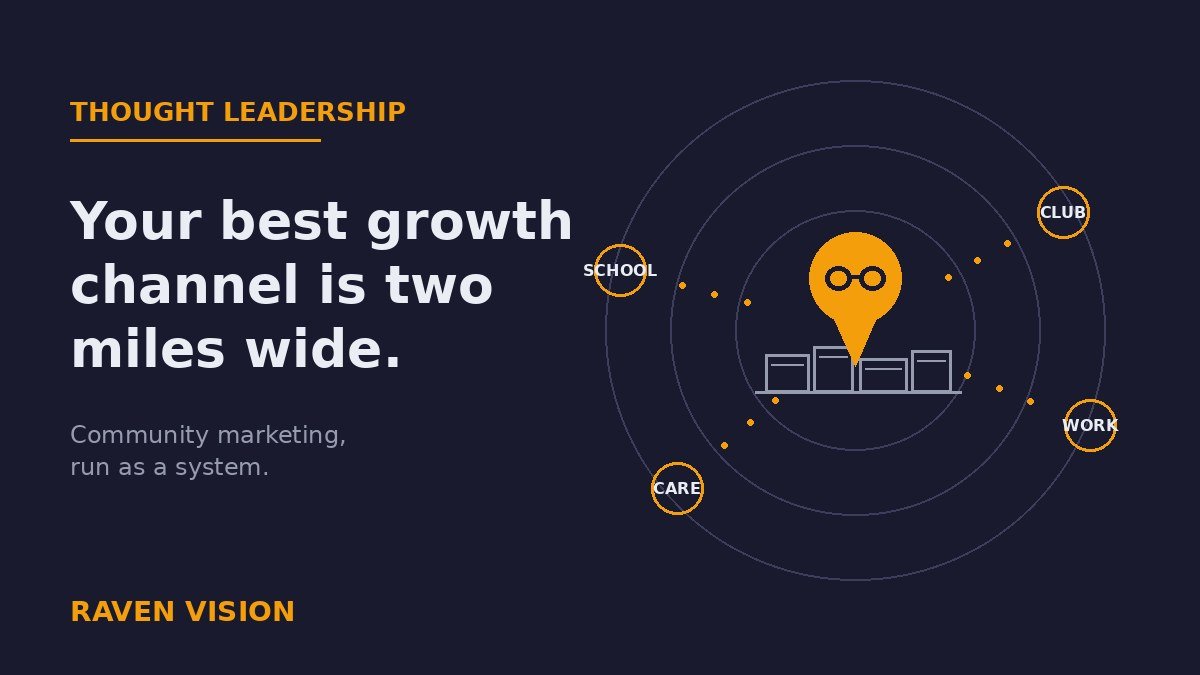

Ask most marketing agencies how an independent optician should grow and you’ll get the same answer they give everyone: run Facebook ads, post on Instagram, do some SEO. None of it is wrong. But it quietly ignores the one advantage you have that Specsavers can’t buy — you’re from somewhere. Your practice sits on a real street, in a real town, surrounded by schools, sports clubs, employers and families who walk past your window every week.
Community marketing isn’t the nostalgic option. For a UK independent optician in 2026, it’s the highest-trust, lowest-cost growth channel you have — and almost nobody runs it as a system.
The two-mile truth
Pull up your patient records and look at the postcodes. For most independent practices, the overwhelming majority of patients live or work within a couple of miles of the door. You’re not competing for the UK eyewear market. You’re competing for one town — sometimes one end of one high street.
That changes the maths completely. A national chain has to buy attention at scale. You need a few thousand local people to know your name, and a few hundred of them to trust it. Those are community-sized numbers, and community-sized numbers respond to community-sized marketing.
The evidence backs this up. Nielsen’s global trust research — 40,000 consumers across 56 countries — found that 88% of people trust recommendations from people they know above every other form of marketing. McKinsey puts word of mouth behind 20–50% of all purchasing decisions. No ad budget gets you that. Being known and liked locally does.
Independents are pushing at an open door
Here’s the part that should give you real confidence: the British public is actively rooting for you. Recent UK high street research found 85% of Brits want to see more independent businesses on their high street, and 45% now visit their local high street at least once a week. When shoppers were asked why they choose independents, 61% said it was the personality of the business — the people, not the prices.
Think about what that means. The sentiment is already there. Most independents just never give their town a reason, or a reminder, to act on it. Community marketing is simply the discipline of showing up where that goodwill already lives.
It also sidesteps the game you can’t win. We’ve written before about why competing on price is a losing strategy for independents — the chains will always out-discount you. But they can’t out-local you. A multiple’s branch manager didn’t test three generations of the same family. You might have.
What community marketing actually looks like
Sponsoring the local under-11s shirts and hoping is not a strategy. Done properly, community marketing has three layers, and they work together.
1. Be findable in your town
Community marketing starts online, whether you like it or not. Around 46% of all Google searches now have local intent, and 76% of people who run a “near me” search on their phone visit a business within a day. When someone in your town searches “optician near me” or “eye test [your town]”, the practices that show up are the ones with a complete Google Business Profile, accurate opening hours, photos of real staff, and a steady stream of recent reviews.
That last one matters most, because reviews are word of mouth at scale — your happiest patients vouching for you in public. If you haven’t already built a routine around asking for them, start with our guide to building a Google reviews system that brings in new patients. It’s the single highest-leverage piece of local visibility work an independent can do.
2. Be present where your town gathers
This is the layer most practices either skip or do randomly. The aim isn’t exposure — it’s repeated, useful presence in places where trust forms:
- Schools. Offer a free “healthy eyes” assembly or a myopia awareness session for parents’ evenings. Every child who needs a first eye test comes with a family attached, and parents talk to other parents.
- Sports clubs. Sponsorship works better than most people assume — Nielsen found 81% of consumers trust brand sponsorships at sporting events. But pair the shirt with something real: a free vision screening evening for members, or a talk on eye protection for the cricket club.
- Local employers. Every office in your town has staff entitled to DSE eye tests, and most employers handle it badly. One letter offering a simple corporate eye care arrangement can open a pipeline of dozens of working-age patients.
- Care homes and community groups. A twenty-minute talk on cataracts, AMD or falls prevention positions you as the town’s eye expert with exactly the audience that needs regular eye care.
None of this costs much. All of it compounds, because the same faces see you in different trusted contexts — and familiarity plus usefulness is how a name becomes the optician in town.
3. Be the local voice on eye health
Local journalists and community Facebook groups constantly need content. A short piece in the town paper on children’s screen time, a quote during National Eye Health Week, a post explaining what that new symptom might mean — each one is a small deposit into the “they’re the experts here” account. You’re not selling. You’re being visibly knowledgeable, which for a clinical business is the best selling there is.
The compounding effect nobody talks about
Here’s why community marketing beats paid channels over time: ads stop working the moment you stop paying. Community presence accumulates.
The family you tested after a school talk joins your recall list. They leave a review. Their neighbour sees it when searching “optician near me”. The neighbour books, mentions the cricket club banner, and three years later brings their teenager in for a first contact lens fit. Every patient your community work brings in becomes an asset that keeps producing — which is exactly the argument we made in why your patient list is the real business asset.
The chains can replicate your frames, your offers, even your prices. They can’t replicate fifteen years of showing up at the summer fair.
A 90-day community marketing plan
You don’t need a marketing department. You need a rhythm. Here’s a realistic starting plan for a small team:
Month one — foundations. Audit your Google Business Profile until it’s complete and current. Set up your review-request routine at the desk. Pull a postcode report from your practice system so you know exactly where your patients actually come from — that’s your true catchment, and it’s where every following action happens.
Month two — pick two partnerships. One school, one club or employer. Not five. Make contact, offer something genuinely useful (a talk, a screening evening, a DSE arrangement), and deliver it well. Depth beats breadth; a partnership that renews annually is worth ten one-off banners.
Month three — make it visible. Photograph the talk, thank the club publicly, post it, send it to the local paper. Then book the next quarter’s two activities before momentum fades. From here, community marketing is a repeating 90-day loop, not a campaign.
An hour or two a week, sustained for a year, will outperform almost any ad spend an independent can afford.
How you know it’s working
This is where most community marketing quietly dies — nobody measures it, so nobody defends the time it takes. The fix is one question, asked at every new-patient booking and recorded every time: “How did you hear about us?”
Your practice management system should let the front desk capture the source on the patient record in seconds, so that six months in you can see plainly: eight new patients from the school talk, five from the cricket club, nineteen who mentioned reviews. Suddenly the fair stall isn’t a nice gesture — it’s a channel with a cost per new patient you can compare against anything digital.
And because community-won patients are trust-rich from day one, they respond unusually well to a proper recall system. Getting them back at the right interval, automatically, is what turns a good first impression into a decade of loyalty — and lets one afternoon at a school assembly keep paying you back for years.
Built for practices that grow this way
Raven Vision was built inside our co-founder Shaukat’s three independent practices — practices that grew exactly this way, on referrals, reputation and community presence, over 35 years. That’s why the things community marketing depends on aren’t add-ons in RV: patient source tracking, automated recall, online booking your new patients can use the moment they’ve heard your name at the club.
It’s £149 a month with three months free, free data migration, and a free practice website with booking built in — so when your town goes looking for you, they find you, and they can book there and then. See full pricing here, or book a demo and we’ll show you how practices like yours turn local goodwill into a full diary.
Your next hundred patients aren’t scrolling past a national ad. They’re two miles away, wishing their high street had more businesses like yours. Go and meet them.