
Ask an independent optician how their day ends and you’ll usually get one of two answers. Either there’s a proper cash-up — count the drawer, run the card terminal totals, check them against the system, chase anything that doesn’t match — or there’s a vague ritual where someone counts the notes, shrugs at a small difference, and locks the door. The second version feels harmless. It isn’t. It’s how small leaks stay invisible for months.
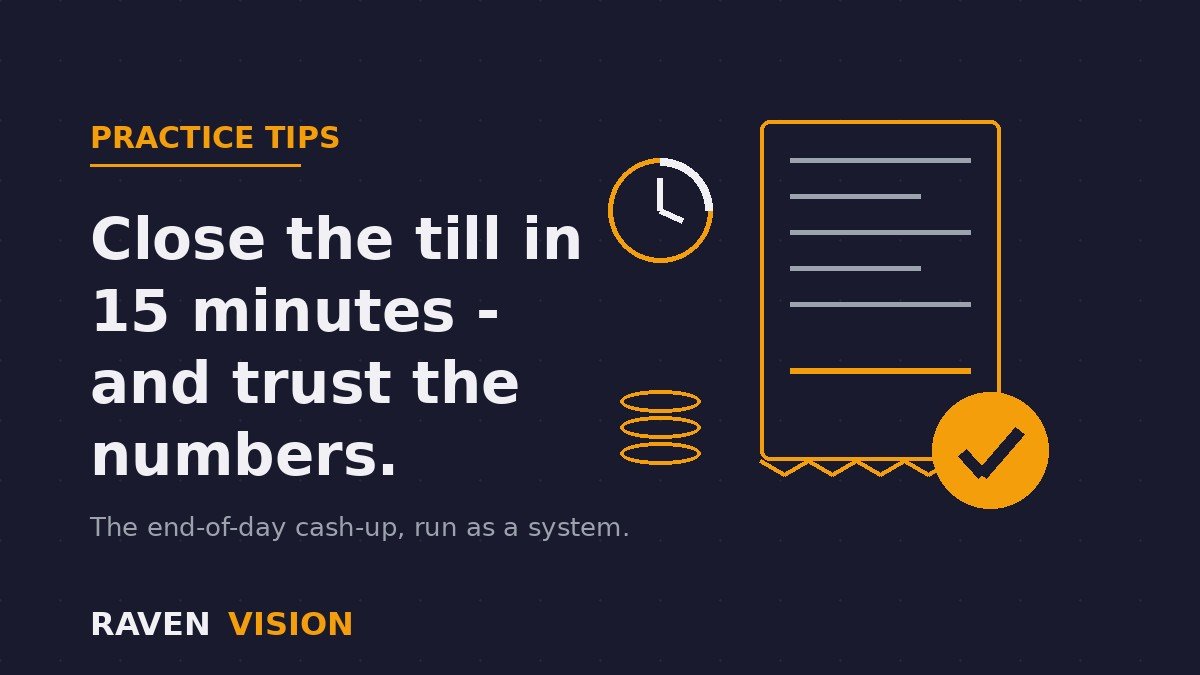
This is a practical guide to the end-of-day cash-up for UK independent optician practices: what it actually needs to cover (which is more than most retail guides assume), a 15-minute routine your team can run every evening, and what to do when the numbers don’t agree.
Why bother, when hardly anyone pays cash any more?
It’s a fair question. According to UK Finance’s Payment Markets report, cash fell to 4.4 billion payments in 2024 — just 9% of all UK payments, the first time it’s dropped below one in ten. Their forecast has it at around 4% by 2034. In most practices, the drawer at 5:30pm holds a modest float and a handful of notes.
But the cash-up was never really about cash. It’s the daily moment where you confirm that everything the practice sold, took, banked and promised today agrees with itself. The card terminal, the till, the patient records, the GOS claims, the deposits taken on new spectacles — the end-of-day routine is where those five stories get compared. Cash is now the smallest character in that story. The routine matters more than ever precisely because the money arrives through more channels than it used to.
Skip it, and discrepancies don’t disappear. They accumulate quietly until your accountant finds them in eleven months, by which point nobody can remember anything about a £40 difference from a wet Tuesday in March.
Why an optician’s cash-up is harder than a shop’s
Most cash-up guides are written for cafés and retailers: count the drawer, match it to the till report, done. An optical practice has four complications a coffee shop never sees.
Money arrives in pieces
A £380 dispense is rarely one payment. It’s a £100 deposit today, the balance on collection in ten days, and occasionally a remote payment over the phone in between. On any given day, your takings include deposits for work you haven’t finished and balances for work you sold weeks ago. If your end-of-day only looks at “sales today”, it’s reconciling a number that doesn’t exist.
NHS money isn’t till money
GOS sight test fees and voucher payments don’t come through the drawer or the terminal — they arrive from the NHS weeks later, and only if the claim was submitted and accepted. A practice doing a healthy mix of NHS work has a meaningful chunk of every day’s earnings that never touches the till. It still needs to be recorded, claimed and eventually matched against the NHS statement. (We’ve written before about cutting GOS claim rejections — the end-of-day check is where unclaimed tests get caught while they’re still fresh.)
Patient balances are a ledger, not a line
Every deposit creates a balance owed. Every collection should clear one. If those two movements aren’t tracked properly, you end up with the classic optical mystery: a drawer that balances perfectly while the patient account ledger quietly drifts out of true.
Small teams, shared tills
In a practice with three or four staff, everyone touches the till. That’s normal — but it means a discrepancy has no obvious owner unless your system records who processed what.
The 15-minute end-of-day routine
Here’s a routine sized for an independent practice. Run at close, it takes about fifteen minutes once it’s habit.
1. Count the drawer blind (3 minutes)
Whoever counts the cash should do it before looking at what the system says should be there. Count it, write it down, then compare. If the counter knows the target figure first, small differences get unconsciously “found”. A blind count keeps everyone honest — including the till.
2. Settle the card terminal and match it (3 minutes)
Run the end-of-day settlement on your card machine and compare the terminal total against the card payments your practice system recorded. These two numbers should agree to the penny. When they don’t, it’s almost always a payment taken on the terminal but never entered in the system — which means a patient record somewhere shows a balance that’s already been paid, and a follow-up call that will annoy someone.
3. Check today’s deposits and collections (3 minutes)
Pull the day’s list of deposits taken and balances collected. Does every collection today have its balance cleared on the patient account? Does every new order have its deposit recorded against the right patient? This is the step retail guides skip and optical practices need most.
4. Confirm today’s GOS tests are claim-ready (2 minutes)
Every NHS sight test done today should have a claim either submitted or queued. Checking daily takes two minutes; discovering unclaimed tests at month-end takes an afternoon and costs real money.
5. Log the result — including “perfect” (2 minutes)
Record the outcome somewhere permanent: date, counted cash, expected cash, card total, discrepancy, initials. A run of clean days is information too. When a difference does appear, a log turns “the till’s been off lately” into “the till has been exactly £10 short on three Thursdays running” — which is a solvable problem.
6. Set tomorrow’s float (2 minutes)
Restore the float to a fixed amount, bag the surplus for banking, and note the banking figure. A fixed float is the quiet hero of easy cash-ups: when the starting point never changes, the maths never gets creative.
When the numbers don’t match: the five usual suspects
A discrepancy is a message. Decoding it is faster when you know the common causes, roughly in order of likelihood:
The unrecorded payment. Card terminal shows more than the system. Someone took a payment in a rush and never entered it. Harmless-looking, but it leaves a paid patient showing as a debtor.
The wrong-method entry. Cash recorded as card, or vice versa. Total takings are right, but both individual reconciliations fail. If cash is over by exactly the amount card is under, this is your culprit.
The deposit that went walkabout. A deposit taken but recorded against the wrong patient — or not at all. The drawer balances today; the argument happens at collection.
The refund without a record. Refunds processed on the terminal but not entered in the system are the mirror image of unrecorded payments, and just as corrosive.
The genuine loss. Rare, but real. This is the uncomfortable one, and it’s exactly why the blind count, the log and the named operator matter. A pattern in the log protects your honest staff — which is nearly all of them — by making the exception visible quickly.
Whatever the cause, the rule is the same: investigate on the day or write it off consciously. What you shouldn’t do is let unexplained differences ride for weeks. Accountants who work with optical practices reckon proper bookkeeping already takes 5–15 hours a week; unexplained till drift is the fastest way to push that number up.
The weekly layer: banking and balances
The daily routine keeps each day honest. Two short weekly checks keep the month honest.
Banking check. Once a week, confirm that the cash you bagged for banking actually shows up on the bank statement, on the dates and in the amounts your log says. Five minutes with the log next to online banking.
Outstanding balances review. Pull the list of patients with unpaid balances and uncollected orders. Anything older than two or three weeks needs a nudge — a reminder message, a phone call. Uncollected spectacles are finished stock sitting in a drawer with your cash inside them; we’ve covered the uncollected glasses problem in its own right, and the weekly balance review is where that system plugs in.
Making it stick in a small team
Routines fail when they depend on one person’s memory. Three things make this one durable:
Name an owner per day. The closer does the cash-up. Not “whoever’s free” — the rota says whose initials go in the log tonight.
Keep the ritual identical. Same order, same log, same float, every day including Saturdays. Variation is where errors breed.
Make Monday the audit. The owner or manager glances over the week’s log every Monday morning. Thirty seconds when everything’s clean. The point isn’t suspicion — it’s that a log nobody reads stops being kept properly within a month.
The software test hiding inside the cash-up
Here’s the quiet truth: how long your cash-up takes is one of the most honest reviews of your practice software you’ll ever get.
If your team is adding up paper day-sheets, cross-referencing a card terminal against a separate till, and keeping patient balances in a diary or a spreadsheet, the end-of-day takes forty minutes and gets skipped when the practice is busy — which is exactly when errors happen. If your billing and payments live in the same system as your patient records, the day’s takings by payment method, the deposits and balances, and the GOS claim status are already on one screen, and the routine above genuinely fits in fifteen minutes.
That’s how Raven Vision handles it — not because we set out to build a reconciliation feature, but because the software was built inside our co-founder Shaukat’s own three practices, where somebody had to cash up every single evening for thirty-five years. Takings, deposits, balances and claims sit against the patient record where they belong, so the end of the day is a check, not an archaeology dig. It’s all part of the standard system at £149 a month — no separate finance module, with 3 months free and free data migration when you switch.
Start tomorrow evening
You don’t need new software to start — you need the routine. Fix your float, print a simple log sheet, and run the six steps tomorrow at close. Within a fortnight you’ll know exactly how honest your numbers have been.
And if step two, three or four turns out to be the slow part — if matching payments to patients is where the fifteen minutes becomes forty — that’s your system telling you something. Book a demo and we’ll show you what the end of the day looks like when everything reconciles itself, or see exactly what’s included in the £149 monthly price.