

Most independent practice owners have a number in their head. It usually comes from a conversation at a conference, a figure a colleague mentioned when they sold up, or a rough multiple of turnover someone’s accountant threw out years ago. And most of the time, that number is wrong — sometimes by a factor of two or three, in either direction.
That matters more than it used to. The optical sector is consolidating fast. Hakim Group alone has brought more than 500 independent practices into its family since 2005, and in 2025 took on ICG as an additional private equity backer alongside All Seas Capital specifically to accelerate acquisitions. At one point the group bought ten businesses in a single day. If you own a decent independent practice in the UK, the odds are good that at some stage someone will ask what you’d take for it.
You don’t have to want to sell. But you should know the number, and more importantly, you should know what moves it. Because the things that make a practice valuable to a buyer are, almost without exception, the same things that make it better to own.
Why knowing the number matters even if you’re never selling
Sales are the obvious trigger for a valuation, but they’re not the only one. Practice owners commission valuations for tax planning and company restructuring, for financial planning and understanding personal net worth, for employee incentive schemes like EMI that lock a good optometrist in for the long term, and for staged handovers to family or existing staff.
Then there are the reasons nobody wants: partnership disputes, divorce, probate. Those situations arrive without warning, and the owner who has never had the business valued is negotiating in the dark.
There’s also a quieter argument. A valuation is one of the few genuinely honest health checks a practice ever gets. It forces someone independent to look at three years of accounts, chair time utilisation, revenue split across clinical and dispensing, staff costs, lease terms and owner dependency — and put a price on the result. Owners often find the exercise more useful than the figure.
How UK optical practices are actually valued
Forget the rules of thumb. Applying a ratio to annual turnover is a crude approach that produces wildly inaccurate figures, because two practices with identical revenue can have completely different underlying economics. In practice there are two credible methods used in the UK optical sector: a yield-based valuation for profitable practices, and an asset-based valuation for very small lifestyle practices or larger businesses that are loss-making or only marginally profitable.
Almost every established independent falls into the first category. And the yield-based approach is a two-step process that a lot of owners have never had explained properly.
Step one: normalising the accounts
Your published accounts don’t show what your practice really earns. That’s not an accusation — it’s how accounts work. They’re prepared to be tax-efficient, which means the stated net profit is usually well below the true underlying profit a buyer would inherit.
Normalisation strips that back out. The classic example: two practices both turning over £550,000. Practice A shows £50,000 net profit, Practice B shows £100,000. On paper, B looks like the better business. But A’s two directors each draw a maximum annual pension contribution of £60,000 before profit is calculated. Add that £120,000 back and Practice A’s adjusted profit is £170,000 against Practice B’s £100,000. The apparently weaker business is worth substantially more.
In reality it’s rarely one adjustment. A proper normalisation typically involves somewhere between five and ten changes: pension contributions, owner’s cars, personal expenses running through the business, one-off costs, and — the trickiest one — replacing the owner’s drawings with a realistic open-market salary, split between their clinical chair time and their management time. Get that split wrong and the error is amplified in step two.
What comes out the other end is your EBITDA: earnings before interest, tax, depreciation and amortisation. That’s the number buyers actually price.
Step two: applying a multiple
Then a multiple gets applied to that EBITDA. And here’s where owners get a shock, because the range in UK optical is enormous — anywhere from around 2 at the very low end to 8 at the extreme high end, with most independent practices landing somewhere in the 2 to 5 band.
Run the maths on a practice with £100,000 of genuine EBITDA and you can see why this is the whole ballgame:
- ×2 = £200,000
- ×3 = £300,000
- ×4 = £400,000
- ×5 = £500,000
Same practice. Same profit. A £300,000 swing in what you walk away with. Two owners with identical EBITDA can end up in completely different financial positions purely on the strength of how repeatable, transferable and low-risk their earnings look to a buyer.
Why the range is so wide in optics specifically
Part of it is structural. England, Scotland and Wales have genuinely different service mandates and remuneration structures, and within England there’s an ICS-level postcode lottery on what services a practice can deliver and what it gets paid for them. Since the pandemic, an unprecedented number of independents have either torn up the GOS contract entirely or moved to some form of hybrid model. Add the growing number of practices bolting on audiology and you’ve got a sector that arguably isn’t one market any more — it’s a market of markets, each priced differently.
The rest of it is you. The multiple reflects how confident a buyer is that the profit will still be there in year three without you standing in the building. That confidence is built — or destroyed — by a handful of specific things.
The five things that actually move your multiple
1. How much of the profit walks out the door with you
This is the big one, and it’s the one owners least want to hear. Perceived reliance on the owner — what valuers call personal goodwill — is a direct drag on the multiple. If patients book to see you, if you’re the only one who knows the supplier terms, if the practice’s reputation is your reputation, then a buyer is being asked to purchase something that may evaporate on completion day.
The fix isn’t complicated, but it takes years: build a clinical team patients trust, document how the practice actually runs, get the diary spread across more than one pair of hands. We’ve written before about why your practice shouldn’t need you every day — the valuation argument is simply the same case with a price tag attached.
2. The trend, not the year
Valuers look at the last three financial years, not the best one. A practice doing £120,000 EBITDA on the way up from £80,000 prices very differently from one doing £120,000 on the way down from £160,000, even though this year’s figure is identical.
Which means the worst possible time to start caring about value is the year you decide to sell. Cutting marketing, letting recall slip and squeezing costs to flatter one set of accounts is transparent to anyone who reads three years side by side — and it damages the trend that actually sets the multiple.
3. Revenue that repeats without being chased
Anticipated repeatability of future profits is one of the core factors in the multiple. Nothing demonstrates repeatability like a large, active, well-managed patient base coming back on schedule, and a contact lens base paying by direct debit every month.
A buyer can see the difference between a practice with 6,000 patients on file and one with 6,000 patients on a working recall cycle. The first is a list. The second is revenue. We’ve made this argument at length in why your patient list is your practice’s most valuable asset, and it holds up under diligence better than almost anything else on the balance sheet.
4. Whether your numbers survive contact with a buyer
Here’s the part nobody warns you about. A valuation needs three years of full accounts, recent management figures, a schedule of fixtures and equipment, analysis of chair time utilisation per service, revenue broken down by clinical and dispensing cost centres, trends in clinical procedures, staffing costs, and a review of your own time input.
If pulling that together means a fortnight of evenings, a shoebox of paper and three phone calls to your software supplier, that tells the buyer something — and it’s not flattering. Practices where the data comes out clean, quickly and consistently signal a business that’s been run deliberately. Practices where it doesn’t invite a discount, because every gap a buyer can’t verify is a risk they’ll price in.
This is where the quality of your practice management system stops being an operational question and becomes a financial one. Clean patient records, honest revenue and billing reporting, and stock figures you’d actually stand behind are worth real money at the point of sale.
5. The unglamorous stuff
Security of tenure matters — a practice with eighteen months left on a lease and no renewal right is a materially riskier purchase than the same practice with a decade of certainty. So does the quality and age of your shop fit and equipment, your catchment population and demographic, the level of local competition, and whether you’ve built a genuine clinical specialism that differentiates you.
None of it is exciting. All of it is priced.
Who’s actually buying in 2026
The buyer pool has changed, and it affects what you should expect. There are still individual buyers — often salaried optometrists making the jump to ownership, typically funding a single practice and usually the right buyer for smaller businesses. Asking prices across the UK independent market commonly run from below £25,000 to around £500,000, occasionally higher.
Then there are the groups. Consolidators backed by institutional capital are actively hunting for practices to add to their platform, and they price differently: they’re buying earnings they can integrate, so they care more about clean numbers, transferable relationships and low owner dependency, and less about whether they like the shop fit.
Being approached isn’t the same as being valued. An unsolicited offer from a group is an opening position, not a market price, and the owner who hasn’t done the work to know their own number has no way of judging it. Worth adding: across a large sample of completed UK optical sales, the average time from offer acceptance to completion runs to around sixteen weeks. This is not a decision you make in an afternoon.
The three-year version, and the three-month version
If you’re three or more years from any kind of exit, the plan is simple and slow. Fix owner dependency first, because it takes longest. Build the recall engine so revenue repeats without heroics. Get your reporting into a state where any question about the business can be answered in ten minutes. Then let three years of improving accounts do the talking.
If you’re closer than that, or you’ve just been approached, the priority list shrinks. Get a proper independent valuation from someone who specialises in optical — not a general accountant, and definitely not one of the free instant online valuation tools, which exist to capture your contact details rather than to tell you anything true. Sort your lease. Clean up your data. And resist the temptation to run the business differently for twelve months in the hope of flattering one set of figures.
The overlap between those two lists is the interesting bit. Nearly everything that raises your multiple also raises your income while you still own the place. A practice with low owner dependency gives you your Thursdays back. A working recall system smooths the diary. Reporting you trust makes every decision faster. You’d want all of it even if you planned to die at the slit lamp aged ninety.
Build for value, not for exit
That’s the real argument. Owners tend to treat practice value as an end-of-career problem, something to think about once the decision to leave has been made. By then most of the levers have already stopped moving. The multiple has been set by ten years of habits.
Treat value as a running score instead — a number you check every couple of years the same way you’d recall a patient — and it changes what you prioritise on an ordinary Tuesday. It stops uncollected jobs and lapsed recalls looking like admin irritations and starts making them look like what they are: money coming off your final number.
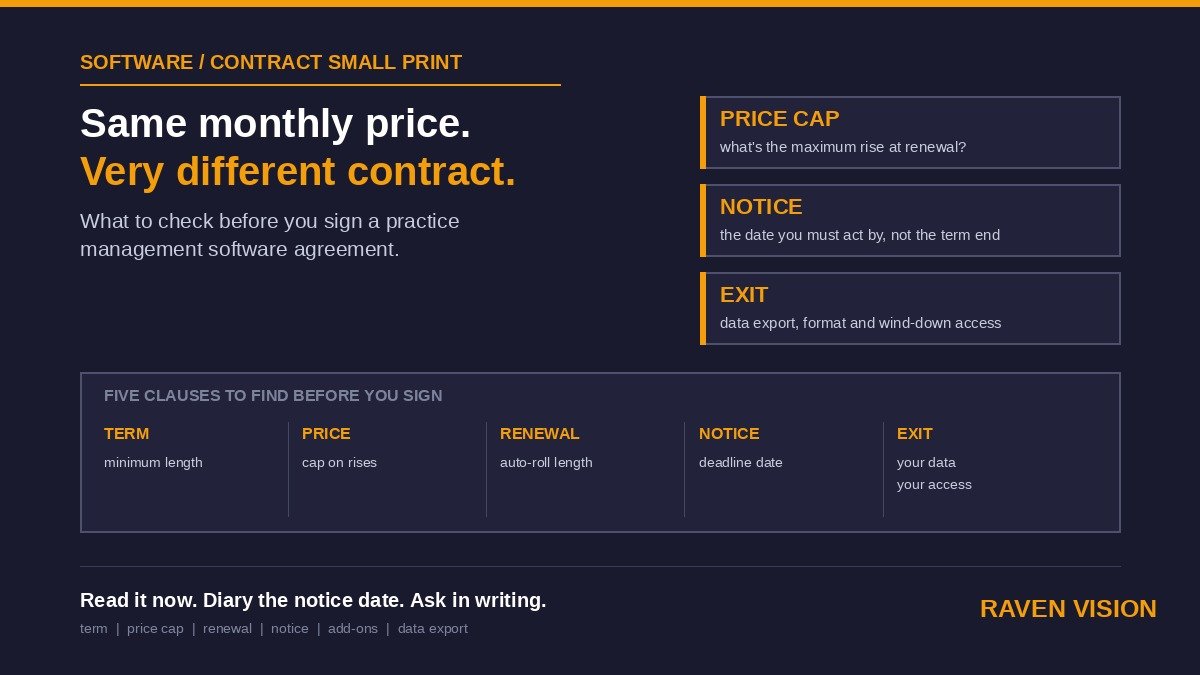
Raven Vision was built inside working practices for exactly this reason. Our co-founder Shaukat has been an optometrist for over 35 years and runs three practices of his own, so the system was designed around the questions owners actually ask — what did we bill this month, who’s due back, what’s sitting in the collection drawer, where’s the stock — rather than around a software company’s idea of what a practice needs. All of it comes in at £149 per month per location, with everything included, free data migration, and no lock-in contract.
If the last few sections made you realise you couldn’t answer those questions quickly today, that’s worth fixing regardless of whether you ever sell. Book a demo and we’ll show you what the reporting looks like on a real practice, or take a look at what’s included at £149 a month.
Your practice is probably worth more than you think, or less. The only way to find out is to look — and the looking is where all the useful stuff happens anyway.