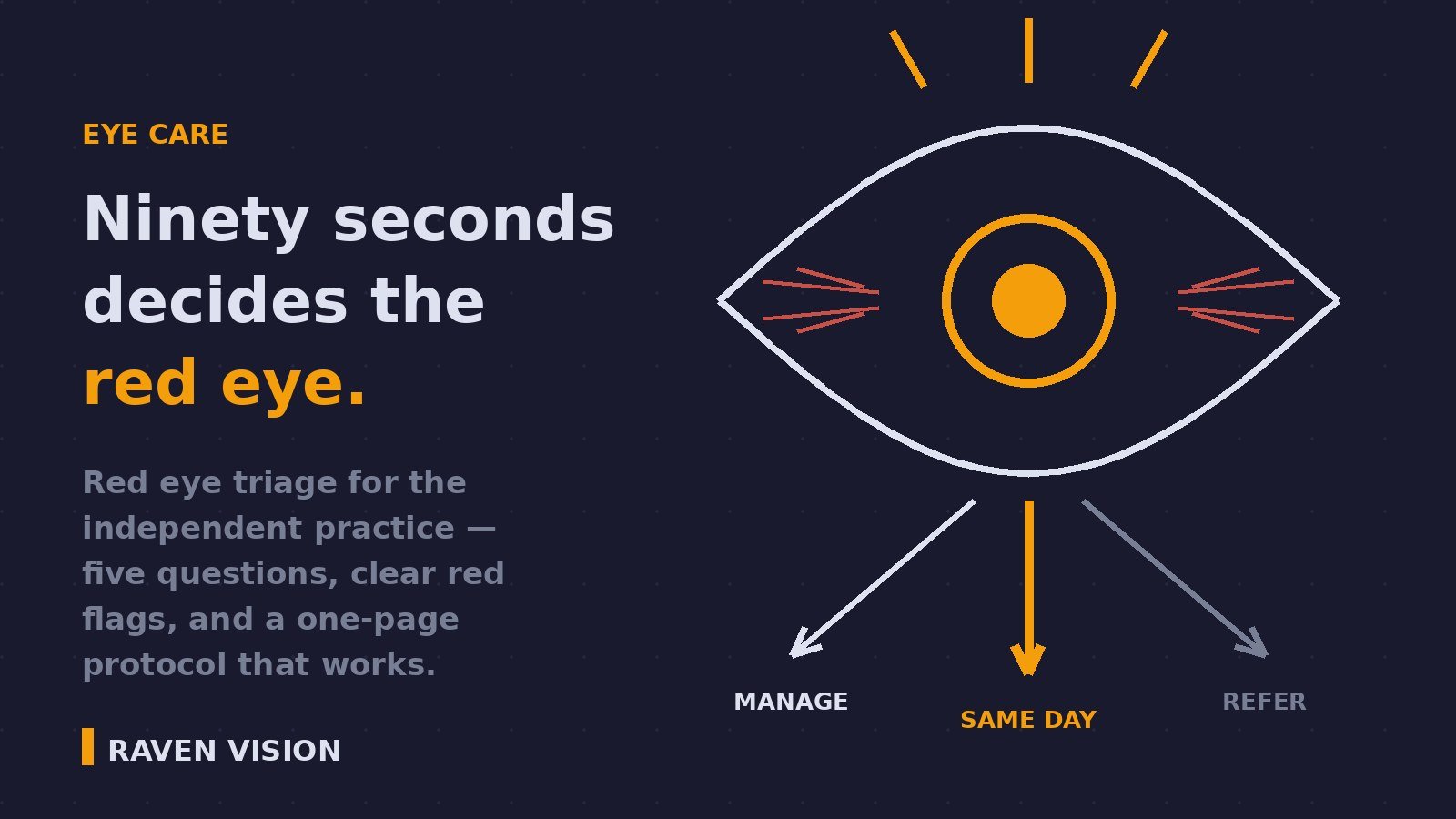

Someone rings at ten past nine: “My eye’s gone red and it really hurts.” Or they walk in off the street, hand over their eye, and look at your receptionist expectantly. Every UK optician practice gets these calls, every week. What happens in the next ninety seconds decides a lot — whether that patient gets seen safely, whether a sight-threatening condition gets caught in time, and whether your diary survives the day.
Most independent practices handle red eye presentations on instinct. The optometrist squeezes them in, or the front desk sends them to the pharmacy, or — worst case — to A&E, where they’ll wait four hours to be told it’s viral conjunctivitis. Instinct works until it doesn’t. A written red eye triage protocol takes an afternoon to build and removes the guesswork for good. Here’s how to do it.
Why the red eye keeps landing on your doorstep
Acute eye problems are a genuinely big slice of front-line healthcare. Eye-related issues account for roughly 1–2% of all GP consultations, and red eye specifically makes up as much as 1–4% of primary care presentations. At the hospital end, eye problems account for around 6% of all A&E attendances in the UK — and studies suggest 30–37% of those attending eye casualty or general A&E could have been managed in the community.
Meanwhile, GPs consistently report low confidence managing eye conditions. They don’t have slit lamps. They don’t have fluorescein routinely to hand. Which means when a patient calls their surgery about a painful red eye, an increasing number of GP receptionists say the sensible thing: “Go and see an optician.”
That’s not a burden. It’s an opportunity — a Welsh population-based study of acute eyecare episodes found optometrists were already managing over half of them. And evaluations of optometry-led urgent care schemes in England found between 75% and 97% of acute presentations were fully managed in the practice without onward referral. You are, whether you planned it or not, the front door for acute eye care in your town. The only question is whether you’re set up for it.
The real triage problem starts at the front desk
Here’s the uncomfortable bit. In most independent practices, the first clinical decision of the day isn’t made by a clinician. It’s made by whoever answers the phone.
Your receptionist hears “red eye” and has to decide: book a routine slot next Tuesday? Interrupt the optometrist mid-test? Tell them to try the pharmacy? Send them to A&E? Without a protocol, that decision depends on who’s on the desk, how busy the diary looks, and how worried the patient sounds. A stoic patient with early angle closure gets Tuesday. An anxious patient with mild allergic conjunctivitis gets squeezed in as an emergency. Both decisions are wrong, and neither is the receptionist’s fault.
The fix isn’t training your front desk to diagnose — that’s not their job and shouldn’t be. The fix is giving them a short, fixed set of questions with unambiguous rules about what happens next.
The five questions that sort almost everything
A front-desk red eye script doesn’t need to be clever. It needs to be consistent. Five questions cover the ground:
1. Is there pain — real pain, or grittiness?
Teach the distinction. “Sore and gritty like sand” points one way; “aching, deep, or throbbing pain” points somewhere much more serious. Deep pain moves the call up the urgency ladder immediately.
2. Has your vision changed?
Any reported drop in vision alongside a red eye is a same-day conversation with a clinician, no exceptions.
3. Does light hurt your eye?
Photophobia is the question front desks most often skip, and it’s the one that flags uveitis and keratitis. Two seconds to ask.
4. Do you wear contact lenses?
A painful red eye in a contact lens wearer is microbial keratitis until proven otherwise. This single question changes the urgency of everything else the patient has said.
5. Has anything gone into the eye, or hit it?
Trauma, chemicals, grinding metal, gardening injuries — anything with a mechanism gets escalated, and chemical splash means irrigate now and phone for advice, not “we can see you at 3pm.”
Any yes to questions 1–5 (beyond mild grittiness) means the call is handed to a clinician or the patient is booked into a same-day slot. All noes? Book them in within a reasonable window, with safety-netting advice: “If the pain gets worse, your vision changes, or light starts to hurt, call us straight back.”
Know your red flags — and your referral clock
Behind the front-desk script sits the clinical layer, and here the College of Optometrists’ urgency of referrals guidance does the heavy lifting. It’s worth pinning the logic to your consulting room wall:
- Emergency (same hour): suspected acute angle closure glaucoma, chemical injury, penetrating trauma. These go to the hospital eye service by phone, not by letter.
- Within 24 hours: suspected infective keratitis, scleritis, anterior uveitis. Painful red eyes with photophobia or reduced vision live here.
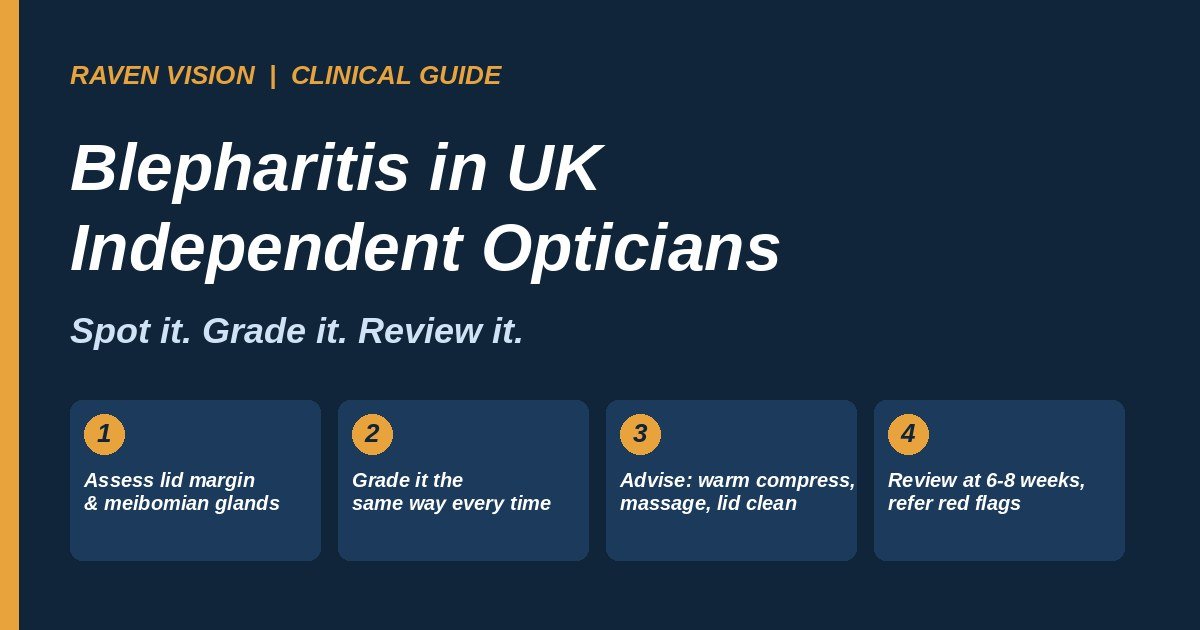
- Manage in practice: bacterial, viral and allergic conjunctivitis, dry eye flare-ups, episcleritis, subconjunctival haemorrhage, blepharitis — the large majority of what actually walks through the door.
That last category is the point worth dwelling on. The evidence from optometry-led urgent care schemes is consistent: three-quarters or more of acute presentations end in the practice, with advice, drops, or reassurance. You’re not a sorting office for the hospital. You’re the place most of these patients get fixed.
With or without CUES, you need your own protocol
If your area commissions a Community Urgent Eyecare Service, some of this structure arrives ready-made — NHS-funded urgent appointments, a triage pathway, a referral route. We’ve written before about what CUES means for UK independents and why joining is usually worth it.
But CUES coverage is patchy, and even inside a CUES area the service doesn’t answer your phone for you. Your front desk still takes the first call. Your diary still has to absorb the same-day appointment. Your optometrist still makes the referral decision at the slit lamp. A practice protocol isn’t an alternative to CUES — it’s the thing that makes you good at it. And if you’re outside a commissioned area, it’s the difference between turning urgent patients away and quietly becoming the town’s eye casualty of first resort, on your own terms and your own private fees.
Writing the one-page protocol
Keep it to a single laminated page at the front desk. Yours should cover:
- The five questions, word for word, with tick boxes.
- The escalation rule: which answers interrupt the optometrist, which book a same-day slot, which book routine with safety-netting.
- The A&E shortlist: the small number of scenarios (chemical splash, significant trauma, sudden vision loss with pain) that bypass the practice entirely — with the local eye casualty phone number printed on the page.
- What to write down: name, number, CL wearer yes/no, answers to the five questions, time of call. Thirty seconds of notes that save the clinician five minutes and protect you if anything is ever questioned.
Then walk the whole team through it — including Saturday staff and anyone who covers lunch. Run the two scenarios that catch people out: the calm patient with dangerous symptoms, and the panicked patient with harmless ones. The protocol exists precisely so those two get sorted correctly.
The diary is where triage lives or dies
A perfect triage script fails if there’s nowhere to put the patient. The practices that handle urgent eye care well hold one or two same-day slots — usually late morning and mid-afternoon — that the front desk can book into without asking permission. If they’re unfilled by mid-morning, they release back to walk-ins or catch-up time, so the cost of holding them is close to zero.
We covered the mechanics of slot design in our guide to building an appointment diary that sees more patients, and urgent slots are the single highest-value application of it. An empty emergency slot that saves one microbial keratitis a year has paid for every gap it ever left.
Safety-netting is a system, not a sentence
“Come back if it gets worse” is where most red eye care quietly ends — and where good practices pull ahead. Every acutely-managed patient should leave with three things: what to watch for, when to call back, and a review booked or scheduled follow-up where the condition warrants it. A CL-related red eye you’ve managed conservatively needs a next-day phone check, not hope.
This is exactly the sort of loop that falls apart when it relies on someone remembering. If your system can flag “phone Mrs Hughes tomorrow about her left eye” the same way it chases routine recalls, the loop closes itself — our recall and patient communication tools were built for precisely this kind of follow-up, not just the 12-month sight test reminder.
Where your practice software carries the weight
None of this needs software to exist — a laminated sheet and a determined practice manager will get you most of the way. But the difference between a protocol that survives one enthusiastic month and one that becomes how the practice simply works usually comes down to the system underneath it:
- Triage notes that land in the record. The front desk’s five answers should end up attached to the patient, visible to the optometrist before the patient sits down — not on a Post-it.
- Same-day slots the diary understands. Protected slot types the whole team can see and book, with automatic release rules.
- Clinical records fit for acute work. An urgent presentation needs history, findings, management and safety-netting advice recorded quickly, in a patient record system that doesn’t fight you at speed.
- Follow-up that chases itself. Next-day checks, one-week reviews and “did the drops work?” calls scheduled at the moment of care, then surfaced automatically.
Raven Vision was built inside Shaukat’s own practices — three of them, 35 years of optometry between their consulting rooms — and urgent patients were part of the design brief from the start, because they’re part of every real practice’s week. The whole system is £149 a month per location, everything included, with 3 months free and no lock-in.
Start this week
You don’t need a commissioning contract or a training budget to get better at red eye triage. Write the five questions. Pick your same-day slots. Print the escalation rules and the eye casualty number on one page. Brief the team on Monday morning.
The next painful red eye that calls your practice will be sorted in ninety seconds — safely, calmly, and by design. That’s what patients remember, and it’s how independents win the trust the multiples can’t buy.
If you’d like to see how Raven Vision handles urgent slots, triage notes and automatic follow-up in one system, book a demo — Shaukat will show you how it runs in his own practices. Or take a look at our straightforward pricing: £149 a month, everything in.