
Ask most independent optician owners how business is going and a fully booked diary sounds like the answer to their prayers. Three weeks out for a routine eye test. No gaps on a Saturday morning. The kind of problem that looks, from the outside, like success.
It isn’t, though — not automatically. A diary that’s full for the wrong reasons bleeds patients just as fast as an empty one, except nobody notices because the practice looks busy. The person who called for an appointment, heard “nothing until the 14th,” and quietly rang the optician two doors down never shows up in your numbers. You don’t lose them loudly. You just stop hearing from them.
The Warning Signs You’re Actually Full, Not Just Busy
There’s a difference between a practice that’s thriving and one that’s straining, and it’s easy to mistake one for the other when the diary looks identical from the front desk. A few honest questions tell you which you’ve got.
How far out is your first available routine slot? Two weeks is healthy. Five or six weeks is a practice quietly turning people away without admitting it to itself. What happens to a same-day call — “my child’s eye is red and swollen” — when there’s genuinely no room? If the answer is “we tell them to try somewhere else,” that’s not full, that’s broken. And when was the last time reception actually counted how many callers they said “sorry, nothing for a while” to in a week? Most practices have no idea, because nobody’s writing it down.
None of this means slow down. It means the diary needs managing as a system, not just filling as a habit.
The Quiet Cost of “We’re Fully Booked”
Here’s the part that doesn’t show up on a spreadsheet: every “sorry, nothing until next month” is a small vote of confidence transferred to a competitor. New patients — the ones without ten years of loyalty built up — are the most likely to simply try elsewhere rather than wait. They don’t complain. They don’t leave a bad review. They just don’t call back, and you never find out why the new-patient number looks soft that quarter even though the diary’s been rammed the whole time.
Existing patients are more forgiving but not infinitely so. Someone due for their annual test who gets bounced twice in a row starts wondering if they’re actually a priority here, or just a name on a recall list. That’s the kind of thing that erodes loyalty slowly enough that you don’t clock it until a competitor’s Google reviews start mentioning “actually got me in the same week.”
A full diary that’s well managed is a genuine asset — proof the practice is trusted and busy. A full diary that’s badly managed is a leak dressed up as a success story.
Build a Waitlist That Actually Works
Most independents have a waitlist in the loosest possible sense: a name scribbled on a sticky note, or a promise reception makes and half-remembers. That’s not a system, it’s a hope.
Ditch the notebook, keep the structure
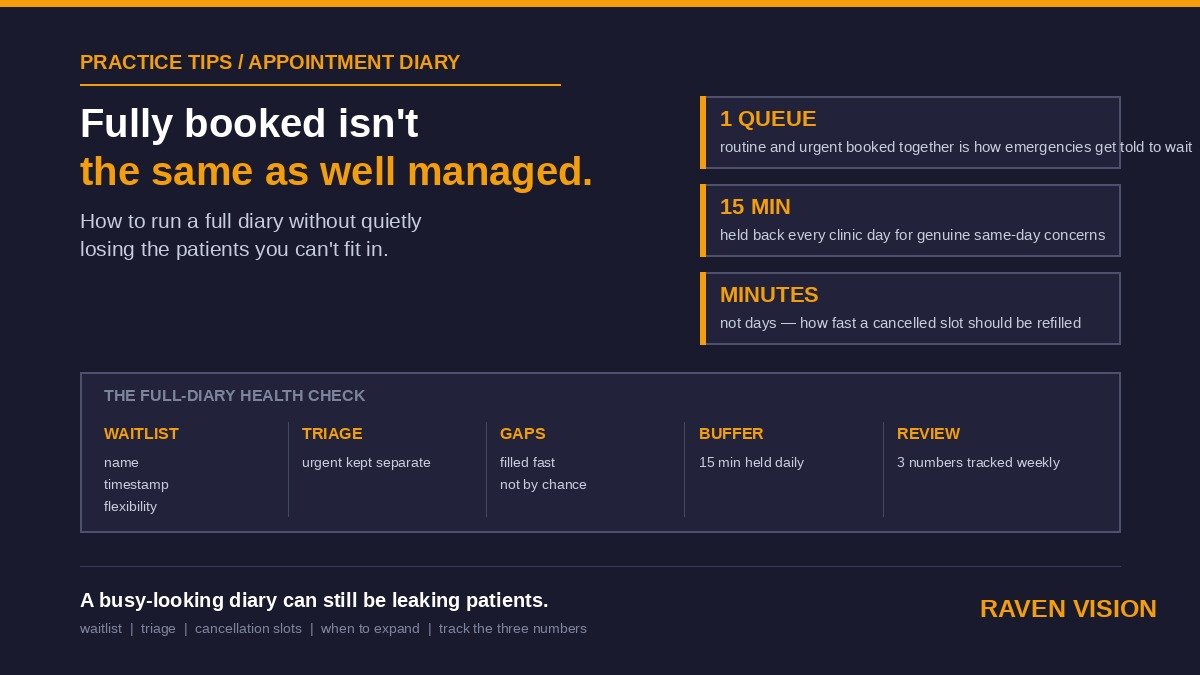
A working waitlist needs three things a Post-it can’t give you: a timestamp for when the person asked, a note on how flexible they are (any day, mornings only, this specific optometrist), and — critically — a way to actually contact them fast when a slot opens, rather than a pile of paper reception digs through during a lull that never comes.
This is where most of the “we already do this” claims fall apart under a bit of scrutiny. Ask honestly: if a 10am cancellation came in right now, how long would it take to find out who’s next on the list and get them called? If the answer is “depends who’s on shift and how busy reception is,” you don’t have a waitlist. You have intentions.
Two lists, not one
Routine and urgent don’t belong in the same queue. Someone happy to wait three weeks for their annual check shouldn’t be competing for the same slot as someone with sudden flashes and floaters who needs to be seen today. Keep them separate, and make sure whoever’s triaging incoming calls actually knows the difference — which brings us to the next problem.
Triage: Not Every Booking Deserves the Same Slot
A diary that treats every request identically — first come, first served, no exceptions — is fair in theory and dangerous in practice. Red flag symptoms (sudden vision loss, flashes and floaters, a painful red eye, a child failing a school vision screening) need same-day or next-day capacity held back deliberately, not squeezed in as a favour when someone happens to have a gap.
Practically, that means building a small buffer into every clinic day — even fifteen minutes — reserved for exactly this, and training reception to ask two or three specific screening questions rather than just offering the next available slot to whoever calls first. It costs you a bit of theoretical efficiency on quiet days. It saves you from the practice’s worst possible outcome: a genuine emergency being told to “try again next week” because the diary was optimised for routine throughput and nothing else.
The Cancellation Slot Problem — Filling Gaps in Minutes, Not Days
Every fully booked diary still has cancellations — patients get ill, forget, or simply don’t turn up. The difference between a well-run practice and a strained one isn’t whether cancellations happen. It’s how fast the gap gets filled.
If filling a cancelled slot means someone manually flicking through a paper list or scrolling a memory of “who was asking last week,” that gap often just sits empty, or gets filled reactively with whoever happens to call that hour — not necessarily the patient who’s been waiting longest or needs it most. Multiply one unfilled ten-minute gap by every clinic day and it adds up to real lost capacity across a year, capacity that could have gone to a patient who’s currently being told “nothing for three weeks.”
This is exactly the kind of gap our appointment management tools are built to close — a live diary that surfaces waitlisted patients automatically when a slot frees up, instead of relying on someone’s memory or a scrap of paper by the phone.
When to Stop Squeezing and Actually Expand
There’s a point where better diary management stops being enough, and the honest answer is that the practice needs more capacity, not a smarter queue. A few signs it’s time: your first routine slot is consistently a month or more out even after tightening the diary; your no-show rate is low but you’re still turning away same-week requests every single week; or your best optometrist is fully booked while a newer one has gaps, meaning demand outstrips supply for the person patients actually want.
The options from there are the usual ones — an extra clinic day, bringing in a locum for peak periods, hiring a second optometrist, or in some cases quietly raising prices to let demand settle rather than growing headcount. None of those decisions should be made on a gut feeling about how “busy” things seem. They should be made on actual numbers: average days to first appointment, cancellation-to-refill time, and how many callers get turned away in a typical week. If you’re not tracking those three things already, that’s the first fix, before any of the bigger ones.
Where Raven Vision Fits
We didn’t build Raven Vision by imagining what an optician practice needed from a boardroom somewhere. Our co-founder Shaukat has run practices for over 35 years and still runs three today, which means the diary and recall problems in this article aren’t hypothetical to us — they’re the reason half of this software exists.
Beyond the live diary and automatic waitlist matching, our recall system means the patients you’re managing around a full book today don’t fall through the cracks tomorrow — due dates get flagged and chased automatically instead of depending on someone remembering to check a spreadsheet. A fully booked practice with a recall system that actually works stays fully booked on its own terms. One without it eventually finds its diary quietly emptying out as patients drift to whoever remembered to call them back.
None of this requires ripping out what you’re using today and starting from scratch. Data migration is part of onboarding, not something you’re left to sort out yourself.
The Twenty-Minute Fix This Week
You don’t need new software to start. This week, ask reception how many callers got turned away in the last seven days — write the number down somewhere you’ll see it again. Build one proper waitlist, split into routine and urgent, with a name, a contact number, and a timestamp for each entry. Block fifteen minutes a day for genuine same-day concerns, even if it sits empty most days. Small changes, but they turn “fully booked” from a vague feeling into something you can actually manage.
If you want to see what that looks like with software actually doing the waitlist matching and recall chasing for you, take a look at our pricing — £149 a month, three months free, no setup fee, and no lock-in if it’s not the right fit. Bring your own diary numbers to a call and we’ll show you exactly where the gap is.