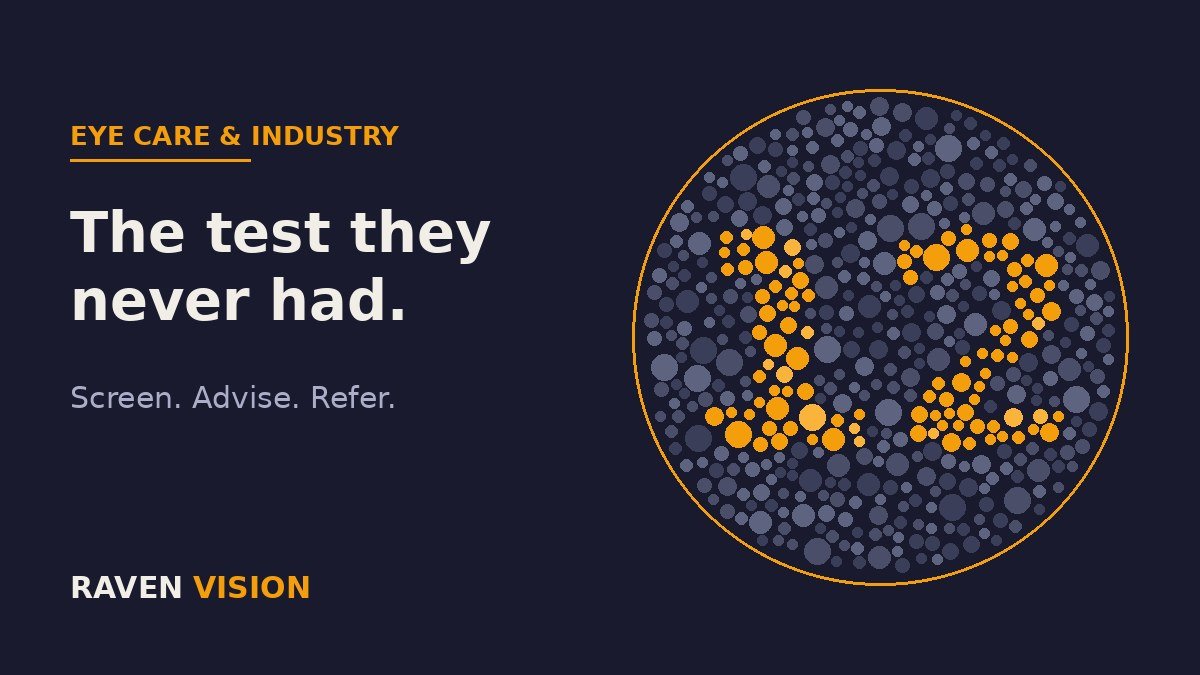

Around three million people in the UK have a colour vision deficiency. Most of them were never formally told. They found out — if they found out at all — from a failed job medical, a confused art teacher, or a sibling’s diagnosis that prompted a family conversation. Almost none of them found out at an optician’s, which is strange, because we’re the profession holding the test book.
Colour vision testing has quietly fallen off the high street. Schools stopped screening for it years ago, the GOS sight test doesn’t require it, and in plenty of practices the Ishihara book sits in a drawer gathering dust between occasional occupational requests. That’s a gap — a clinical one and a commercial one — and independent practices are perfectly placed to fill it.
The gap nobody is filling
The numbers are worth sitting with. Colour vision deficiency affects roughly 1 in 12 men and 1 in 200 women — about 4.5% of the population, and one child in every average classroom of 30. According to Colour Blind Awareness, an estimated 450,000 school-aged children in the UK are colour blind, and around 80% of them arrive at secondary school not knowing it.
Here’s the part that should sting: roughly three quarters of those undiagnosed children have had an eye test. They sat in a consulting room, read a chart, maybe had their retinas photographed — and left without anyone checking whether they could tell red from green. Colour vision screening was removed from the national child screening programme around 2009, and nothing replaced it. The NHS doesn’t screen. Most schools can’t. If we don’t, nobody does.
Why colour vision testing disappeared from the high street
Nobody decided to stop. It just eroded. The sight test fee doesn’t pay for it, so it slipped out of the routine. Appointment slots got tighter. The Ishihara book got older — some practices are still using editions faded enough to be clinically questionable. And there’s a lingering assumption that someone upstream (the school nurse, the GP, the hospital) is catching these children. They aren’t.
The result is a service that patients actively need, that takes two to five minutes to screen for, that requires almost no capital outlay — and that most practices within five miles of yours are not offering in any deliberate way. In a market where independents win by being deliberately different, that’s about as open as a goal gets.
The two groups who need this service
Children — the classroom cost of not knowing
A colour vision deficiency doesn’t just mean trouble with rainbows. Primary classrooms run on colour: colour-coded reading schemes, sorting activities, maps, whiteboard markers, traffic-light behaviour charts. A child who can’t distinguish the colours isn’t slower — but they can look slower, and they often get quietly labelled that way. By secondary school it’s chemistry indicators, wiring diagrams in design tech, and colour-coded revision guides.
A baseline plate test on every child old enough to engage with it — typically from around age four or five with picture-based plates, and reliably from six or seven with numbers — costs you a few minutes. When it picks something up, you’ve given that family something genuinely valuable: language for what’s happening, a letter for the school, and a heads-up before the career conversations of the teenage years. If you already position yourself as the practice parents trust — and children’s eye tests are one of the strongest trust-builders an independent has — colour vision screening belongs in that offer.
Working adults — the career gateway tests
The second group finds you at a moment of mild panic: they’ve applied for a job and been told they need to pass a colour vision assessment. Aviation, rail, some electrical work, maritime roles, some police forces and fire services, the armed forces — all have colour vision standards, and they differ.
Aviation is the strictest and most codified. The UK CAA screens with the 24-plate Ishihara test — the first 15 plates, presented in random order, must be identified without a single error. Fail that, and the route is the CAD (Colour Assessment and Diagnosis) test, which grades the type and severity of the deficiency rather than just recording a fail. Rail operators typically screen with Ishihara and follow up with functional testing. HSE guidance on occupational colour vision names three tools: the Ishihara test, the City University test and the lantern test.
You don’t need to run every one of those in-practice. You do need to know the map — what each industry requires, what you can test yourself, and where to send someone for anomaloscopy or CAD testing when a graded result is needed. A practice that can say “here’s your result, here’s what it means for that specific career, and here’s exactly where to go next” is providing something a chain’s 20-minute conveyor genuinely cannot.
What a proper colour vision assessment looks like in 2026
Ishihara, done properly
The plate test is quick, but it’s easy to run badly. Done properly means: a current, unfaded edition; daylight or a daylight-balanced lamp, not a warm consulting-room bulb; plates presented in randomised order at the right distance; no tinted lenses or “colour-correcting” glasses; and the result recorded plate by plate, not just “passed” or “failed”. For occupational work, note the edition and the plate protocol you used — an employer’s occupational health team may ask.
Beyond the plates
Ishihara detects red-green deficiency well, but it doesn’t grade severity and it misses tritan (blue-yellow) problems. That’s where a second-line test earns its place: the City University test or a D-15 panel arrangement test lets you classify the type and get a working sense of severity. For aviation-grade certainty, refer for CAD or anomaloscope testing at a specialist centre. The point isn’t to own every instrument — it’s to move the patient from “you failed some plates” to “you have a moderate deuteranomaly, and here’s what that does and doesn’t rule out”.
Record it like it matters
Because it does. Colour vision results follow a patient for decades — into job applications, school reports and family planning conversations (the inheritance pattern means a mother whose father was colour blind has sons with a 50/50 chance). Record the test used, edition, illumination, presentation order, result per plate and your classification. A scribbled “CV: NAD” helps nobody in five years’ time.
The conversation matters more than the test
Telling a 15-year-old they have a colour vision deficiency lands differently depending on what you say next. The internet will tell them they can’t be a pilot, an electrician or a police officer — and the internet is frequently wrong. Severity matters. Standards differ between industries and even between employers. Aviation has a graded second-chance pathway. And one myth worth killing on the spot: ordinary driving in the UK has no colour vision requirement at all. (Professional and vocational standards are a separate conversation — the same one we covered in our DVLA vision standards pathway.)
Your job is to replace folklore with the actual standard: here’s your classification, here’s the official requirement for the career you’re asking about, here’s the formal test that decides it, and here’s where that test is done. Ten minutes of that conversation builds the kind of loyalty no voucher scheme ever will — with the patient, and with the parents sitting next to them.
Pricing and positioning
Keep the screening layer cheap or free. A plate test inside every private child’s eye test costs you three minutes and differentiates the appointment instantly. Charge properly for the occupational layer: an extended assessment with classification, a written report and signposting to industry standards is skilled clinical work, and a fee in the £25–£60 range is entirely defensible. Employer reports and repeat assessments are a legitimate small revenue line on top.
Then let it market itself. A short letter to local primary schools explaining what you offer (and why the school screening they assume happens, doesn’t) positions you as the community’s eye care authority. One detected deficiency per month, each arriving with siblings, parents and a story to tell, compounds quietly.
Run it as a system, not a favour
The difference between “we can do that if someone asks” and an actual service is workflow. It needs an appointment type with the right slot length. It needs the result captured in a structured clinical record, not free text. It needs a flag on the patient so every future clinician knows. It needs the family link recorded, because an X-linked condition is a household conversation. And it needs recall logic — a child with a deficiency benefits from a recheck as career-shaping subject choices approach, and that follow-up should fire automatically from your recall system, not depend on anyone’s memory.
That’s PMS plumbing. A patient management system built for optical work should let you set up a colour vision appointment type, template the assessment record, flag the patient, and drive the recall — in an afternoon, not a support ticket.
A 60-day launch plan
Days 1–14: audit your kit. Check your Ishihara edition and lighting, decide on a second-line test, and write down the referral route for CAD/anomaloscope testing. Days 15–30: build the system — appointment type, record template, patient flag, recall rule, a one-page occupational standards crib sheet for the consulting room. Days 31–45: train the team, including the front desk script for the “I need a colour vision test for a job” phone call. Days 46–60: tell the world — website page, Google Business Profile service listing, the letter to local schools, a line in your recall communications for families with young children.
From day 61 it runs like any other clinical pathway: screen at every child’s examination, book occupational assessments at a proper fee, refer the complex cases well, and let the flags and recalls do the remembering.
Where Raven Vision fits
Raven Vision was built inside our co-founder Shaukat’s own practices — three of them, run over 35 years of optometry — which is why the things this service needs are already in the box: custom appointment types, structured clinical records, patient flags, family linking and recall rules that fire themselves. No modules to bolt on, no per-feature surcharges. It’s £149 a month, all in, with three months free, free data migration and a free practice website with booking built in.
If you’re building out clinical services your local chains can’t be bothered with, we’d love to show you how the plumbing works. Book a demo — it takes half an hour, and Shaukat still insists on doing the onboarding himself.