
There’s a version of this appointment most UK practices have had. It’s 9:40 on a Tuesday. The patient is 83, brought in by a daughter who booked the test because “Mum keeps saying she can’t see the telly properly.” Twenty minutes in you’ve got a retinoscopy result you trust, a subjective you don’t, a patient who’s asked three times what the letters are for, and a daughter in the corner answering questions that weren’t addressed to her.
You can finish that badly — rush it, prescribe something, hand over a bag and hope. Or you can finish it well. The difference isn’t clinical skill; most optometrists have that. It’s whether the practice around you was set up for the appointment: whether anyone knew before she arrived, whether the diary gave you the time, and whether the spectacles you dispense are still on her face in six weeks.
The scale nobody has really planned for
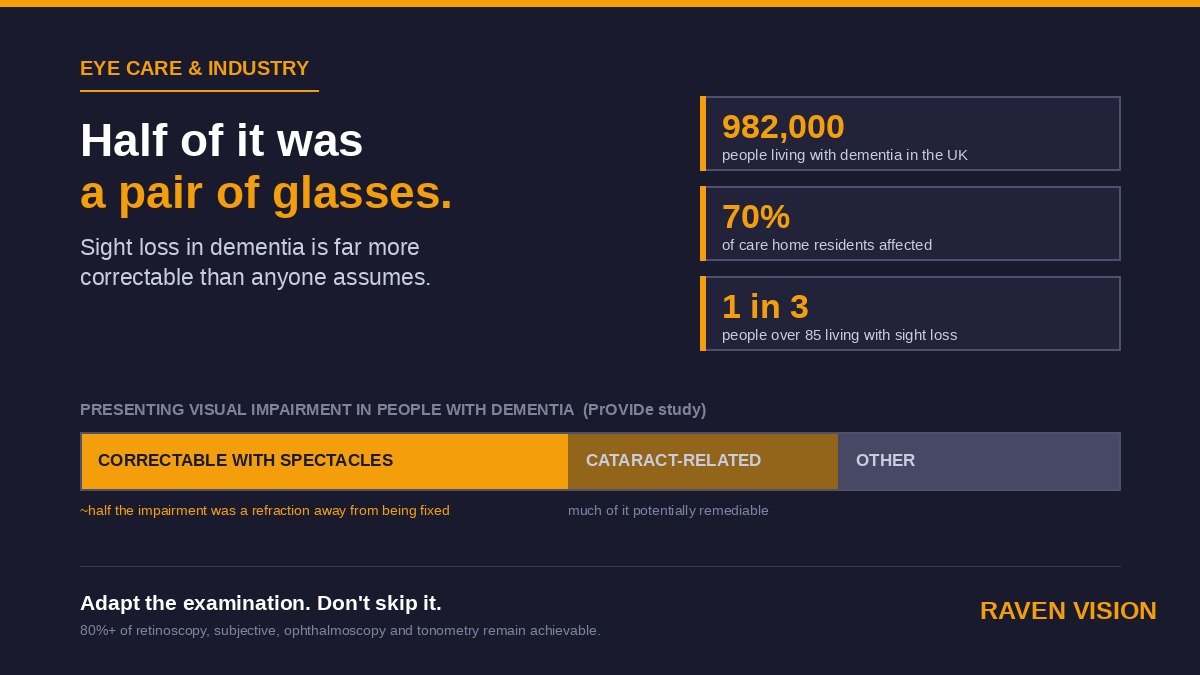
Around 982,000 people in the UK are living with dementia, more than a third undiagnosed. That’s forecast to reach 1.4 million by 2040, and in care homes an estimated 70% of residents have dementia or severe memory problems. Put the sight loss numbers next to that — one in four people aged 75 or over is living with sight loss, one in three over 85 — and the two populations overlap almost entirely.
The PrOVIDe study — UK research run with the College of Optometrists, Alzheimer’s Society and Thomas Pocklington Trust, covering 60 to 89-year-olds with dementia — found high prevalence of visual impairment, disproportionately worse in care homes. The finding that should stop you: almost half the presenting visual impairment was correctable with spectacles. Of what remained, around half was cataract-associated and therefore potentially remediable too.
Half the sight loss in this group was a refraction away from being fixed. Not pathology, not an inevitability of ageing — a pair of glasses nobody had got round to. And someone with dementia who can’t see properly gets more confused, falls more and withdraws more, then gets recorded as having deteriorated cognitively when their near add stopped working two years ago.
What dementia does to vision, and what it doesn’t
The ordinary conditions still apply
People with cognitive impairment get everything everyone else gets: cataract, glaucoma, age-related macular degeneration, diabetic retinopathy, dry eye — with specific vulnerabilities on top. Nothing about a dementia diagnosis makes routine ocular assessment less relevant. If anything the opposite, because this patient can’t reliably report symptoms.
The changes that come with the condition
Cognitive impairment can bring reduced contrast sensitivity and changes in colour vision. Both matter enormously for function and neither shows up in a Snellen acuity — a patient reading 6/9 may still be unable to find the edge of a cream step against a cream floor. Record contrast findings properly and explain them to the family, because the home environment can be changed to compensate.
Dementia can also cause cortical visual loss. The eye is fine, the pathway is fine, the processing isn’t — so you see acuities that don’t match the optics and behaviour that doesn’t match the acuity.
Posterior cortical atrophy: when you’re the first to see it
Worth knowing specifically, because you may be the first clinician a PCA patient sees. Posterior cortical atrophy is a dementia in which visual symptoms dominate the early stage while memory, language and insight stay substantially intact. Patients report blurred vision, difficulty reading — particularly losing their place following lines of text — trouble writing, distortions and light sensitivity.
Because it presents as a vision problem, PCA patients often go to an optician first and receive ocular misdiagnoses. Someone who’s been back three times in eighteen months for a prescription that never quite works, whose refraction keeps coming out clean and stable, who describes reading difficulty that doesn’t match their measured acuity, deserves a better question than “shall we try a stronger add?”
Hallucinations aren’t always what the family assumes
Visual hallucinations here have more than one cause and the distinction matters. Charles Bonnet syndrome — formed hallucinations in someone with significant sight loss and intact cognition — frightens families who assume it means dementia. In Lewy body dementia they’re a feature of the condition. Some medications cause them. Explaining the difference calmly is one of the more valuable things you can do in the chair.
Before the patient arrives
Most of what makes these appointments go badly is decided before anyone walks through the door.
Ask the right question at booking
Not “any special requirements?” — nobody knows what that means. Try: “Is there anything about how the appointment runs that would help? Would a quieter time of day be better?”
Then the answer has to land somewhere it’ll be seen again. This is where practices lose it — information given at the desk, noted on a scrap of paper, never reaching the consulting room. You want a flagged field on the record that surfaces automatically when the appointment is opened. A decent patient management system lets you define your own mandatory fields rather than working around a fixed template.
Put the appointment in the right part of the day
Late morning beats late afternoon. Sundowning is real, and a 4:30pm slot for a patient whose confusion worsens through the day is a decision you’ve made on their behalf without meaning to. Give it more time, too — College guidance says take longer where responses are slow, which is impossible on 20-minute slots with no flex.
Practically, your appointment system needs types with different durations, and staff need to know which to book. A 40-minute extended slot, bookable at the front desk without asking permission, solves most of this. Busy patterned flooring, strong reflections and a crowded waiting room are harder for someone with dementia too — you don’t need to redecorate, you need to know which ten minutes of your day are quietest and book into them.
Consent and capacity, without the panic
The framework is more workable than its reputation. Decisions for people who lack capacity are governed in England and Wales by the Mental Capacity Act 2005, in Scotland by the Adults with Incapacity (Scotland) Act 2000, and in Northern Ireland by the Mental Capacity Act (Northern Ireland) 2016. Capacity is assumed unless established otherwise, and assessed decision by decision, at the time it’s needed. Someone may lack capacity for a complex treatment decision but retain it for whether they want new glasses — and capacity varies day to day, which is why College guidance says you may need to reassess on another occasion.
Three things follow.
The sight test must be clinically justified and in the patient’s best interests, with reasons documented on the record. That’s a GOC Standards point, and “the daughter asked” isn’t the answer by itself. There’s usually a good clinical reason — it’s a matter of writing it down.
Record who accompanied the patient, and separately who the patient consents to receiving results and recommendations. Two pieces of information, two fields. With one free-text notes box, this is lost the moment someone else picks up the file.
The carer’s wishes may not be the patient’s. A relative who wants their mother in new varifocals because the old ones look scruffy isn’t a clinical need. Your duty runs to the patient.
Adapting the examination
The encouraging finding in the research is that most of a routine examination stays possible: retinoscopy, subjective refraction, direct ophthalmoscopy and tonometry were each achievable in over 80% of people with dementia. This isn’t a population you can’t examine — it’s one you examine differently.
Weight towards objective techniques where attention span is limited. Be willing to accept the retinoscopy result as your working answer rather than grinding through a subjective that produces noise.
Use a computerised test chart if you have one. It works at any distance, presents single letters or symbols rather than a wall of them, and — the detail people miss — needs no mirror. Some people with dementia find mirrors genuinely disturbing, and a 3-metre room with a mirror is a problem you can design out.
Simplify what you ask. “Which is better, one or two?” requires holding two experiences in memory and comparing them. Larger dioptric steps, fewer comparisons, and treat “I don’t know” as real data rather than pushing.
Have the relative or carer present where possible — the College recommends it — but address the patient. It’s a small thing and it’s noticed.
Record the limitations. If you couldn’t get reliable fields, say so and why. A record that reads like a normal routine examination when it wasn’t is worse than useless: the next clinician, possibly a locum, compares against it and reaches the wrong conclusion about progression.
Prescribing decisions that actually matter
The temptation with a difficult refraction is to prescribe the number you found. The better question is whether a new prescription improves this person’s life. College guidance sets out what to weigh: whether the change is significant, whether functional vision genuinely improves, how serviceable the current spectacles are, whether the patient wears them, and their own desire for a new pair.
One deserves its own line — the danger of large prescription changes in patients at risk of falling. A big change, or a first pair of varifocals, given to an unsteady 84-year-old is a fall waiting to happen. Sometimes the right answer is a smaller change than the refraction suggests, or single-vision distance plus a separate reading pair. Falls turn independent lives into care home admissions. Be conservative.
Where the loss is cortical rather than optical, spectacles won’t fix it, and saying so kindly at the point of dispense saves a family months of false hope. Low vision aids and advice on lighting often do more good here than a new prescription.
Dispensing, labelling and aftercare
This is where practices lose the benefit of everything they did well in the consulting room.
If you supply spectacles to a patient with cognitive impairment, consider labelling them: name, date of supply, and whether they’re for distance or near. In a care home that’s the difference between glasses that get worn and glasses that end up in a communal drawer with eleven other pairs. Do it in a way that preserves dignity — a discreet mark inside the temple, not a sticker on the lens. You must also arrange aftercare for as long as is reasonable: an Opticians Act requirement, and a practical necessity, because this group needs adjustments more often than most.
Which raises the systems question: aftercare only happens if someone remembers it’s owed, and a follow-up living in one person’s head doesn’t survive a holiday. Segmentable recall matters here — filtering by address group so you see every patient at one care home at once, and routing correspondence to a named relative or the home manager rather than a patient who won’t open the post. If your system can’t tell you “everyone we’ve dispensed to at Ashfield House this year,” you can’t run this properly.
Referral, the GP, and being the one who spots it
Referral decisions here often need a conversation with the patient and carer rather than a straight decision. Weigh the burden of the hospital journey against the benefit. Cataract extraction that restores useful vision is frequently worth it — remember how much of the residual impairment in PrOVIDe was cataract-related. Investigations leading nowhere useful may not be.
If you have concerns about the patient’s wider circumstances — safety at home, self-neglect, a carer visibly struggling — report your findings to the GP. That’s explicit in the guidance and sits alongside your safeguarding responsibilities for vulnerable adults.
And keep the PCA possibility live. Unexplained visual complaints with clean optics and clean fundi in someone over 55 justify a letter to the GP describing exactly what the patient reports, with the words “I could not account for these symptoms optically” in it.
What this asks of your practice systems
Almost none of the above is a clinical capability problem. It’s an information problem:
- Flags that surface at the right moment — extra time, quiet slot, communication needs, reaching the person booking and the person testing automatically.
- Structured fields, not just notes — accompanying person, consent to share results, communication preferences and capacity observations each need a recorded, searchable place.
- Flexible appointment types — different durations, bookable at the front desk without a negotiation.
- Recall you can segment — by address group or care home, with correspondence directed to whoever actually reads it.
- Dispense and aftercare tracked to the patient — supply date, labelling, planned follow-up, in one place.
- The full record wherever the patient is — because a growing share of these patients are seen at home or in a care home.
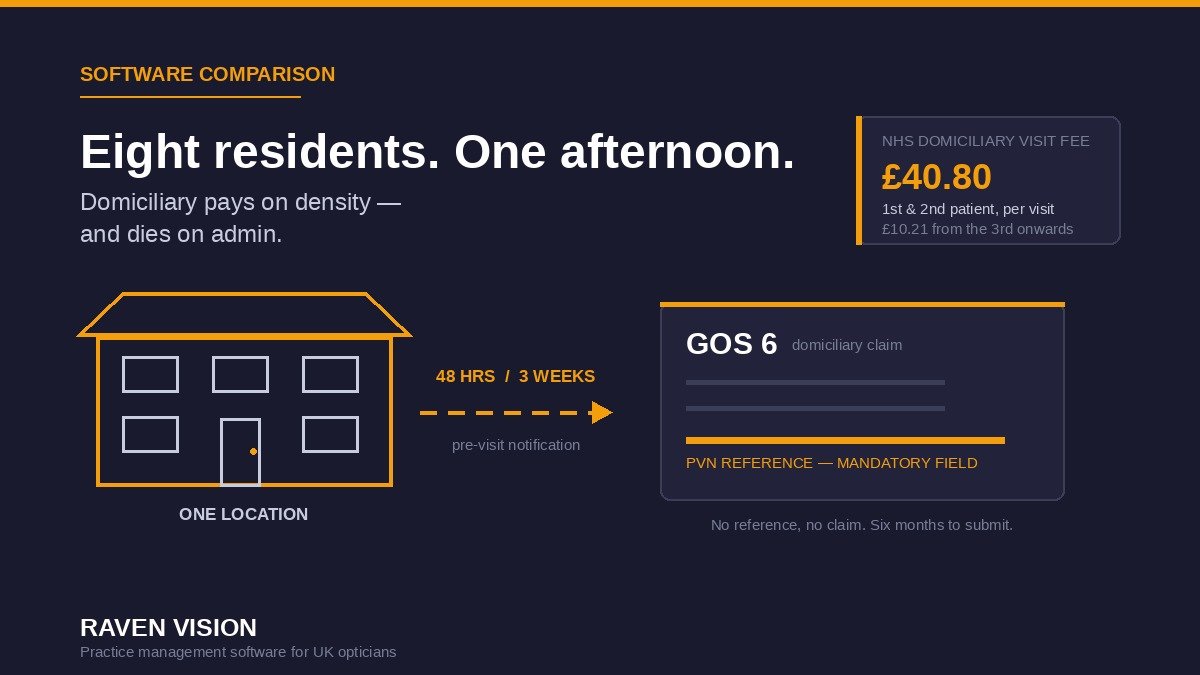
That last point connects to domiciliary work, where much of this population increasingly sits. A cut-down mobile view isn’t adequate for a complex older patient with several ocular conditions and a cognitive impairment. You need the whole record at the bedside.
Raven Vision was built inside working practices — co-founder Shaukat has been an optometrist for over 35 years and runs three of his own — which is why it’s designed around exactly these things: customisable mandatory clinical fields, configurable appointment types, segmentable recall by location, and a cloud system that runs the full record on a tablet in a care home the same as on the desk. Whether or not you choose us, the test is the same: walk one of these appointments through any system you’re evaluating and see where it breaks.
Where to start
Five things, this month.
- Create an extended appointment type and tell the front desk when to use it.
- Add a visible flag on the patient record for extra time and communication needs, and agree who fills it in.
- Add fields for who accompanies the patient and who may receive results.
- Agree a labelling standard for dispensed spectacles and write it down so everyone does it the same way.
- Print the Alzheimer’s Society factsheet on sight, perception and hallucinations and keep copies where the optometrists can reach them.
None of that costs anything meaningful, and all of it makes the Tuesday morning appointment go better.
This is a group where a significant share of sight loss is correctable, where UK care is patchy, and where being good at it is both right clinically and a real local differentiator. Care home managers talk to each other. So do families. An independent practice can build around this in a way a chain running fifteen-minute slots can’t.
If you want to see how Raven Vision handles it — the flags, appointment types, segmentable recall and the full record on a tablet at the bedside — book a walkthrough and bring a real patient scenario. We’d rather show you the awkward bits than the demo script. Our pricing is on the site: £149 a month per location, no setup fee, no lock-in.