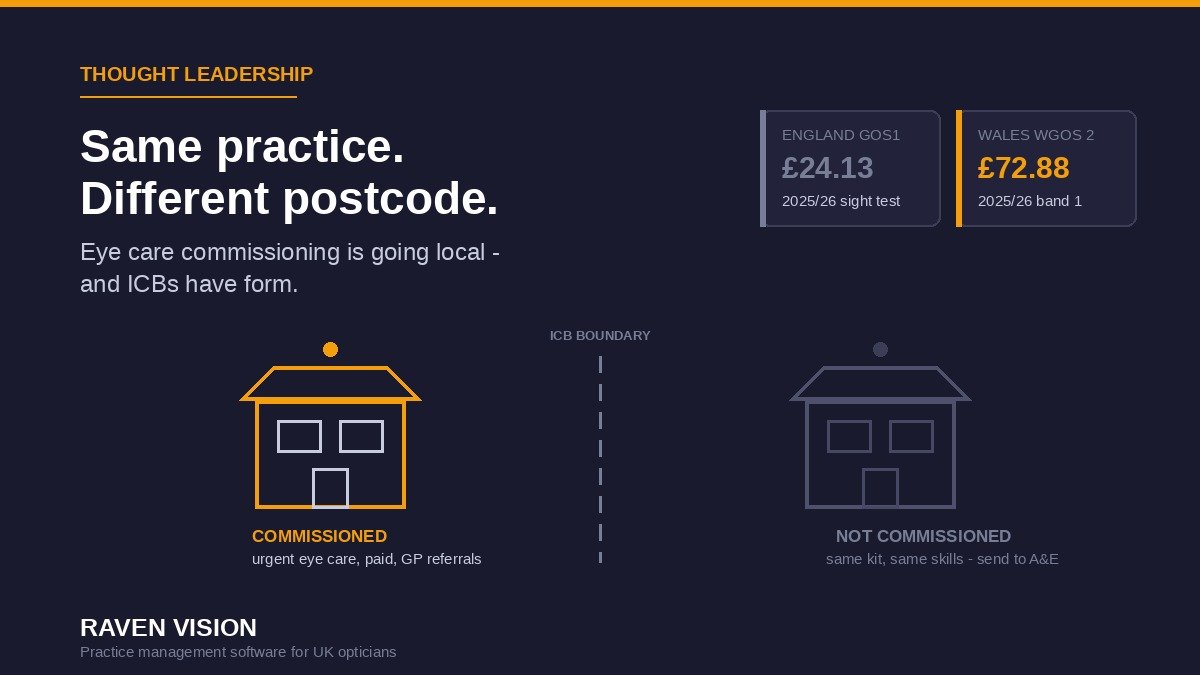

Two practices, four miles apart. Same size, similar kit, optometrists who trained a year apart at the same university. One of them sees red eyes, foreign bodies and sudden-onset flashes under a commissioned urgent eye care contract. It gets paid for that work, the local GPs know to send patients its way, and a good chunk of those patients come back six months later and buy spectacles. The other practice tells the same patient to ring 111 or sit in A&E for five hours.
The clinical difference between those two practices is nothing. The commercial difference over ten years is enormous. And the only thing separating them is which side of an integrated care board boundary they happen to sit on.
That’s the state of NHS eye care in England in 2026. It’s also about to get more consequential, because the machinery that decides who gets commissioned to do what is being handed to your local ICB — and most independent practice owners haven’t yet worked out what that means for them.
The bit everyone agrees on
Start with the thing there’s no argument about. Hospital eye services in England cannot cope, and haven’t been able to for years.
Ophthalmology is the busiest outpatient specialty in the NHS — close to nine million attendances in England in 2023/24. Somewhere in the region of 600,000 people are waiting for a first appointment with an ophthalmologist. When the Royal College of Ophthalmologists surveyed clinical leads, seven in ten said they were more worried about the impact of outpatient backlogs on patient care than they’d been twelve months earlier. Glaucoma and medical retina were the two areas that worried them most — which, if you’ve ever chased a hospital about a patient you referred with suspicious discs, will not surprise you.
Meanwhile there are somewhere around six thousand optical practices across the UK, most open six or seven days a week, on high streets, with slit lamps, fields machines, OCT in a growing number of cases, and clinicians who are already seeing the same patients for other reasons. The AOP has pointed out that GPs write more than 1.5 million eye-related prescriptions a year for conditions that optometrists have the equipment and the training to handle.
So the logic writes itself. Move the work to where the capacity already is. The 10 Year Health Plan says as much — care shifting out of hospital and into neighbourhoods is one of its headline commitments. Every professional body has welcomed it. Nobody in the sector disagrees.
The problem has never been the logic. It’s the plumbing.
What the Health Bill actually does
Buried in the Health Bill that’s been working its way through committee this summer is Clause 28. It amends Section 115 of the NHS Act 2006, and it moves the duty to commission primary ophthalmic services — General Ophthalmic Services, the sight tests you do every day — from a national framework to individual integrated care boards. Each ICB would be required to secure provision “to the extent that it considers necessary to meet all reasonable requirements”.
Read that phrase again. To the extent that it considers necessary.
The optimistic reading
The AOP’s assessment is that this is largely administrative. ICBs were already exercising these powers under delegation from NHS England; the Bill just makes them the commissioner in their own right rather than a delegate. No new powers are being created. GOS remains a national contract with national terms, and nobody is proposing that your ICB gets to decide whether sight tests happen in its patch.
On that reading, the change is plumbing. Boring, necessary, no cause for alarm.
The pessimistic reading
The pessimistic reading isn’t about GOS at all. It’s about what ICBs have already demonstrated they’ll do with the discretion they’ve got over everything else.
Surrey and Sussex ICB cancelled its Sussex urgent and minor eye care service in 2024 to save money — despite each episode of community care costing roughly half what the same care costs in A&E. Hampshire and Isle of Wight moved community glaucoma schemes back into hospitals and signalled it would end community urgent eye care when the contract ran out. In West Yorkshire, most of the patch has walk-in access to urgent eye care through local practices — but in Leeds, patients have to phone a call centre, where the first 21 callers get referred to an optician and everyone after that is told to go to A&E.
First 21 callers. That’s a rationing mechanism dressed up as a pathway.
None of that is a prediction about what happens to GOS. It’s evidence about how commissioning decisions get made when a finance director is looking for in-year savings and eye care is one of the smaller lines on the spreadsheet. And it’s the reason the “postcode lottery” phrase came up repeatedly when the Bill had its second reading.
England’s blind spot — and Wales’s answer
The really telling document this year wasn’t the Bill. It was the Neighbourhood Health Framework published in the spring, which set out how the community shift would actually be delivered. Optometry barely features in the initial priorities. Community pharmacy, dentistry and optics got a vague commitment to consider how they might contribute over the “next few years”. The AOP called it a huge opportunity missed, and it’s hard to argue.
Primary care, in the framework’s language, mostly means GP-led care. The profession with the premises, the equipment and the diagnostic capability sitting on every high street in the country is, once again, a footnote.
Contrast that with Wales. In 2023 the Welsh Government scrapped the old patchwork — GOS(W), Eye Health Examination Wales, Low Vision Services Wales and a scattering of local enhanced pathways — and replaced it with a single tiered contract, Wales General Ophthalmic Services. Practices sit at a level, higher levels require higher qualifications, and the fees follow. For 2025/26 a WGOS 2 eye examination is banded at £72.88, £55.18 or £27.07 depending on complexity.
England’s GOS1 fee for 2025/26? £24.13. A rise of sixty pence, below inflation, with most other grants frozen.
Those aren’t identical services and it isn’t a fair like-for-like — the Welsh bands cover a broader clinical remit. That’s exactly the point. Wales redefined what the state buys from primary eye care. England is still buying a refraction and hoping the rest gets sorted out through local enhanced schemes that any given ICB can switch off with three months’ notice.
What commissioners actually buy
Here’s where this stops being policy commentary and starts being your business.
If commissioning is going local — and it is, with NHS England’s strategic commissioning framework expecting every ICB to start adopting it through the 2026/27 planning cycle — then the question for an independent owner isn’t “will the shift happen?” It’s “when my ICB has money for a community pathway, am I on the list of practices that can deliver it?”
Commissioners are not buying clinical excellence. They assume that. They’re buying four things, and most independents are strong on one and weak on the other three.
1. Capacity they can count
A commissioner needs to know you can absorb the volume. Not “we’ll fit them in” — an actual number. How many urgent slots a week can you hold open? What’s your current utilisation? Can you offer same-day and Saturday access without cannibalising your routine book?
If you can’t answer that from your appointment system in about ninety seconds, you’re going to lose to a group practice that can. The multiples and the primary eye care companies pitch with dashboards. You should be able to as well.
2. Capability they can accredit
Higher-tier work means higher-tier qualifications — independent prescribing, glaucoma certificates, medical retina accreditation. These take time and money and there’s a real chicken-and-egg problem: you don’t want to fund the qualification until there’s a contract, and the contract goes to practices that already have the qualification.
The owners who’ll do well over the next five years are the ones who broke that deadlock early and treated accreditation as capital investment rather than CPD. Wales’s tiered model made that calculation explicit. England’s will too, eventually, one ICB at a time.
3. Data they can audit
Every commissioned pathway comes with reporting obligations — activity volumes, outcomes, referral rates, onward referral accuracy, time-to-be-seen. If producing that means somebody spends a Sunday cross-referencing paper records against a spreadsheet, you will quietly stop wanting the contract by month four.
This is the least glamorous and most decisive of the four. A practice whose patient records are structured and searchable can produce a quarterly return in an afternoon. A practice running on cards and memory can’t, and won’t bid again. Same goes for the money side — enhanced service claims live alongside your GOS claims, and if one of those is already a monthly headache, adding a second stream isn’t going to fix it.
4. A relationship, via your LOC
ICB commissioners don’t know you. They know your Local Optical Committee, and they know whichever provider company holds the current contract. If you’ve never been to an LOC meeting, you are not in the room where the pathway gets designed — and pathways get designed by the people who show up.
This is the cheapest of the four to fix and the one most independents skip, usually because the meetings clash with clinic. Send someone. Send yourself twice a year if that’s all you can manage.
The uncomfortable maths
Now the part the trade press tends to skip: enhanced services are not free money.
An urgent eye care episode pays reasonably. It also eats a slot you might have filled with a routine test that led to a dispense. If your average patient journey from a routine test is worth £150 to £250 in dispensing on top of the fee, and an urgent episode pays a flat fee with no spectacle sale attached, the contract can look busy and profitable on paper while being margin-neutral in reality.
That doesn’t make it a bad idea. It makes it a decision that needs numbers. The genuine returns from commissioned work tend to be second-order:
- New patients you’d never have reached. Someone attends with a red eye, has a good experience, and becomes a household of routine patients. That’s the real payback, and it only shows up in your data if you can see where new registrations came from.
- Referral credibility. Once local GPs have a practice they trust to see eyes today, you become the default. That relationship is worth more than the tariff.
- Clinical retention. Optometrists want interesting work. A practice offering only routine refraction competes for staff on salary alone, and you will lose that fight.
- Practice value. A book of commissioned NHS work with a track record is a real asset when you come to sell. Buyers pay for revenue that isn’t purely retail.
Work out which of those you’re actually after before you sign. A contract you took for the tariff will disappoint you. A contract you took to open a new front door usually doesn’t.
The next ninety days
Nothing here needs a strategy away-day. Four things, none of which cost much:
Find out what your ICB currently commissions. Not what you think it commissions — what’s actually live, who holds it, and when it’s up for renewal. Your LOC will know. Half the owners I speak to are surprised by the answer in one direction or the other.
Work out your true spare capacity. Pull twelve weeks of appointment data. How many slots went unfilled? How many were lost to non-attendance? Most practices discover they have more room than they thought, sitting in the wrong places on the wrong days — and that’s capacity you could offer a commissioner without hiring anyone.
Audit whether you could report. Pick a plausible metric — say, all patients seen in the last quarter with a red eye presentation. Can you produce that list? How long did it take? That single exercise tells you more about your readiness than any amount of strategic thinking.
Get one qualification moving. Whoever on your team is most likely to stay, most likely to enjoy it, and closest to being ready. Start now, because the contracts follow the accreditation and not the other way round.
The point underneath all of this
There’s a version of the next decade where independent practices become genuine neighbourhood health providers — where a meaningful slice of income comes from managing eye conditions in the community, where the high street practice is the front door to the eye care system rather than a shop that also does tests, and where the value of the business isn’t wholly dependent on how many frames you shift.
There’s another version where the shift happens without you. Where the provider companies and the multiples hoover up the enhanced contracts because they had the infrastructure to bid, and independents are left holding a £24.13 sight test fee that hasn’t kept pace with the cost of the room it’s delivered in.
Which version you end up in isn’t decided in Westminster. It’s decided by whether, when your ICB finally has money for a community pathway, you can put your hand up and prove three things: that you have the capacity, that you have the capability, and that you can account for the work afterwards.
The first two are a matter of investment and intent. The third is a matter of how your practice runs day to day — and it’s the one that quietly disqualifies more independents than anything else.
Getting the boring part right
Raven Vision was built inside working practices, by an optometrist who’s run his own for decades, precisely because the admin layer is where good independents lose. Structured patient records you can actually search. Appointment data that tells you where your capacity really is. eGOS claims that don’t need a Sunday afternoon. Recall that runs itself. None of it is glamorous, and all of it is what a commissioner’s reporting request lands on top of.
It’s £149 a month per practice, with three months free, free data migration, and no lock-in. If you’d rather see it than read about it, book a demo and we’ll walk through your actual numbers — or have a look at what’s included first.
The commissioning shift is coming whether or not any of us are ready. Worth being one of the practices that is.
Related reading: Community Urgent Eyecare Service (CUES): what it means for UK independent opticians and what your optician practice is actually worth in 2026.