
There’s a particular look a 46-year-old gives you when you say the word “varifocal” for the first time. It’s not quite offence. It’s closer to grief. They came in because the menu in the restaurant had gone blurry and they’d been holding their phone at arm’s length for six months, and now you’re telling them the thing their parents wore.
How your practice handles that moment decides a lot. It decides whether they walk out with a pair of lenses that genuinely changes their day, or a £12 pair of ready readers from the chemist and a vague plan to “sort it properly later”. It decides whether they come back in two years or drift to whoever’s cheapest. And it decides how many of your varifocal dispenses turn into remakes and non-tolerance returns, which is where a lot of independents quietly leak margin.
This one’s for the whole team: the optometrist who has the clinical conversation, the dispensing optician who has to make the lens work, and the front desk who books the follow-up. Presbyopia is the most predictable thing that will ever happen to your patient list. Let’s treat it that way.
What presbyopia actually is, in words your patients will accept
You know the mechanism. The crystalline lens stiffens with age, the ciliary muscle can’t bend it the way it used to, and accommodation falls away. Most people notice it somewhere in their early-to-mid forties, and it keeps progressing until the add settles in the late fifties or so.
The problem isn’t the science. It’s that “your lens has stiffened” lands as “you’re getting old”, and nobody books a follow-up because they felt old in your test room.
The explanations that work in practice are the ones that make it normal and mechanical rather than personal. “This happens to every single person, usually around your age. Your distance vision is fine. Your eyes have just stopped auto-focusing for close work, so we’re going to do the focusing for them.” Some clinicians use the camera-lens comparison, some use the zoom analogy. Whatever you use, say it the same way every time, so the dispensing optician isn’t re-explaining it ten minutes later with a different metaphor.
The College of Optometrists’ own patient advice on presbyopia is refreshingly plain: get a sight test, and if it’s recommended, use reading glasses, varifocals or contact lenses for anything held closer than arm’s length. If the patient already wears glasses, a switch to varifocals may be all that’s needed. That’s the tone to aim for. Practical, not apologetic.
Why the first varifocal is a different dispense to every other dispense
A single-vision dispense is mostly about the frame. A first varifocal dispense is about expectations, and it starts before the patient has picked a frame up.
Adaptation is the whole conversation
Every experienced DO has the same story: the patient who came back on day three saying the floor “looked like it was moving” and wanted their money back. Almost none of those patients were told, clearly and in advance, what the first couple of weeks would feel like.
The standard adaptation advice hasn’t changed much and it works: wear them all day from day one rather than swapping in and out, start at home before heading out, point your nose at what you want to see instead of glancing sideways, and expect a bit of mild blur or a swimming sensation at the edges that fades as the brain learns the lens. Some people are comfortable within a few days; some take a few weeks. If it’s still not right after that, come back so we can check the fit and the measurements.
Say all of that at the dispense, say it again at collection, and put it on a card they take home. The patients who return with a “problem” that’s really just day-four adaptation are the ones who were never told day four was coming.
Driving deserves its own sentence
Night driving is where a first-time varifocal wearer most often decides they hate the lens. A quiet suggestion to be a passenger for the first few journeys, or to drive familiar routes in daylight for the first week, avoids the panicked phone call. It costs you nothing and it’s the kind of detail patients repeat to their friends as evidence you actually cared.
Match the lens to the life, not the price list
The 45-year-old who spends nine hours a day on two monitors has a different problem from the 45-year-old plumber who needs to read a boiler manual under a sink. One of them may be far better served by an occupational or office lens as their main pair, with a general varifocal as the second pair. The other wants a wide intermediate and a lens that copes with looking up. Ask about the day before you talk about the lens. If your team already has a good digital eye strain conversation in the test room, the office-lens recommendation is a natural continuation of it rather than an upsell.
The measurements are the guarantee
Non-tolerance is rarely random. Most of the time it’s a fitting problem wearing a lens problem’s clothes.
Monocular PDs measured properly, fitting heights taken with the frame adjusted and sat as it will be worn, pantoscopic tilt and vertex distance recorded, back vertex distance considered on higher adds, and a frame with enough depth for the corridor. None of this is new. What’s new is how often it gets rushed on a busy Saturday because the patient has a bus to catch.
Two practical habits help. First, treat the fitting as a separate step with its own couple of minutes, not something done while the patient is halfway out of the chair. Second, record the measurements against the patient, not just on the order form. When the same patient comes back in two years for their next pair, or comes back in two weeks unhappy, you want the heights and the tilt in the record, not in a filing cabinet. Practices that have moved to a proper patient management system tend to find this is where it earns its keep: the dispensing history sits next to the clinical history, and the DO doing the aftercare can see exactly what was fitted, by whom, and why.
If your remake rate on progressives feels high, start there. We wrote a longer piece on cutting spectacle remakes and most of it applies doubly to first varifocals.
Reading glasses are not the enemy, and pretending they are loses you the patient
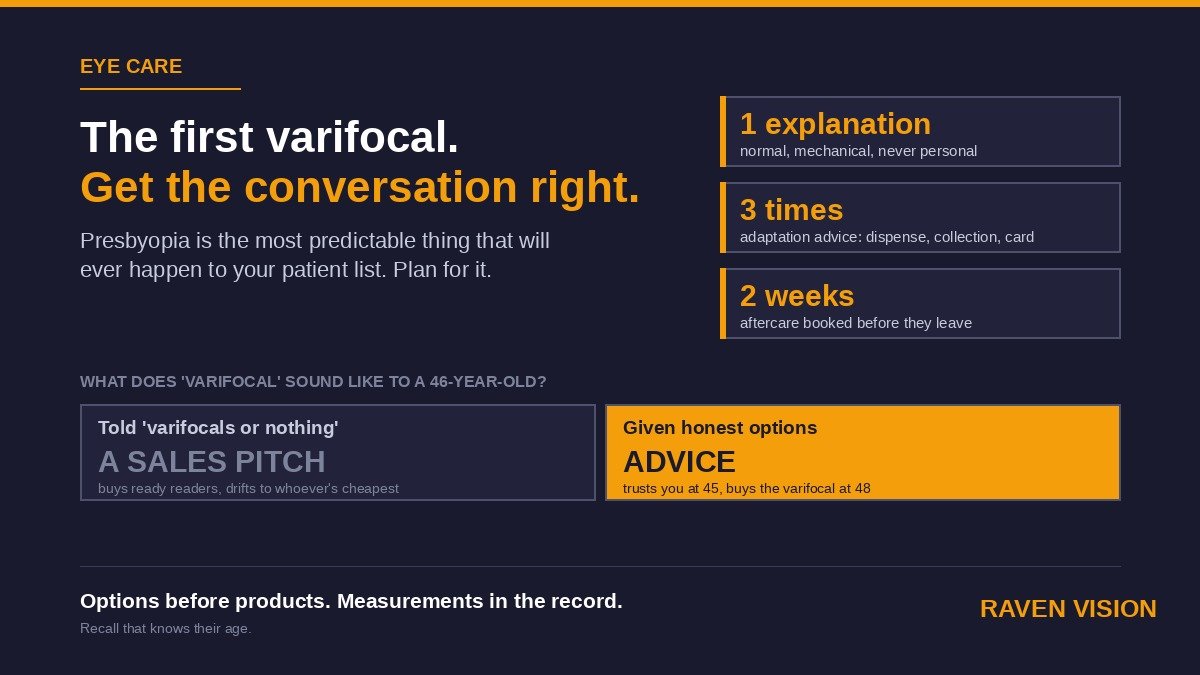
Here’s where a lot of practices get the tone wrong. A newly presbyopic patient who’s been told “varifocals or nothing” hears a sales pitch. A patient who’s told “there are three sensible options, here’s who each one suits” hears advice.
Be honest about ready readers. For an emmetrope who only needs help with the menu and the phone, a decent pair of single-vision readers, properly prescribed and made to their PD, is a perfectly good first step. It’s also a much better product than the £12 pair from the chemist, and you can say so without sneering. Then explain what happens next: the add will increase, distance will eventually need a hand too, and at that point a varifocal stops being a luxury and starts being the thing that means one pair instead of three.
Contact lens wearers need their own version of this. Multifocal contact lenses and monovision are both real options now, and the patient who’s worn dailies since university deserves to hear about them before being handed a spectacle frame. If you’ve built out your contact lens services properly, presbyopia is the moment to use them, not the moment to quietly lose those wearers to glasses.
The point is that the patient who’s given honest options at 45 trusts you enough to buy the varifocal at 48. The patient who was pushed at 45 buys it online at 48.
The follow-up is where the money and the loyalty both live
A first varifocal without a scheduled aftercare is a coin toss. Book the check at collection: two weeks out, ten minutes, no charge. It does three things.
It catches the adaptation problems while they’re still fixable with an adjustment rather than a remake. It gives the patient a legitimate reason to come back into the practice with a positive outcome attached. And it turns “I’m not sure about these” into “they sorted it for me”, which is the single most repeatable thing a patient can say about you to a friend of the same age.
Most practices agree with all of that and then don’t do it, because the appointment gets booked verbally and forgotten. The fix is boring: make the aftercare a standard appointment type in your appointment diary, book it before the patient leaves the collection desk, and send a reminder the day before like any other slot. If your diary can’t do that in three clicks, that’s a diary problem, not a staff problem.
Recall for presbyopes is a different rhythm
The 40-to-60 window is the most commercially interesting stretch of a patient’s life with you, and most recall systems treat it exactly like every other window.
Between about 45 and 55 the add is still moving. That means the prescription that was perfect at 46 is noticeably short at 48, and a two-year recall is fine clinically but slow commercially. For patients in this bracket it’s worth building a lighter-touch contact at the twelve-month mark, not a “your sight test is due” letter but a “how are you getting on with the varifocals, and has anything changed at work” message that opens the door to a second pair, an office lens, or an early retest if they want one.
Then, at 60, the picture changes again. In England, patients aged 60 and over are entitled to an NHS-funded sight test, normally every two years, with a shorter interval where there’s a clinical reason. Your recall should know that birthday is coming. A patient who’s been paying privately for fifteen years and gets a note in their sixtieth year saying “your next test is now NHS-funded, we’ve booked you in” is a patient who feels looked after. A patient who finds that out from a competitor’s window poster is gone.
Both of those depend on your recall system being able to segment by age and by what was dispensed last time, and to send something other than the one standard letter. If you’ve got a recall engine that can do that, presbyopia is where it pays for itself. If you haven’t, the workaround is a monthly list of everyone in the 44-to-56 bracket who was dispensed a varifocal more than eleven months ago, and a phone call.
Where second pairs actually come from
Every practice wants a better second-pair rate. Presbyopia is the most natural source of it there is, because the problem is genuinely multi-pair.
The office lens for the desk. The prescription sunglasses that can now be a varifocal too, because squinting at the sat-nav with sun readers is miserable. The dedicated readers for the bedside table. The multifocal contact lenses for the gym and weekends. None of these are invented needs; they’re the honest answer to “how do I see well all day now that my eyes don’t auto-focus.”
The trick is timing. Don’t try to sell three pairs at the first varifocal dispense; the patient is already absorbing a lot. Plant it: “Once you’ve settled into these, we’ll talk about whether a desk pair or a sunglass pair makes sense for you.” Then raise it at the two-week aftercare, when they can tell you what’s still awkward. We covered the mechanics of that conversation in the second-pair and prescription sunglasses piece, and the broader logic in how to increase your dispense rate.
A simple presbyopia pathway for a small practice
You don’t need a protocol document. You need five agreed habits everyone actually does.
1. One explanation, said the same way by everyone
Agree the words. Normal, mechanical, not personal. The optometrist introduces it, the DO repeats it, the front desk doesn’t contradict it.
2. Options before products
Readers, varifocals, office lenses, contact lenses. Say which one suits which life. Let the patient choose with you.
3. Adaptation advice three times
At the dispense, at collection, and on a card. Include the driving line.
4. Measurements in the record, aftercare in the diary
Monocular PDs, heights, tilt, vertex, frame, lens design, and who fitted it, all stored against the patient. Two-week check booked before they leave.
5. Recall that knows their age
A twelve-month touch for the 45-to-55 bracket. A note before the sixtieth birthday. Segment by what was dispensed, not just by date.
Do those five consistently and you’ll see it in three places: fewer varifocal remakes, a higher second-pair rate in the 45-plus group, and a noticeably better retention rate through the years when patients are most likely to wander.
Where Raven Vision fits
We’ll be direct about this. Raven Vision was built by Shaukat, an optometrist with more than thirty-five years in practice who runs three of his own, and the presbyopia pathway above is more or less how his practices run it. The software exists because the paper version kept breaking: measurements lived on order forms, aftercares got booked on a Post-it, and the recall letter said the same thing to a 47-year-old that it said to a 27-year-old.
So the dispensing record sits with the clinical record, the aftercare is a standard appointment type, and the recall can be segmented by age and by what was last dispensed. It’s £149 a month per practice, with free data migration from whatever you’re on now and no long contract. If you’d like to see how the presbyopia pathway looks in practice, book a walkthrough and bring a real patient scenario with you. Or have a look at the pricing page first if you’d rather see the numbers before anyone talks to you.
Either way, the 46-year-old with the blurry menu is coming in next week. It’s worth having the conversation ready.