
Go to the website of almost any independent optician in the UK and try to find out what an eye examination costs. Most of the time you can’t. You’ll find “contact us for details”, a phone number, maybe a line about NHS eligibility. The price itself, the one number a patient actually wants before they pick up the phone, is missing.
That’s not an accident. Most owners have made a quiet decision that publishing prices is risky. The multiples will undercut you. Patients will judge you on a number instead of on care. You’ll box yourself in. I’ve heard every version of the argument, and for a long time I believed most of it.
I don’t any more. This is a piece about why pricing transparency is now the stronger position for a UK independent optician, what it does and doesn’t mean, and how to do it without turning your practice into a price list.
Why opticians hide their prices
Let’s be fair to the case for secrecy, because it isn’t stupid.
The first argument is comparison. A private eye examination at an independent might be two or three times the headline price at a multiple. Put those two numbers side by side on a screen and the independent loses, because the screen can’t show the 40-minute appointment, the OCT, the same optometrist every visit, or the fact that nobody is going to hand you off to a sales floor.
The second argument is flexibility. If you don’t publish, you can adapt. Different prices for different patients, discretionary discounts, the occasional “don’t worry about the fee” for a long-standing patient. Publishing feels like handing over that discretion.
The third argument is the sale. If the price is on the website, the argument goes, the patient has already decided before you’ve had a chance to explain the value. Better to get them in the door, then let the practice speak for itself.
All three rest on the same assumption: that the patient’s alternative to your published price is walking in without a number in their head. In 2026, that assumption is wrong.
What actually happens when you don’t publish
The patient’s alternative to your published price is not ignorance. It’s someone else’s published price.
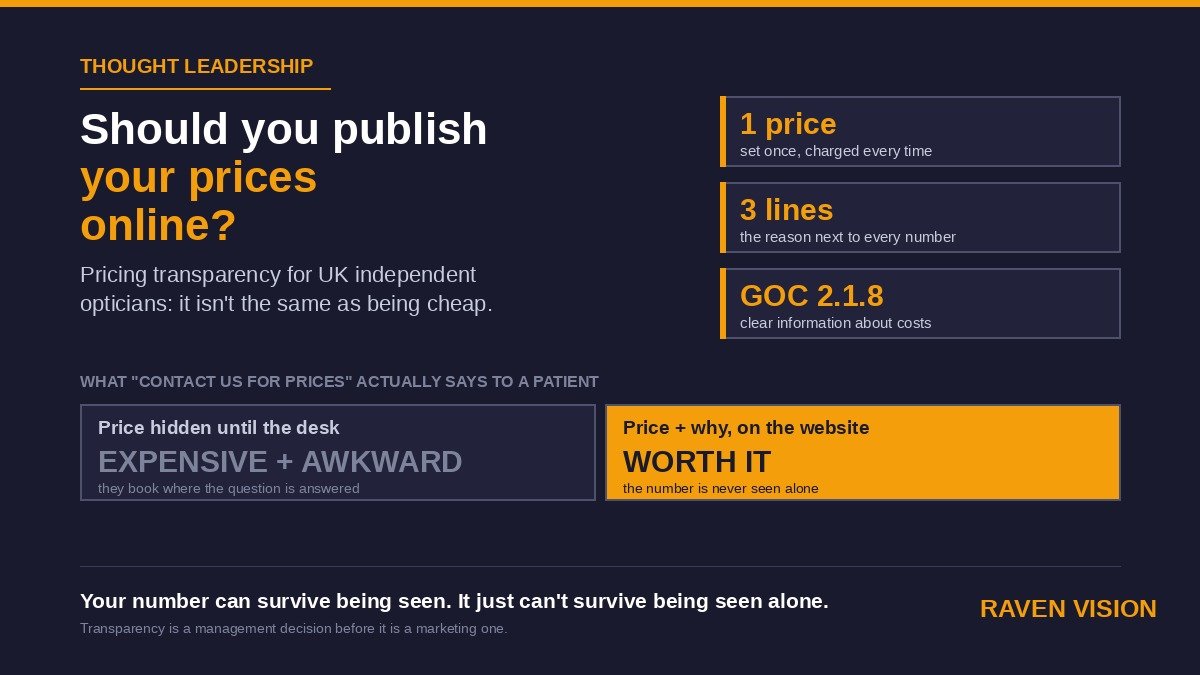
When a prospective patient searches “eye test near me” they’ll see the multiples with a number, a couple of independents with a number, and you with “contact us”. They don’t read that as “premium”. They read it as “expensive, and a bit awkward to ask”. A meaningful share of them go somewhere with a number, not because it’s cheaper but because it’s answered.
The ones who do phone you now start the relationship with a question you’d rather not be answering on the phone. Your receptionist gives a price cold, with none of the context the website could have carried, and the patient compares it in their head to the number they already saw elsewhere. You’ve had the comparison forced on you anyway, only in the worst possible setting. If you want to see how much of that first call is about price, the piece on converting telephone enquiries into bookings is a good place to start.
And the younger patients you say you want? They’re the least likely to phone at all. A practice with no visible price and no online booking simply doesn’t exist for a 28-year-old who does everything else from her phone. We covered that audience in winning younger patients, and price visibility was part of the answer then too.
The regulators have already made up their minds
This is the part most owners haven’t clocked. The direction of travel on price information in UK optics isn’t neutral. It points one way.
The General Optical Council’s Standards for Optical Businesses, which every registered optical business has been held to since October 2019, include a plain sentence under the heading “The services you provide are open and transparent”: your business “provides clear information to patients about costs of products and professional services” (standard 2.1.8). A separate standard, 1.3.2, says commercial pressure shouldn’t stop staff giving patients the time they need to process information and change their mind.
Neither says “put your prices on your website”. But read them together and the spirit is obvious. A patient who finds out the fee at the desk, after the exam, with a dispensing optician waiting, has not been given clear cost information in a way that lets them take their time. A patient who saw it on your website last night has.
Consumer law is moving the same way. The consumer protection rules that came into force in April 2025 target “drip pricing”, where the real cost is only revealed in stages. Optics isn’t the main target of that law, but the underlying principle, that the headline price should be the real price, is now the baseline expectation for every UK business that sells to the public. Being the business that still says “ask in store” puts you on the wrong side of where the public and the regulators both are.
Transparency is not the same as being cheap
Here’s the confusion that keeps independents stuck. They hear “publish your prices” and think “compete on price”. Those are opposite strategies.
Competing on price means letting the number do the talking and hoping it’s lower than the next number. We’ve written before about why that’s a losing game for an independent, in stop competing on price. Nothing in that argument has changed.
Transparency means letting the number sit next to the explanation. A published price of £85 for a private eye examination, with three lines underneath explaining that it’s a 40-minute appointment with OCT imaging and the same optometrist every time, does something a hidden price can never do: it tells the patient what they’re paying for before they’ve decided you’re expensive.
The multiples publish a low number with almost nothing next to it. That’s their model and it works for them. Yours is a higher number with a lot next to it. The mistake is thinking your number can’t survive being seen. It can, if it’s never seen alone.
What to publish
You don’t need a full tariff. You need the prices that a patient uses to decide whether to book, and the prices that cause arguments when they’re discovered late.
That usually means the private eye examination fee, what an NHS sight test costs the patient (nothing, if they’re eligible, and say who’s eligible in plain English), the fee for OCT or any enhanced scan if you charge separately, a contact lens assessment and aftercare fee, and a from-price for spectacles, complete pair, with the honest caveat that the range is wide and why.
You don’t need to publish every lens option or every frame. Nobody is booking on the basis of a coating price. What you’re publishing is the answer to “roughly what will this cost me and why”, not an invoice.
What to publish next to it
Every number gets a reason. Length of the appointment. What’s included that a cheaper test doesn’t include. Who they’ll see. What happens if they need a referral. That’s it. Not a wall of copy, three or four lines that make the number make sense.
If you offer a recall pattern, say it. “We’ll see you every two years unless there’s a reason to see you sooner, and we’ll tell you if there is” is a pricing statement too. It tells the patient the relationship has a rhythm and a cost they can plan for.
The internal problem transparency exposes
Now for the uncomfortable bit, and the real reason a lot of practices don’t publish. It isn’t the competition. It’s that they don’t have a price.
Ask three members of a typical independent team what a private eye exam costs and you’ll get two numbers and a “depends”. The optometrist charges one thing, the desk another, and the owner waives it for people they like. Discounts are given from memory. Two patients in the same week pay different amounts for the same thing and the only record is in someone’s head.
Publishing a price forces you to have one. It forces the practice to decide what the exam is worth, write it down, and charge it consistently. That’s a management job, not a marketing job, and it’s the single most useful thing the exercise does.
Once you have a price, you need the system to hold it. That means a billing setup where the fee is set once, applied every time, and any exception is recorded as an exception with a reason. A billing system that carries the price list means the desk isn’t guessing and the owner can see, at the end of the month, how many exams were charged at full rate and how many weren’t. The first time most owners run that report they find out how much they’ve been giving away without deciding to.
The same logic applies to the diary. If the price of a private exam is on your website and a patient can book it online without a phone call, the price and the appointment type travel together. The patient books what they saw, the desk sees what was booked, and the invoice matches both. That’s what transparency looks like inside the practice, not just on the website.
The objection about discretion
“But I like being able to waive the fee for Mrs Patel who’s been coming for 30 years.”
Keep doing it. Transparency doesn’t remove discretion, it makes discretion visible. The published price is the price. The waiver for Mrs Patel is a gift, recorded as a gift, given by a person who decided to give it. That’s a better relationship than a vague fee that sometimes gets charged and sometimes doesn’t, because Mrs Patel now knows what she’s been given and so do you.
What transparency does remove is accidental discretion: the fee that got dropped because the desk wasn’t sure, the discount given because the patient pushed and nobody had the confidence to hold the line. Those aren’t kindness, they’re leakage. A clear price and a clear exception process end them.
What changes in the consulting room
The clinical team usually worries that a published price turns the exam into a transaction. In practice the opposite happens. When the patient already knows the fee, the optometrist stops having to be the person who breaks the news at the end. The money conversation has happened before the appointment, on the patient’s terms, and the consulting room is free to be about eyes.
The dispense benefits too. A patient who came in knowing spectacles start from a stated figure and why is less likely to be surprised at the till, and less likely to leave a pair uncollected. If you’ve read our piece on increasing dispense rate, you’ll know how much of a lost dispense is a price shock that could have been avoided two days earlier on a web page.
It also cuts complaints. A surprising share of the complaints an independent handles start with “nobody told me it would cost that”. We looked at that pattern in handling patient complaints. A published price is the cheapest complaint prevention there is.
How to do it without losing your nerve
Do it in this order and it stops being frightening.
First, settle the price internally. One number for a private exam, one for each enhanced service, one from-price for spectacles. Write them down. Put them in the billing system. Tell the team the price is the price and that exceptions are recorded, not improvised.
Second, write the reasons. Three or four lines per number. Say what the patient gets. Say who they’ll see. Say how long it takes. If you offer something the multiples don’t, this is where it goes, next to the number, not on an “about us” page nobody reads.
Third, publish. A pricing page on the website, linked from the main navigation, and the exam fee visible on the booking page too. If you’re nervous, publish the exam fee first and the rest a month later. Nobody has ever lost a practice to a pricing page.
Fourth, watch what happens. Count phone enquiries that mention price before and after. Count online bookings. Count how many exams are charged at full rate. Give it three months. In our experience the phone gets quieter, the bookings get fuller, and the average fee actually charged goes up, because the leakage stops.
And if the numbers are lower than you’d like, that’s a business decision to face, not a reason to hide. If you’re worried your exam is priced below what it’s worth, the answer is to raise it and explain it, not to bury it. There’s a longer argument about pricing the exam properly in stop building your practice around the NHS sight test fee.
Where Raven Vision fits
We’ll be honest about what software can and can’t do here. It can’t decide your prices for you and it can’t write the three lines that make them make sense. That’s your job, and it’s the important bit.
What it can do is hold the price once you’ve set it. Raven Vision was built by Shaukat, an optometrist with more than 35 years in practice who runs three of his own, and one of the things he wanted was for the fee to be set in one place and applied everywhere: the online booking page, the diary, the record and the invoice, without the desk having to remember it. The billing module carries your price list, records exceptions as exceptions, and shows you at month end what was actually charged against what should have been.
It’s £149 a month per practice, with three months free, no setup fee, free data migration from whatever you’re on now, and no long contract. We publish that on our own pricing page for the same reason we’re suggesting you publish yours. If you’d like to see how the billing and online booking pieces work together, book a short walkthrough. Bring your current price list, or the three different versions of it, and we’ll start there.