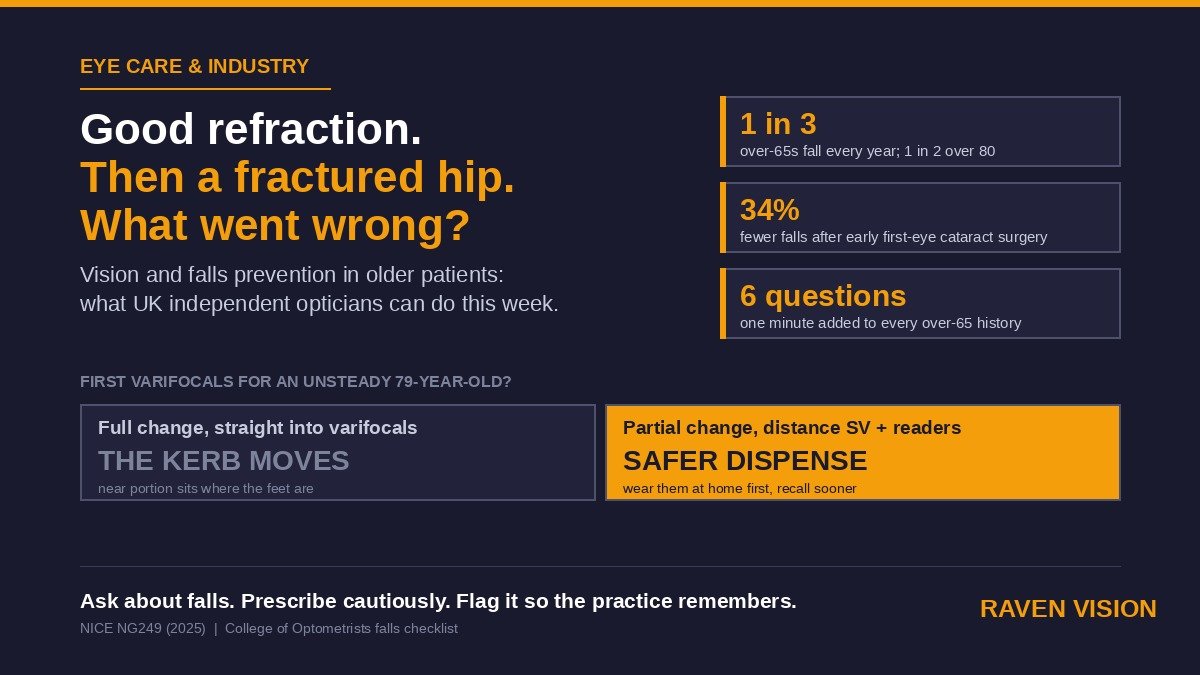

She’s 79, she’s been coming to you for eleven years, and today’s refraction shows a decent shift in her right eye. You correct it properly, she picks a new frame, and because she’s been squinting at her phone you move her from single vision into her first pair of varifocals. Good clinical work. Three weeks later her daughter rings to cancel the collection appointment. Mum caught her foot on the kerb outside the Co-op, went down hard, and is in Wythenshawe with a fractured hip.
Nobody in that story did anything wrong by the book. But nobody asked her whether she’d fallen before either, and nobody talked to her about what a new varifocal does to the pavement. That gap between good refraction and good outcome is where falls prevention lives, and for UK independent opticians it’s one of the most useful things you can do for an older patient that doesn’t need any new equipment at all.
Falls are an eye care problem, not just a geriatrics one
The numbers are big and they’re not new. Around a third of people aged 65 and over fall at least once a year, and around half of those aged 80 and over. In 2022/23 there were roughly 210,000 emergency hospital admissions in England related to falls in the over-65s. Falls are the most common cause of hospitalisation for people over 65 and of accidental death in the over-75s. Between 18% and 33% of people die within a year of a hip fracture, and fragility fractures cost the UK an estimated £4.4 billion a year.
Vision runs through all of it. Balance and postural stability depend on what the eyes are telling the brain. Stepping off a kerb, judging a stair edge, spotting the rug that’s rucked up in the hall, all of it is visual. The College of Optometrists’ work on falls puts it plainly: undetected and untreated visual impairment plays a significant role in the high incidence of falls among older people. And a fair chunk of that impairment is sitting in your patient list right now, in people who haven’t been in for three years, or who came in and left with a prescription that made things worse for a fortnight.
So this isn’t a public-health talking point. It’s a Tuesday afternoon in your consulting room.
What changed in 2025: NICE NG249
In April 2025 NICE published NG249, which replaced the 2013 falls guideline (CG161). Three things in it matter to an optical practice.
First, the scope widened. It now covers everyone aged 65 and over, plus people aged 50 to 64 who have a condition that raises their risk: dementia, Parkinson’s, stroke, arthritis, diabetes, a learning disability. That’s a younger patient than most of us picture when we think “falls”.
Second, it recommends a full multifactorial falls assessment for anyone who’s fallen in the past year and is living with frailty, was injured, lost consciousness, couldn’t get up on their own, or has fallen twice or more. That assessment includes gait and balance, a medicines review, and a home hazard check by an occupational therapist or trained assistant. Vision is one of the factors that should be looked at, which is where you come in.
Third, it’s built around referral. The falls team can’t do the eye examination. You can. The College’s updated report on the importance of vision in preventing falls, endorsed by Age UK, the Royal College of GPs and the British Geriatrics Society, exists to make that link work in both directions.
None of this makes you a falls clinician. It makes you part of the pathway, and most practices haven’t told anyone locally that they’re in it.
Six questions that take one minute
You don’t need a new form. You need six questions in the history for anyone over 65, or over 50 with one of the conditions above:
- Have you had a fall in the last year, even one you didn’t tell anyone about?
- Do you ever feel unsteady on your feet, or worry about falling?
- How many different medicines are you on? (More than four is a flag, sedatives especially.)
- Do you wear your varifocals or bifocals when you’re out walking?
- Stairs at home? Lighting on them?
- Do you live alone?
The College’s own falls checklist lists the risk profile: increasing age, being female, gait or balance problems, arthritis, postural hypotension, stroke, diabetes, Parkinson’s, sedatives, polypharmacy, and a history of falling. Two or three of those together and you should be prescribing differently and thinking about a referral. Write the answers in the record, not in your head. The next optometrist to see her, or the locum, needs to know.
The prescribing decisions that change the outcome
This is where the evidence gets specific, and where the reflex to “correct it fully and move her into varifocals” needs a second look.
Big prescription changes
Magnification changes with myopic and hyperopic shifts, and distortion changes with cylinder. For an unsteady 80-year-old, a large jump means the floor is somewhere different from where her brain thinks it is for a week or two. The College’s advice is to partially prescribe large changes and see them again sooner, and to warn patients about adaptation. Tell them to wear the new pair at home first, in familiar surroundings, rather than putting them on in the car park.
First-time multifocals
The College is direct on this: try to avoid prescribing bifocal, multifocal or varifocal lenses to patients at risk of falling who have never worn them before. The near portion sits exactly where the feet and the kerb are. For our 79-year-old, single-vision distance plus a separate reading pair was the safer dispense, even if it’s a less elegant one.
Long-term multifocal wearers who are active
The VISIBLE trial (Haran and colleagues, BMJ 2010) gave 606 older multifocal wearers at risk of falling a pair of single-vision distance glasses for outdoor use. In people who regularly went out and about, falls dropped by about 40%, and injurious falls dropped too. But in people who rarely left the house, the extra pair actually increased outside falls. The lesson isn’t “everyone gets a distance pair”. It’s that the intervention works when it’s matched to how the patient lives and when they’re counselled properly about swapping. The College’s version: for active long-term wearers, offer either a distance single-vision pair for outdoors or an intermediate-add design, and explain why.
That’s also a legitimate second-pair conversation with a clinical reason behind it, which is a much better footing than a discount. We covered the mechanics of that in our piece on second-pair sales that patients actually want.
Cataract: refer earlier, not later
Harwood’s randomised trial in the British Journal of Ophthalmology (2005) took 306 women over 70 with cataract and compared expedited first-eye surgery (about four weeks) against a twelve-month wait. The operated group fell 34% less often, and 3% of them had a fracture compared with 8% in the waiting group. That’s a strong argument for referring first-eye cataract on the basis of function and falls risk rather than waiting for the acuity to hit an arbitrary line, and for saying so in the referral letter. If your cataract referral pathway has a threshold baked into it, falls history is a reason to go under it.
Low vision, field loss and AMD
Patients with field loss, monocular vision or AMD are at significantly higher risk, and central loss in particular makes stairs and steps hard to judge. These patients should be flagged, told plainly about the risk, and pointed at the local falls service for a home hazard assessment. Our low vision services post goes into the clinical side; the falls angle is the same patients, one more conversation.
The dispensing conversation nobody has
Most falls counselling should happen at the dispensing desk, not in the chair, because that’s where the lens choice gets made and where the patient is thinking about the glasses rather than the diagnosis. Four things belong in that conversation for every at-risk patient:
How the new pair will feel for the first week and why. Where to wear it first (at home). Whether to take multifocals off, or swap to a distance pair, when walking outside. And the home stuff: brighter bulbs on the stairs, a contrasting strip on the top step, the rug in the hall, non-slip footwear. The College publishes a patient leaflet, Ageing Vision and Falls, that you can order overprinted with your practice details. Put it in the case with the new glasses.
This takes two minutes and it’s the part patients remember. It’s also the part the daughter remembers when she’s deciding where to take her mum next time.
Refer both ways, and tell them you exist
Every area has a falls service, usually sitting in community therapy or the older people’s team. NICE wants people who meet the criteria to get a multifactorial assessment; you can prompt that with a letter to the GP that says “history of two falls, first varifocal wearer, recommend falls assessment”. The College keeps a directory of falls teams that have registered their contact details, so you don’t have to guess who to write to.
The other direction is the one most practices miss. Falls teams see people whose vision hasn’t been checked in years. They’d send them to you if they knew you wanted them, offered a longer appointment, and would report back. One email to the local team lead, a paragraph about what you do, and a named contact at the desk is usually all it takes. The College even has a presentation template if you want to go and talk to them. That’s a referral stream that costs nothing and brings in exactly the patients who need you most.
Making it stick: records, recall and appointment length
The honest problem with all of the above is that it depends on remembering. The optometrist who asked the six questions in May isn’t the one seeing her in November, and the dispenser who did the counselling has moved on. Falls prevention that lives in people’s heads doesn’t survive staff turnover.
So it needs to live in the record. A falls-risk flag on the patient record that shows at the front desk, in the pre-test room and in the chair, so nobody has to rediscover it. A note of what was advised and which pair she was told to wear outdoors. And the medication count and the “lives alone” answer, because those change the prescribing decision next time too.
Then recall. If you’ve partially prescribed a big change, she needs to come back sooner than the standard interval. That’s a recall rule, not a Post-it: at-risk patients on a shorter cycle, with a message that says why (“we’d like to check how you’re getting on with the new glasses”) rather than the generic reminder. And when she does book, the appointment diary should know she needs the longer slot, so the desk doesn’t squeeze a 79-year-old with a walking stick into a twenty-minute gap before lunch.
If you offer home visits, this is the population that fills them. Our domiciliary eye care post covers the operational side. And the overlap with patients living with dementia is large; the conservative-prescribing rule is the same, and the risk is higher.
Where Raven Vision fits
We’ll be plain about this. Raven Vision doesn’t do the falls counselling. Shaukat does that, and has done for 35 years across the three practices he still runs. What the software does is stop the good work evaporating: a risk flag that follows the patient through the practice, appointment lengths that are set by the patient’s needs rather than the default, and recall rules you can set once for at-risk patients instead of relying on someone remembering.
It’s £149 a month per practice, with your first three months free, your data migrated for you, and no long contract. The pricing is public. If you’re comparing systems, ask each one how a clinical flag set in the chair shows up at the desk. It’s a small question with a big answer.
Start this week
You don’t need a project plan. Add the six questions to your over-65 history. Agree with your dispensers that first-time multifocals for at-risk patients get a second opinion before they’re ordered. Order the College’s leaflet. Email your local falls team. And put a falls flag in your records so that what you learn about a patient this month is still there next year.
Our 79-year-old is a composite, but the pattern isn’t, and most practices have a version of her every week. The difference between a good refraction and a good outcome is a few questions, a more cautious dispense, and a system that remembers.
If you’d like to see how flags, recall rules and appointment lengths work together in Raven Vision, book a walkthrough and bring a real patient record with you (anonymised, obviously). Or start with the pricing page, because we’d rather you knew the number before the demo.