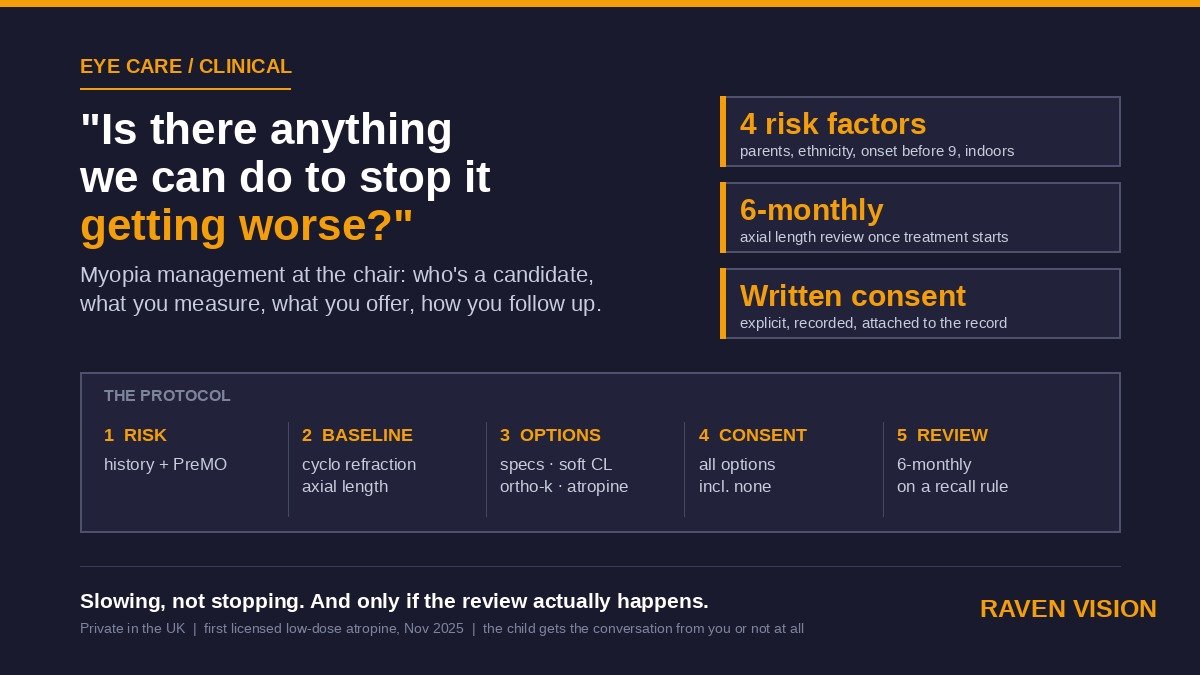

He’s eight. Last September he was −1.50 in both eyes and you gave him his first pair. Today he’s −2.25 right, −2.50 left, and he’s been sitting closer to the board. Mum is −5.00 herself and has been wearing glasses since she was seven. She asks the question every parent asks now, because they’ve read about it: “Is there anything we can do to stop it getting worse?”
Five years ago the honest answer in most UK independent practices was “not really, we’ll keep an eye on it.” That’s no longer true, and it’s no longer good enough. The College of Optometrists’ guidance says every optometrist should be able to discuss the risks of myopia and the options for managing it, whether or not they deliver the treatment themselves. This post is about what that looks like at the chair: who’s a candidate, what you measure, what you offer, how you consent, and how you follow up. Last week we wrote about what myopia management does to the shape of a practice over ten years. This is the consulting-room half of that conversation.
Why myopia management for UK children stopped being optional
Two things changed. The evidence matured, and the regulators caught up with it.
On the evidence side, the leading optical interventions now have multi-year trial data behind them. Daily disposable dual-focus soft lenses, defocus spectacle lenses and orthokeratology have all shown they slow progression, with the headline figures for the best-studied options clustering around half over the first few years, and a lot of variation between individual children. The Cochrane living review that the College points to keeps updating as new trials land. Nobody serious is arguing any more about whether it works. The argument is about who benefits most and how to deliver it well.
On the regulatory side, the College’s Guidance for Professional Practice now has a dedicated section on assessing and managing children with myopia. The 2024 UK and Ireland expert consensus set out what a baseline examination and a monitoring schedule should look like. And in November 2025 the MHRA licensed the first low-dose atropine product for slowing childhood myopia, which moved pharmacological treatment from “off-label, ophthalmology only” to something an independent prescribing optometrist can sit across the desk and talk about with a parent.
None of it is on the NHS. Every option is private. That’s a commercial fact, but it’s also a clinical one: the child in front of you either gets the conversation from you or doesn’t get it at all.
Who’s a candidate: risk before refraction
The mistake most practices make when they start is treating myopia management as something you offer once a child is already −3.00. By then you’ve missed the years where slowing progression makes the biggest difference to the final prescription.
The College lists four risk factors for becoming highly myopic, and they’re all things you can find out in the history: myopic parents, East Asian ethnic origin, onset before the age of nine, and a lifestyle heavy on near work and light on time outdoors. It also suggests using a risk-stratification tool based on age and refraction, such as PreMO, to spot children at risk of developing myopia before they have it.
The pre-myope
A six-year-old who’s only +0.50 when you’d expect more hyperopic reserve at that age, with two myopic parents, is a child you want back in twelve months rather than two years. The advice at this stage is simple and evidence-backed: more time outdoors may delay onset, and in some children prevent it. That’s a two-minute conversation with a leaflet, and it’s the cheapest intervention in the whole field. Our post on children’s eye tests covers how to get those families through the door in the first place.
The progressing myope
This is our eight-year-old. Young onset, a shift of more than half a dioptre in a year, a myopic parent. The College’s wording is that you should recommend myopia management options when, in your professional opinion, it’s clinically indicated and in the child’s best interests. For a child like this it plainly is, and the consent discussion should start today, not at the next test.
The child you’ll monitor
A fourteen-year-old at −1.00 who’s moved a quarter of a dioptre since last year, with no family history, is a different conversation. You still discuss it, because the guidance says you should, but “let’s measure properly and see” is a legitimate plan. What matters is that it’s a plan, with a date on it.
What you measure: the baseline that makes the rest possible
Myopia management is a long-term course of treatment. The College is explicit that you need a management plan set out at the start, with a repeatable, objective method for measuring baseline data and monitoring progression. If your baseline is a subjective refraction and a note that says “watch,” you’ve got nothing to compare against in six months.
Cycloplegic refraction
Cycloplegic autorefraction or retinoscopy gives you an objective, repeatable refractive baseline and takes accommodation out of the picture. The 2024 consensus lists it as part of the examination before starting treatment. In practice this means booking the child a longer slot, warning the parent about the drops and the blur afterwards, and doing it before you decide on a treatment rather than after.
Axial length
Axial length is the number that actually describes what’s happening to the eye. The consensus view is that it should be measured at baseline and then six-monthly once treatment starts. The College accepts either direct measurement with a biometer or a derived figure calculated from keratometry and cycloplegic refraction. A biometer is a real capital decision for a small practice, and the consensus is clear that not having one shouldn’t stop you delivering evidence-based myopia management using refractive and clinical progression data. But if you’re going to build a service around this, an axial length reading is what turns “the prescription’s gone up a bit” into a growth chart you can show a parent.
Everything else
Near point and amplitude of accommodation, binocular status, ocular health, and a proper history: parents’ prescriptions, hours outdoors, screen time, reading distance. Record all of it in a structured way, because the child will be seen by your locum in March and your new associate in September, and the plan has to survive that.
What you offer: the options in a UK practice in 2026
The College says you should explain the short- and long-term benefits and risks of all available interventions, in plain language, including what happens with standard single-vision correction and with no correction at all. That’s the framework. Within it, these are the options a UK independent can realistically offer.
Myopia-control spectacle lenses
Defocus spectacle lenses (the DIMS and HAL designs most UK practices dispense) are the easiest entry point. No handling, no hygiene concerns, works for the seven-year-old who won’t tolerate a contact lens, and the dispensing skills your team already has. The lenses are more expensive than single vision and need replacing as the prescription changes, which is the conversation to have upfront rather than at collection.
Dual-focus daily soft contact lenses
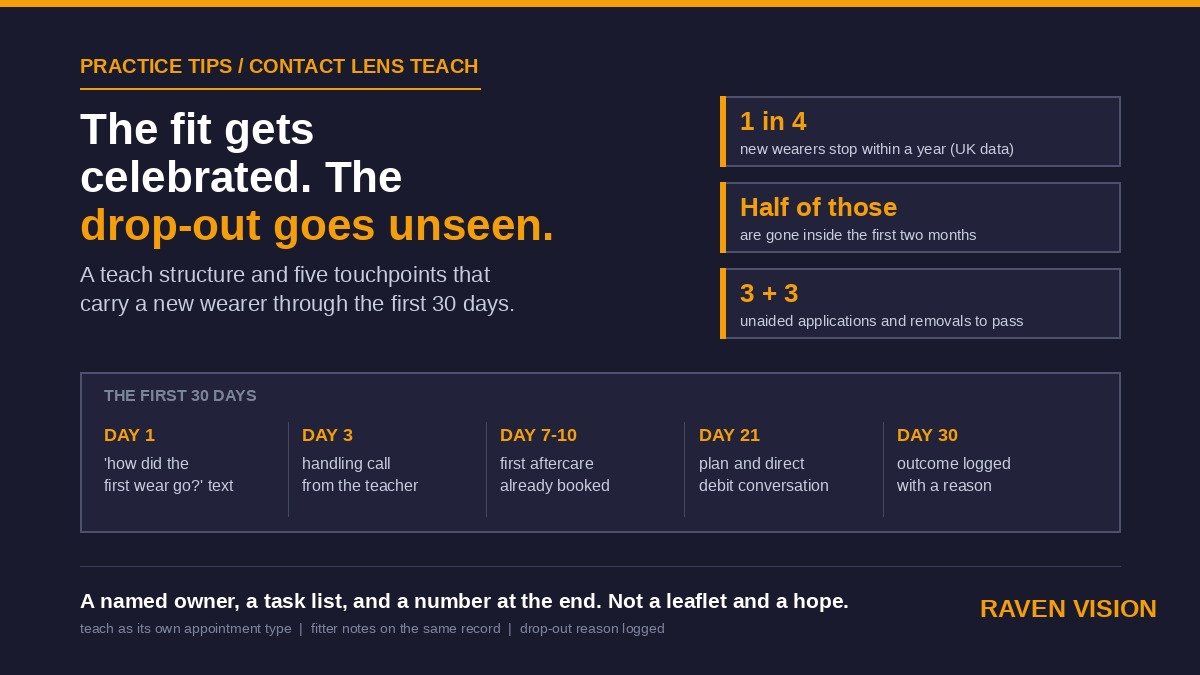
Daily disposables designed for myopia control suit the child who’s active, self-conscious about glasses, or old enough to manage the routine. It’s a teach appointment, an aftercare schedule and a monthly supply, which is exactly the shape of a contact lens plan on direct debit. Most practices that do this well run it as a plan rather than a series of purchases.
Orthokeratology
Overnight lenses that reshape the cornea, with daytime freedom from correction. Strong evidence, a keen following among sporty teenagers, and a higher bar in terms of fitting skill, topography and aftercare vigilance. It’s the option most independents add second, not first.
Low-dose atropine
This is the one that’s changed most recently. The MHRA licence granted in late 2025 covers low-dose atropine 0.1 mg/ml (0.01%) drops, once daily at bedtime, for children aged 3 to 14 with myopia between −0.50 and −6.00 DS who are progressing by 0.50 DS or more a year. It’s a prescription-only medicine, privately prescribed, and NICE’s appraisal is still to come, so it stays a private treatment for now. An IP optometrist can prescribe it; a non-IP optometrist can identify the candidate, have the conversation and refer. Check with your supplier on current availability, because the launch has been staged. Either way, the College’s position is that low-dose atropine belongs in the consent discussion alongside the optical options, and so does the option of no treatment.
The honest summary for a parent is this: there are several options that work, they differ in how they fit into your child’s life more than in how well they work, and the best one is the one your child will actually use every day for several years.
How you consent: the part that protects everyone
The College uses the word “must” here, which it doesn’t do lightly. When a decision to manage myopia is made, you must obtain explicit consent, giving enough information about every material risk that a reasonable parent would attach significance to, and giving them time to decide. A written consent form is described as a robust record of both the decision and the information provided.
What goes in the discussion: what myopia is and why it matters for long-term eye health, the expected outcome expressed as honestly as the evidence allows (slowing, not stopping; relative and absolute terms where you can), the likely length of treatment, the aftercare schedule, the cost over the whole course rather than the first appointment, and what happens if they choose single vision instead. Then the record needs a summary of that discussion, the decision, the anticipated outcomes and the actions taken.
Two practical points. First, don’t do the consent in the last three minutes of a standard sight test. Book a separate myopia consultation, twenty minutes, with the parent present and the numbers on the screen. Second, put the consent form in the record system rather than a filing cabinet. If the parent asks in two years what you told them, or if a complaint ever comes in, the version that’s attached to the patient record is the one that counts.
How you follow up: six-monthly, on a rule, not a memory
This is where most myopia services quietly fail. The baseline was done properly, the lenses were fitted, the parent was delighted, and then the child came back eighteen months later because nobody chased the six-month review and the family assumed the new glasses had “fixed it.”
The consensus schedule is straightforward: once an intervention starts, review six-monthly with a non-cycloplegic axial length measurement, plus refraction, plus a check that the child is actually wearing the correction as agreed. Annual cycloplegia is a judgement call. What’s not a judgement call is that the review happens.
Which means the six-month review needs to be a recall rule that the system applies to every myopia management patient, with a message to the parent that explains why (“this is the check that tells us whether the treatment is working”), not a generic reminder. It means the appointment diary needs to know this child gets a myopia review slot, not a standard test slot, so the front desk doesn’t have to remember. And it means the axial length readings need to sit in the record as a series, so the optometrist can pull up the trend in the chair rather than digging through three old letters.
Do the same for the pre-myopes you’re watching. Twelve-month recall, flagged as “at risk,” so the reminder goes out on time and the next optometrist sees the flag before they see the child.
The team, not just the optometrist
The ABDO guidance for practice teams makes the point that myopia management works best when optometrists and dispensing opticians share it. In practice: the optometrist assesses, consents and prescribes; the dispensing optician fits the spectacle lenses or teaches the contact lenses and runs the aftercare; the front desk explains the plan pricing and books the six-month review before the family leaves. Everyone needs to be able to answer “is this really worth it?” the same way, because the parent will ask all three of them.
Train it once, write it down, and put it in the induction for the next receptionist. A myopia service that only works when one person is in the building isn’t a service.
What the software has to do
We’ll keep this short. Raven Vision doesn’t measure axial length or fit an ortho-k lens. Shaukat does that, in the three practices he still runs after 35 years, and he’s the one who told us what the record needed to hold.
What the software does is stop a long-term treatment falling apart between visits: a myopia management flag on the patient record that everyone sees, structured fields for the baseline and each six-monthly reading so the trend is there in the chair, the consent form attached to the record rather than a drawer, a review recall rule set once for every patient on the programme, appointment types with the right length, and plan billing so the monthly cost is collected without a conversation at the desk every time.
It’s £149 a month per practice, your first three months are free, we migrate your data, and there’s no long contract. The pricing is public. If you’re comparing systems for a myopia service, ask each vendor one question: where does the axial length go, and can the optometrist see the trend without leaving the record?
Start with the eight-year-old
You don’t need a biometer or an IP qualification to start this month. Add parental prescription, outdoor time and near-work habits to your paediatric history. Agree the recall rule for at-risk children. Write down the consent conversation so it’s the same every time. Pick one optical option your team can deliver well, and get the training done. Then, when the next eight-year-old comes in half a dioptre worse than last year, you’ll have an answer that isn’t “we’ll keep an eye on it.”
If you’d like to see how flags, structured clinical fields, recall rules and plan billing work together for a myopia programme, book a walkthrough and bring a real (anonymised) myopia patient with you. Or start with the pricing page, because we’d rather you knew the number before the demo.