
Ask an independent optician what the practice made last year and you’ll usually get one of two answers. Either a turnover figure, said with some pride, or a slightly defensive “we did alright”. Ask what they made, personally, for the hours they put in, and the room goes quiet.
That silence is the subject of this post. Most owner-optometrists and owner-DOs in the UK have never separated two numbers that should never be mixed: what the practice pays them for the job they do, and what the practice earns as a business after that. Blend the two and you can run a practice for twenty years, work fifty-hour weeks, and never find out whether you actually own a profitable business or just a demanding job with a lease attached.
The number most owners are quoting isn’t the number that matters
Turnover tells you how busy you are. Net profit on the accounts tells you what’s left after costs. Neither tells you the thing you actually need to know, which is this: if you paid someone else to do everything you do in this building, would there be anything left?
Here’s why the accounts don’t answer that. If you trade as a limited company, and most practices with any scale do, your accountant will almost certainly have you on a small director’s salary and the rest in dividends. For 2026/27 the tax-efficient director’s salary for a lot of one-director companies sits down at £5,000 a year, roughly the employer National Insurance threshold, with the balance taken as dividends. That’s sensible tax planning. It’s also the reason your P&L shows a healthy-looking profit: the biggest cost in the practice, which is a qualified clinician working full-time, has been recorded at a fraction of its real value.
Sole traders have the opposite problem. There’s no salary line at all. Drawings come out of profit, so “profit” is really “everything, including my wages”. Either way, the accounts are built for HMRC, not for you as a manager.
Why this is worse in optics than in most small businesses
Because the owner is usually the main fee-earner. A café owner can stand behind the counter or not; the coffee still gets made. In a single-testing-room independent, the owner is often the only person who can legally do the thing the patients came in for. So the “owner’s job” isn’t a bit of admin on top. It’s the clinical engine, plus the buying, plus the HR, plus the landlord conversations, plus the person the team rings on a Sunday. All of that gets bundled into one figure called “what I take out”.
We wrote about where those hours actually go in the owner’s time audit. This post is the money version of the same exercise.
Split it: what the practice pays you, versus what the practice makes
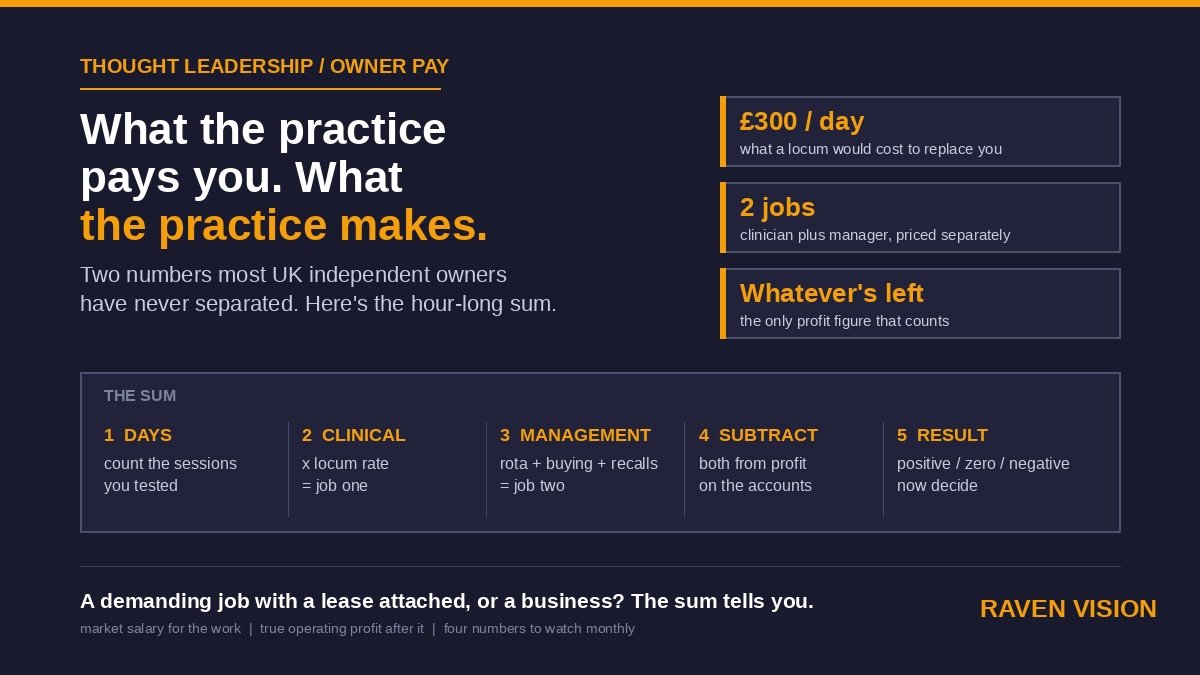
The fix is a piece of mental accounting your real accounts will never do for you. Take last year’s figures and rebuild them with one change: replace your actual salary and drawings with a market salary for the jobs you do. Not what you’d like. What it would cost to hire someone.
Step one: price the clinical hours
Count the testing sessions you personally covered last year. Then price them at what you’d pay a locum to cover them, because that’s the real replacement cost. Locum optometrist rates in community practice in 2026 sit broadly in the £250 to £350 a day range depending on region and whether it’s a Saturday, and they’ve been drifting upwards since the post-pandemic squeeze on supply. An employed optometrist on a full-time contract typically comes in somewhere around the low-to-mid £50,000s nationally, more in London and more again if you want someone with independent prescribing.
Pick whichever basis matches how you’d actually cover the gap. If you tested four days a week for 46 weeks, that’s 184 locum days. At £300 a day that’s £55,200 before you’ve done anything but test eyes.
Step two: price the management hours
Now the part almost everyone skips. Someone has to do the rota, the stock buying, the supplier chasing, the recalls, the GOS submissions, the reviews replies, the appraisals. If it’s you, price it. A practice manager in a UK independent is a real job with a real salary; if you’re doing half of one, the honest figure is half of one. We looked at when that hire pays for itself in when to hire a practice manager. For this exercise, put something realistic in. £15,000 to £20,000 for a part-time-equivalent slice isn’t unusual.
Step three: look at what’s left
Add the two together. That’s the salary the practice should be paying you for the work. Now subtract it from the profit on the accounts (adding back whatever token salary was already in there). What remains is the true operating profit: the return the business generates on its own, over and above paying the person running it.
Three outcomes are possible, and each one tells you something different.
It’s comfortably positive. Good. You own a business. The next question is whether you’re extracting that profit, reinvesting it, or leaving it in the bank because you’ve never had a reason to think about it. That figure is also, roughly, the number a buyer would look at, and it’s the basis of what your practice is actually worth.
It’s around zero. This is the most common result and the most uncomfortable one. It means the practice pays you a fair salary for two jobs and generates nothing beyond that. You’re not losing money. You’re also not building anything. Every year of ownership is, financially, one more year of employment with extra risk and no employer pension contribution.
It’s negative. The practice can’t afford you at market rate. You’ve been subsidising the business with underpaid hours. That’s not a moral failing; it’s extremely common in year one to three, and in practices carrying an expensive lease or a second site that never quite took off. But it needs a plan with a date on it, not another five years of hoping.
Why owners avoid doing this sum
Partly because the accounts don’t prompt it. Partly because it’s genuinely a bit frightening. But mostly, in our experience, because of three beliefs that sound reasonable and aren’t.
“It’s fine, I’ll take the profit out eventually”
Only if there is some. A lot of owners are running on the assumption that a good year is coming which will make up for the flat ones. Without the split, you can’t tell whether the flat years are the practice’s normal state or an aberration. The split makes the pattern visible.
“I’m not in it for the money”
Nobody goes into independent practice purely for the money; you’d have joined a multiple. But there’s a difference between choosing to earn a bit less for the freedom, and not knowing how much less. The first is a decision. The second is drift. Most owners who do the sum find the gap is bigger than they’d have guessed, and some find it’s smaller, which is its own relief.
“The building and the goodwill are my pension”
Sometimes true. But goodwill in an owner-dependent practice is worth far less than owners assume, precisely because the buyer inherits a business that only works when you’re in it. If your true operating profit is zero, the goodwill is largely your own labour, and you can’t sell that. We covered the mechanics in the practice that shouldn’t need you every day. The pay split is the financial proof of the same problem.
Moving the number: what actually changes it
Once you have the true operating profit in front of you, there are only a few levers that move it, and they’re not the ones people reach for first.
Charge for what you actually do
The single biggest reason true profit is thin in UK independents is that the clinical hour is priced by someone else. The GOS sight test fee in England moved to £24.13 in April 2026, and everyone in the sector knows what that buys. If a large share of your testing days are spent on funded tests with no private wrap-around (enhanced exam, OCT, dry eye assessment), then your most expensive resource, your own chair time, is being sold below cost. We’ve made the full argument in why you should stop building the practice around the sight test fee. The pay split just puts a number on how much it’s costing you personally.
Get off the testing rota, at least partly
Counter-intuitive, but true. If a locum costs £300 a day and a day of you doing owner work (recall strategy, pricing, the second-pair conversation with the DOs, chasing the lab that’s been slow for three months) is worth more than £300 to the business, then buying yourself out of the chair one day a week is the highest-return spend available. Most owners don’t do it because they can’t see the return. The split makes it visible: if your management hours are worth £20,000 and you’re doing them at 8pm, you’re paying yourself for them twice, once in money and once in exhaustion.
Fix the leaks that are invisible in the accounts
Overdue recalls that never get chased. Uncollected spectacles sitting in a drawer. Remakes absorbed as “just one of those things”. GOS claims rejected and never resubmitted. None of these show up as a line on the P&L; they show up as revenue that quietly didn’t happen. In a practice with £400,000 of turnover, a 3% recall improvement and a 2% cut in remakes is worth more than most owners’ entire “profit” under the honest calculation.
Pay yourself properly, then see what’s left
Some owners, having done the sum, decide to formalise it: set a real salary, pay it monthly, and treat anything above that as the business’s result rather than theirs. It changes behaviour. A practice that has to fund a £60,000 owner salary every month before it counts as profitable starts making different decisions about pricing, about the Saturday rota, about the frame rep who keeps turning up with “just a few more” lines. Whether your accountant wants it structured as salary or dividends is a tax question and theirs to answer. The management discipline is yours.
What you need to be able to see, every month
You can do this exercise once a year on the back of the accounts. It’s more useful as a monthly habit, and for that you need the practice management system to give you a handful of numbers without a spreadsheet exercise.
Revenue split by NHS and private, and by clinical, dispensing and contact lens income, so you can see which of your hours are earning and which aren’t. That lives in the billing and finance module, where NHS and private sit on the same invoice and the split reports itself rather than needing reconstruction from the till roll. Clinician-level output, so you can put a value on your own testing days against the associate’s or the locum’s; that comes from the diary, provided appointment types are set up properly. Recall performance and overdue patients, because that’s where the leaks live; the recall system should be telling you how many patients are past due, not leaving you to guess. And dispense rate by clinician, which comes from linking the record to the dispense in the patient record rather than in two systems that don’t talk.
If getting those four numbers takes an afternoon, you won’t do it monthly. If it takes ten minutes, you will.
Where Raven Vision fits, honestly
Raven Vision was built inside real independent practices by an owner who’d done exactly this sum and didn’t like the answer. The reporting is set up around the questions above: NHS versus private, income by category, clinician output, recall status, dispense conversion. Nothing in it will run the practice for you, and it won’t decide what your salary should be. What it does is take the “I’d need to pull that together” out of the monthly review, so the honest number is something you look at rather than something you avoid.
It’s £149 a month, all modules, no per-user pricing, and no long contract. The pricing is on the pricing page. Against ourselves: if your accountant already gives you a proper management-accounts pack every month with a market-rate owner salary built in, you may not need the software for this particular job. Most independents we meet don’t have that pack. They have year-end accounts, nine months late, built for the tax return.
Do the sum this week
It takes about an hour. Last year’s accounts, a count of the days you tested, a locum rate, and an honest guess at your management hours. Write down the three numbers: market salary for the clinical work, market salary for the management work, and what’s left after both.
Then decide what you’re going to do about the third number. If it’s healthy, decide what the profit is for. If it’s zero, pick the one lever above that moves it most and give yourself a quarter. If it’s negative, that’s the conversation to have with your accountant before Christmas, not after.
And if you’d like to see how the monthly numbers look when the system is doing the pulling-together for you, book a walkthrough. Bring last year’s accounts if you like. We’ll show you where the four numbers live and let you do the sum on your own data.