
Ask most independent opticians where new patients come from and you’ll hear “word of mouth,” “the school run mums,” maybe “that leaflet drop we did in 2023.” Ask them who last checked their Google Business Profile and you’ll usually get a shrug. Someone claimed it years ago, put the opening hours in, and never touched it again.
That’s a problem, because for a huge share of the people searching for an optician right now, that profile is your practice. They haven’t found your website. They haven’t heard your name from a friend. They’ve typed “optician near me” or “eye test Sale” into their phone, and Google has handed them a map, three names, a star rating and a “Open until 6pm” badge — and they’ll pick one of those three before they ever click through to a site.
The Door Patients Walk Through Before They Walk Through Yours
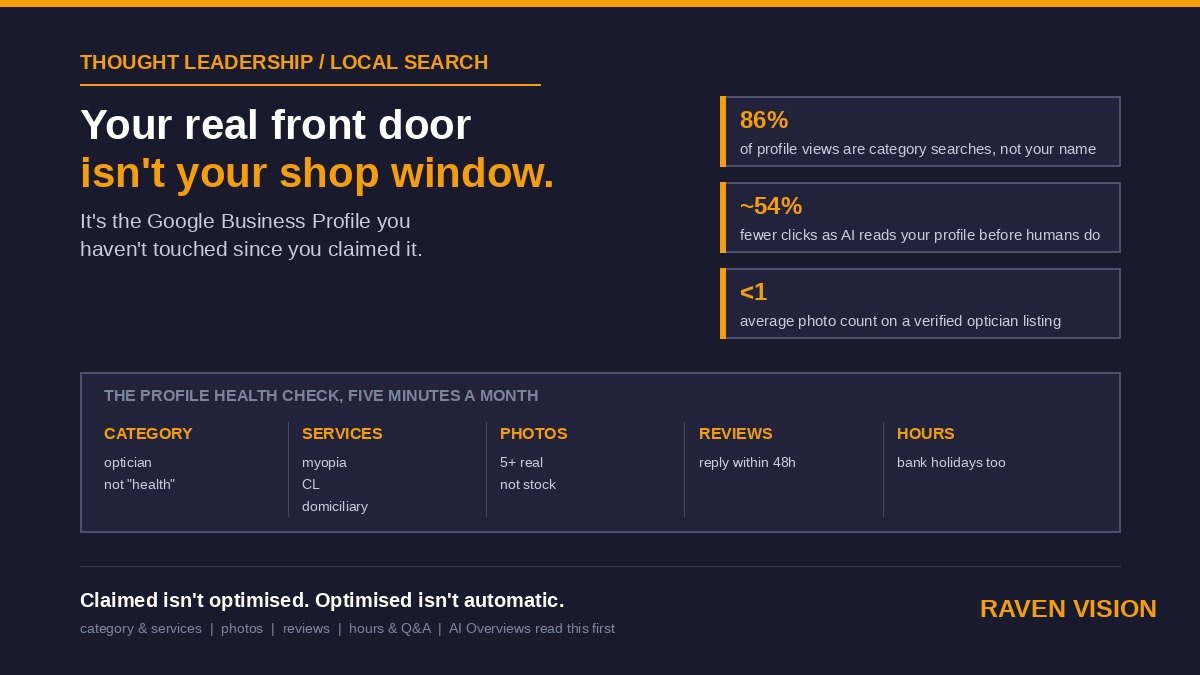
Local search doesn’t work the way most practice owners assume. It isn’t a smaller, slower version of the main website. For category searches — “optician,” “eye test,” “opticians near me” rather than a branded search for a specific practice name — the local pack often is the entire decision-making surface. One recent industry analysis found that 86% of Google Business Profile impressions now come from category-based searches rather than branded ones, meaning the overwhelming majority of people finding a listing weren’t looking for that business by name at all. They were looking for “an optician,” and Google decided which three they’d see.
Mobile makes this sharper. Roughly three-quarters of local searches now start on a phone, most of them away from a desk, often while someone’s already out and thinking “I’ll sort my eyes while I’m passing.” Those searches convert fast — industry figures put a large majority of “near me” mobile searches as leading to a visit within 24 hours. That’s not a browsing window. That’s someone deciding, in the next hour, whether it’s your practice or the one two doors down that gets the appointment.
None of that requires your website to be good. It requires your profile to be accurate, complete and current — which, for most independents, it isn’t.
What “Optimised” Actually Means (Not What You Think)
“Optimise your Google Business Profile” has become one of those pieces of advice that gets repeated so often it stops meaning anything. In practice, for an optician, it breaks down into a handful of specific things — most of which take twenty minutes, not an agency retainer.
Get the primary category right first: “Optician” or “Optometrist,” not the vaguer “Health” or “Medical clinic” some directories default to. Add every relevant service as a listed service, not just implied by the name — eye tests, contact lens fittings, myopia management, dispensing, domiciliary visits if you offer them. Someone searching “myopia management optician near me” is a far higher-intent lead than someone searching “optician,” and Google can only surface you for that search if the service is actually on the profile.
Keep opening hours genuinely current, including the boring bit: bank holidays, the early close before Christmas, the one Saturday a month you’re shut for training. A profile that says “Open” when the shutters are down doesn’t just lose that visit — it teaches Google, and the patient, that your data can’t be trusted.
The Photo Problem Nobody Notices
Here’s a specific, slightly embarrassing stat: the average verified Google Business Profile has fewer than one photo. Not one category of photo — fewer than one photo, full stop. Profiles with fifteen or more photos see measurably stronger engagement across clicks, calls and requests for directions.
For an optician, this is an easy win sitting in your camera roll. The frame wall. The testing room. Reception on a Tuesday morning, not staged, not stock. The team, named, smiling. A close-up of the dispensing bench. None of it needs a photographer. It needs someone to open the app once a month and upload five photos instead of zero — and it’s one of the few local-search levers that costs nothing but attention.
Categories and Services Aren’t a One-Time Job
The profile you set up when you opened isn’t the profile you need now. If you’ve added myopia management, an OCT scanner, or a specific contact lens brand partnership in the last two years, does your Google Business Profile know that? Most don’t. Revisit the services list every time the practice’s actual offer changes — not annually, when it changes.
Reviews Are the Second Door
Once someone’s past the map pack, reviews decide the rest. Somewhere in the region of 97–98% of consumers say they read reviews before choosing a local business, and a large majority say they trust those reviews roughly as much as a personal recommendation from someone they know. That’s not a soft “nice to have” — for a health-adjacent purchase like glasses or contact lenses, where people are naturally a bit more cautious than buying a coffee, it’s close to a prerequisite.
We’ve written before about building an actual review-generation habit rather than hoping happy patients remember to leave one unprompted — see our Google reviews system for UK independent opticians for the mechanics. The point that matters here is the connection: reviews live on your Google Business Profile. A profile with forty-three reviews and a 4.8 average is doing active selling, every hour it’s live, before a human on your team says a word.
AI Search Is Reading Your Profile Before Anyone Clicks
This is the part that’s changed fastest, and it’s the part most independents haven’t clocked yet. AI Overviews and similar AI-driven answers are now pulling directly from Google Business Profile data to answer questions like “is there an optician near me open on Sunday” or “which opticians offer myopia management in [town]” — without the searcher ever clicking through to a website, or in some cases even to the map pack.
The headline number from a recent industry study on this shift is worth sitting with: impressions per location have fallen by roughly 54% as AI answers absorb searches that used to generate a click, while the actions that actually matter — calls, direction requests, bookings — have dropped by only around 5%. Read that carefully. Fewer people are browsing. The ones still taking action are the ones who were always going to book. Visibility is contracting; the searches that convert are holding up.
What that means practically: the fight isn’t for more impressions any more, it’s for being the accurate, structured, well-populated profile that the AI answer pulls from in the first place. If your services, hours, and categories are vague or stale, you’re not just invisible to a human scrolling — you’re invisible to the system doing the scrolling for them.
The Owner Habit This Actually Takes
None of this needs to become a project. It needs to become a fifteen-minute habit, ideally owned by one named person rather than “whoever remembers”:
Weekly: reply to any new reviews, good or bad — a reply within a day or two signals an active, cared-for business, and a calm, professional response to a bad review often does more for trust than the review itself did damage.
Monthly: upload two or three fresh photos; check opening hours are still accurate against the actual rota; post one update (a new service, a seasonal reminder, a staff addition).
Quarterly: search for your own practice from a personal phone, log out of any business accounts, and look at what a stranger actually sees — wrong phone number, a duplicate listing from years ago, an out-of-date “temporarily closed” flag from a snow day in January. These things sit there silently costing you visits until someone looks.
Where This Sits Next to Everything Else You’re Doing
If you’re already running local community marketing — school partnerships, workplace talks, the stuff that builds real relationships two miles from the practice — your Google Business Profile is the free layer underneath all of it. Every one of those relationships eventually sends someone to their phone to check you out before they book. If what they find is a stale profile with three-year-old opening hours and no reviews, the community goodwill you built doesn’t survive the search.
Think of it as the free, always-on version of the marketing you’re already doing elsewhere — it doesn’t replace paid ads or local partnerships, but it decides whether the people those efforts send your way actually convert.
Where Raven Vision Fits — and Where It Doesn’t
Let’s be straight about this: Raven Vision doesn’t manage your Google Business Profile for you. That’s not our software, and any practice management vendor telling you otherwise is stretching the truth.
What we do sit next to is the follow-through. Once a search brings someone through the door, our appointment booking and patient management tools make sure that first visit actually gets recorded properly, that a recall is set so they come back for their next test, and that the experience matches the four-and-a-half-star version of your practice they read about before they walked in. A brilliant Google Business Profile that sends someone to a practice with a messy diary and no recall system is a wasted click. The two things need to work together — visibility gets them to the door, the software behind the desk decides whether they become a patient for the next ten years via efficient recall.
We’re a single-room practice’s software as much as a five-branch group’s — built inside working practices first, not designed in a boardroom and sold in afterward. If your Google Business Profile is already sending you people, and your systems behind the scenes aren’t quite keeping up with them, that’s exactly the gap we close.
Twenty Minutes, This Week
You don’t need a marketing agency to fix any of this. Open the Google Business Profile app, or search your own practice name and click “Manage now.” Check the category. Check the services list matches what you actually offer today. Upload five photos. Reply to your last unanswered review. That’s the whole first pass — twenty minutes, no budget, and it starts working on your busiest front door immediately.
If you want to see how the follow-through side works — turning the people your profile brings in into patients who actually rebook — take a look at our current offer or check pricing. Bring your own numbers to a demo and we’ll show you where the gap actually is.