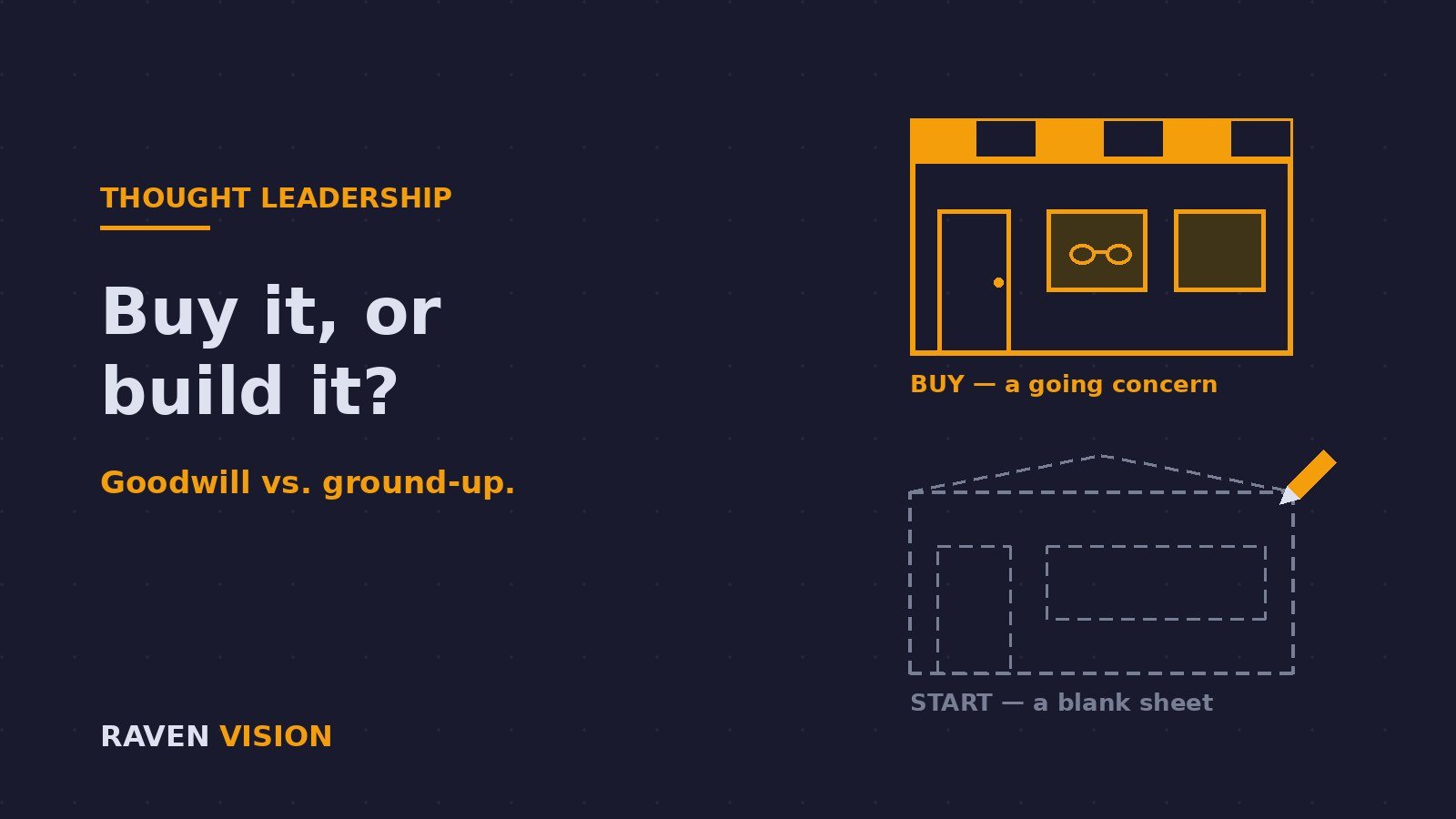

At some point, almost every ambitious optometrist or dispensing optician working for someone else has the same thought on the drive home: I could run my own practice. And then, hot on its heels, the second thought — the one that actually matters: do I buy one, or do I build one?
It’s the biggest financial decision most people in this profession will ever make, and the advice floating around tends to come from people with something to sell you. Brokers lean towards buying. Shopfitters and equipment suppliers love a cold start. Your accountant will tell you it depends, which is true and also no help at all.
So here’s an attempt at the honest version — what each route actually costs, what each one actually gets you, and the questions that matter more than either.
What you’re really choosing between
Strip away the detail and the choice is simple: you’re deciding whether to pay for certainty or pay for control.
Buy an existing practice and you’re paying a premium — the goodwill — for a patient base that already exists, a diary that already fills, and a turnover figure you can show a bank. Start from scratch and you keep that premium in your pocket, but you spend it anyway: on marketing, on months of overheads with a half-empty diary, and on the slow, expensive process of convincing a town you exist.
Neither route is cheaper than the other in any reliable way. They just move the cost — and the risk — to different places.
The case for buying: you’re paying to skip the scary years
When you buy a going concern, the thing you’re mostly buying isn’t the frames on the wall or the test chair. It’s the patient records, the recall cycle that keeps generating appointments, the reputation, and the cash flow that starts on day one. That’s what goodwill is: the value of not having to build any of that yourself.
A practice with an established recall system is a machine that books its own appointments. You take the keys on Monday and there are patients in the diary on Tuesday — patients who were recalled by a system someone else spent twenty years building. From a pure risk perspective, that’s an enormous head start. It’s also why lenders like practice purchases: there’s a trading history to underwrite, not a spreadsheet of hopeful projections.
How practices are actually priced in 2026
Forget the old pub wisdom about “a percentage of turnover.” Specialist optical business transfer agents Myers La Roche — who value over a hundred independent optical businesses a year — describe turnover ratios as an incredibly crude approach that produces wildly inaccurate figures. The credible method is yield-based: work out the practice’s true underlying profit (its EBITDA), then apply a multiple.
Two things matter here. First, the “true” profit is rarely the number on the accounts. Valuers typically make five to ten adjustments — adding back owner pension contributions, correcting owner salaries to market rate, stripping out one-offs — before the real earnings picture emerges. Second, the multiple varies enormously: anywhere from 2 at the bottom end to 8 at the extreme top, with most independent practices sitting in the lower half of that range. A practice with £80,000 of genuine adjusted profit might be worth £200,000 to one buyer’s logic and £350,000 to another’s, depending on location, lease security, specialisms, and how much of the goodwill walks out the door when the current owner does.
That last point deserves underlining. If the practice’s reputation is the outgoing owner — their name on the sign, their relationships with three generations of families — some of what you’re paying for evaporates the day they leave. Good valuations price that in. Optimistic buyers don’t.
What buying doesn’t protect you from
You inherit everything, and everything includes the problems. A tired shop fit that needs £40,000 spending on it within two years. A lease with eighteen months left and a landlord who won’t commit. Staff on terms you’d never have offered. Patient records held in a piece of desktop software that was last updated when flip phones were fashionable, with no clean way to get the data out — something we covered at length in our guide to switching practice management software.
Due diligence is where practice purchases are won or lost. Not the headline price — the lease, the staff contracts, the state of the recall data, and how much of last year’s profit was really the owner working sixty-hour weeks for free.
The case for the cold start: nothing to unpick
The romance of the cold start is real, and it isn’t only romance. Every decision is yours. The location, the brand, the shop fit, the equipment, the services, the software, the culture — all chosen deliberately, none inherited. There’s no previous owner’s ghost in the consulting room and no twenty-year-old habits to unwind. For a certain kind of owner, that clean sheet is worth more than any patient list.
What it really costs
Sector finance specialists put the entry cost of a modest cold start at around £50,000 — premises, basic fit-out, essential equipment — but that’s the floor, not the average. Plenty of founders report needing £100,000 or more once you price in a proper test room, an OCT if you want one, stock, and enough working capital to survive the quiet months. The good news: lenders generally view optics as a low-risk sector and are willing to fund it. The bad news: they’re markedly less willing when there’s no trading history, because your business plan is a story, not evidence.
The two-to-three-year grind
Here’s the part the shopfitter’s brochure skips. Myers La Roche’s own guidance for founders is blunt: expect to commit to significant marketing spend for the first two to three years, carry the full overheads while turnover slowly climbs to meet them, and accept that established local competitors — who cleared their borrowings years ago and know their suppliers’ best prices — can outlast you in any price war you’re daft enough to start.
A cold start doesn’t fail at the grand opening. It fails in month fourteen, when the founder is doing the testing, the dispensing, the marketing and the bookkeeping, the diary is 60% full, and the overheads arrive with the same punctuality they did in month one. The founders who make it through tend to be the ones who budgeted for that valley honestly — in cash and in stamina — before they signed the lease.
The question underneath: what are you actually good at?
Most articles on this topic pretend the decision is financial. It’s mostly not. It’s temperamental.
Buying suits people who are good at improving things: spotting the underperforming practice whose owner has coasted for a decade, seeing the 20% that’s missing, and executing. You need to be comfortable inheriting other people’s decisions and patient enough to change a culture without breaking it.
Starting suits people who are good at building things: selling a vision before there’s proof, doing five jobs at once, and holding their nerve through eighteen months of numbers that would make a buyer’s bank manager faint. You need stamina more than capital, though you’ll need both.
Be honest about which one you are. The most expensive mistake in this decision isn’t overpaying for goodwill or under-budgeting a fit-out — it’s choosing the route that suits the owner you wish you were rather than the one you actually are. It’s the same self-audit we recommended when we looked at opening a second practice: the numbers only work if the owner does.
One more thing worth knowing before you choose: the independent sector is consolidating, and strong practices are increasingly courted by groups and corporate buyers. That cuts both ways. It means good practices rarely go cheap — but it also means that whichever route you take in, you’re building an asset someone will one day want to buy from you. Worth reading alongside our piece on succession planning for UK independent opticians, because the best time to think about the exit is, unhelpfully, the entrance.
Whichever route you take, the systems decision comes with it
Here’s the thread that runs through both routes and gets budgeted for in neither.
Buy a practice and you inherit its systems — often a desktop dinosaur, sometimes literal paper. The patient records are the single most valuable thing you just paid for, and they’re sitting in software you can barely export from. Migrating that data cleanly isn’t an IT chore; it’s protecting the goodwill you just bought. A recall list that doesn’t survive the transition is money quietly leaving the building.
Start from scratch and you get the opposite problem: a genuinely blank slate, and a strong temptation to solve it with a spreadsheet and a paper diary “just until things settle.” Things never settle. The practices that scale smoothly are the ones that started with a proper practice management system on day one — appointments, records, recalls and billing in one place — so the recall engine starts compounding from the first patient, not the five-hundredth.
This is, candidly, the problem Raven Vision was built for. Our co-founder Shaukat has spent thirty-five years in optics and runs three practices of his own — he’s been the buyer inheriting someone else’s records and the builder starting with none. RV comes with free data migration for buyers taking over legacy systems, and for cold starts it’s the whole operational stack from day one at £149 a month, with three months free and no lock-in. Either way, the systems question is answered before it becomes expensive.
Five questions to settle before you decide
If you’re at the crossroads now, sit with these before you talk to a broker or a bank:
- How much certainty can you afford to lose? If a year of thin income would break you financially or psychologically, buy. Cash flow from day one is worth the goodwill premium.
- Is there actually a practice worth buying where you want to live? The right purchase in the wrong town is the wrong purchase. If nothing good is for sale in your area, the market has made the decision for you.
- What does the seller’s profit look like after normalisation? Not the accounts — the adjusted figure, with a market-rate salary for the work you’ll actually be doing yourself. Pay a multiple of the real number, not the flattering one.
- If starting: can you fund the valley, not just the opening? Fit-out plus equipment plus two years of marketing and overhead shortfall. If the plan only works with a full diary by month six, it isn’t a plan.
- What happens to the data? Buying: can the records come out of the old system cleanly, and who pays for that? Starting: what system runs recalls from patient number one? Answer it before the lease, not after.
The bottom line
Buying pays for the past — someone else’s years of patient-building, priced as goodwill. Starting pays for the future — your own vision, funded through a long unprofitable valley. Both can work brilliantly. Both go wrong for predictable, avoidable reasons: buyers who skip due diligence and founders who budget for the opening but not the grind.
And both, on day one, need the same thing: a practice that runs on a system rather than on memory. If you’re weighing up either route and want to talk through the operational side — what migration from a legacy system actually involves, or what a cold-start stack should look like — book a demo and we’ll show you how it works, using the setup Shaukat runs in his own three practices. No hard sell. Just the machinery, working.