
Sooner or later, the letter arrives. Or the phone call, or the polite conversation at a trade show that turns out to have an agenda. Someone wants to buy your practice, partner with your practice, or sign your practice up to something. The pitch is always a version of the same sentence: you can’t compete on your own any more.
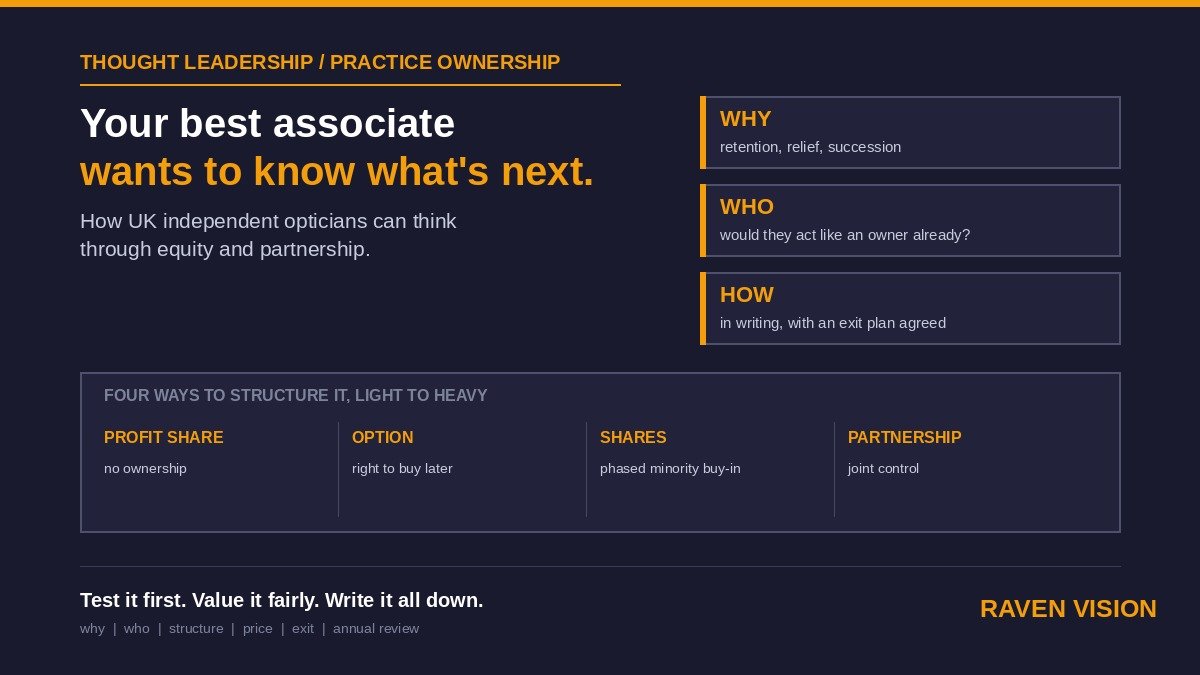
It’s worth taking that sentence seriously, because it’s half true. The half that’s true is about buying power, back-office costs and marketing budgets. The half that isn’t true is the conclusion — that the answer is handing over equity, your fascia, or both. Between “fully independent and going it completely alone” and “selling to a multiple” there’s a whole spectrum of models, and most practice owners only ever hear the sales pitch for one of them at a time.
So here’s the whole spectrum, laid out honestly, with the trade-offs attached.
The four models, honestly described
Fully independent, no affiliations
You own everything: the name above the door, the supplier relationships, the pricing, the patient list, the headaches. Every discount you get, you negotiated. Every system you run, you chose. This is the model with the most control and the least leverage — one practice negotiating with a lens lab gets one practice’s terms.
It’s also the model where your practice is most obviously yours when you come to sell it. No shareholder agreement to unwind, no brand licence that expires, no group to approve the buyer. We’ve written before about what actually drives a practice’s valuation — clean ownership is quietly one of the biggest factors.
Buying group member
This is the least dramatic option on the list, which is probably why it gets the least airtime. You stay fully independent — your name, your equity, your decisions — and you join a purchasing group that negotiates supplier terms on behalf of hundreds of practices at once.
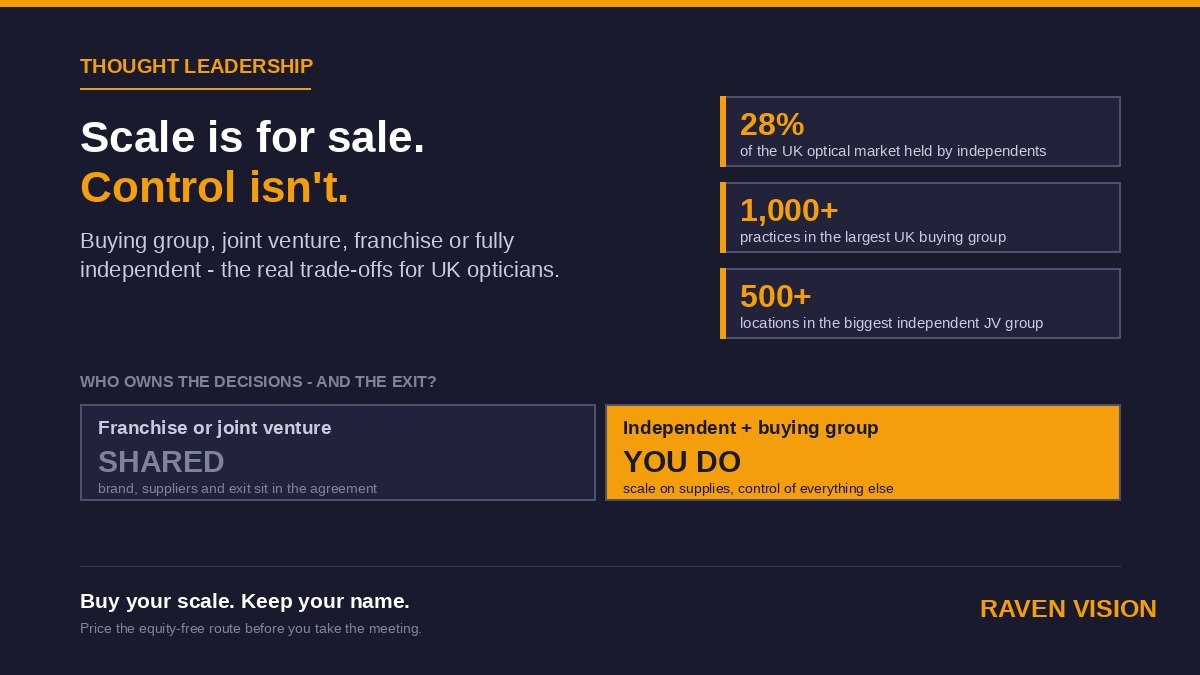
The National Eyecare Group has been doing this since 1979 and now negotiates on behalf of more than 1,000 member practices. There’s no joining or subscription fee; instead it charges a management fee of around 5% on purchases through roughly half of its suppliers, with nothing charged on the rest. Sight Care runs a similar model as a non-profit — a small monthly membership fee in exchange for negotiated pricing, consolidated invoicing and, in some years, a dividend back to members.
The unglamorous benefit that members tend to rave about isn’t even the discounts. It’s the single monthly statement. One consolidated bill across your suppliers instead of a drawer full of separate invoices is a genuine chunk of admin gone — the same logic as running your billing and finance in one system instead of three spreadsheets and a shoebox.
Joint venture inside an independent group
The fastest-growing version of this in the UK is the Hakim Group model: you keep your practice’s name and its local identity, but the group takes an ownership stake and runs the back office — HR, payroll, buying, marketing support. Hakim now counts more than 400 joint venture partners across 500+ locations in the UK and Ireland, with over 3,000 employees. That’s a serious operation, built in two decades from one practice in Bolton.
For the right owner this is a genuinely attractive deal: you get scale economics and professional back-office support while your patients still see the same independent practice they’ve always known. But be clear-eyed about what’s happened structurally. You’ve sold part of your business. The group’s stake, and the shareholder agreement behind it, now sit between you and every major decision — including the eventual sale. For some owners that’s a fair price for the support. For others it dawns slowly that “independent” is now a description of the branding rather than the ownership.
Franchise or joint venture with a multiple
The Specsavers joint venture partnership is the best-known version: each store is a separate company, with A shares held by the partners who run it day to day and B shares held by Specsavers, which provides the IT, legal, payroll and marketing machinery. Partners draw a salary and take the distributable profits. Thousands of optometrists have built careers and real wealth this way, and it would be dishonest to pretend otherwise.
But it’s the far end of the spectrum for a reason. Your fascia is theirs. Your pricing architecture, your product range, your promotions calendar — the things that make a practice feel like yours — are set by the model, not by you. You’re running a business within a brand, brilliantly supported and tightly constrained. If what you wanted was to own an independent practice, this isn’t a variant of that. It’s the alternative to it.
The numbers behind the pressure
The reason these conversations keep happening is that the maths of the UK optical market has consolidated hard. One 2025 market analysis put Specsavers at roughly 42% of the market, Boots Opticians at around 11% and Vision Express at about 9% — leaving independents, collectively, with something like 28%. Spread across the few thousand independent practices among the UK’s roughly 5,500 optician businesses, that’s a lot of small players sharing a minority of a £5.8 billion market.
That’s the context for every partnership brochure that lands on your doormat. It’s also, read differently, the case for staying independent: 28% of a £5.8 billion market is not a rounding error, and it’s held by practices offering something the multiples structurally can’t — continuity, clinical time, and an owner whose name is on the door. We’ve written before about what makes an independent practice resilient, and nothing in the market share data changes it. Independents don’t lose to multiples on care. When they lose, they lose on unit costs and back-office drag — and both of those are fixable without selling anything.
What each model does to your exit
Here’s the lens that cuts through most of the marketing: ask what each model does to the day you sell.
Fully independent, your exit is clean. You sell a business you wholly own to whoever you choose — another optom, a group, a consolidator — and the goodwill you spent twenty years building is priced in your favour.
In a buying group, nothing changes. Membership isn’t equity. You leave the group or the buyer inherits the membership; either way it doesn’t touch the sale.
In a joint venture — independent group or multiple — your exit is defined by the shareholder agreement you signed on the way in. Who can buy your shares, at what valuation formula, with what approval rights: it’s all in there, and it was all drafted by the party with more lawyers. That doesn’t make it a trap. Plenty of JV partners exit well. But the time to understand those clauses is before you sign, not when you’re ready to retire.
Seven questions to ask before you sign anything
Whatever’s being offered — group membership, joint venture, franchise — sit with these before you sit with their business development person:
- What exactly am I selling? Nothing (buying group), a stake (JV), or the whole identity of the practice (franchise)?
- How do I leave? Notice period for a buying group; share transfer terms and valuation formula for a JV. Get the exit clauses explained to you by your own solicitor, not theirs.
- Who owns the patient records and the recall relationship? If the answer is fuzzy, everything else is too.
- What happens to my supplier freedom? Some arrangements gently prefer certain labs and frame houses; others mandate them.
- What does it cost, all-in? Management fees, marketing levies, share of profits, minimum purchase volumes — get the full-year number, not the headline.
- What do I actually get for the back-office promise? “We handle your admin” means something different in every brochure. Ask them to itemise it.
- Would better systems solve the same problem for less? This is the question nobody pitching you will ask, so ask it yourself.
The quiet option most owners overlook
Because here’s the thing the consolidation pitch skips over: most of what’s being sold — buying power, less admin, professional back office — can be assembled without giving up a single share.
Buying power is available by subscription. A buying group gets you multi-practice supplier terms for a management fee or a modest monthly cost, no equity involved. That’s most of the “scale” benefit, bought at trade price.
The back office is a systems problem, not an ownership problem. The admin drag that makes group support sound appealing — chasing invoices, juggling the diary, manual recalls, frame stock you can’t see across — is exactly what modern practice management software exists to remove. When your appointments, records, dispensing, stock and finances run through one cloud system you can check from anywhere, you’ve replicated a good chunk of what a group’s head office would do for you — without the head office owning a piece of your practice.
And competing with the multiples’ polish is mostly about consistency, which is also a systems outcome. Automated recalls that actually go out, online booking that actually works, a till that reconciles — none of this requires a fascia change. It requires software that was built for the way independents actually compete: on care and continuity, not price.
That’s the corner of this debate where we should declare our interest. Raven Vision was built by Shaukat, an optometrist with 35+ years in practice who runs three independents of his own, precisely because he wanted multiple-grade systems without multiple-grade ownership. It’s £149 a month per location, with free data migration and no lock-in contract — because a software company asking you to value your independence shouldn’t then trap you in a five-year term. Have a look at the pricing; it’s all public.
The decision, plainly
There’s no universally right answer here. If you’re five years from retirement with no successor, a group offer might be the best exit you’ll get — read the valuation post and take the meeting. If you’re exhausted by running everything alone, a JV with a group whose values fit yours can be a genuine partnership.
But if the thing pulling you toward a group is buying power and back-office relief, price the alternative first: a buying group membership plus proper practice management software costs a few hundred pounds a month and asks for none of your equity, none of your name, and none of your exit. Run both numbers over ten years. The gap will surprise you.
If you want to see what the systems half of that looks like, book a walkthrough — bring your current admin week with you, and we’ll show you which parts of it shouldn’t exist. Your name stays over the door. That’s rather the point.