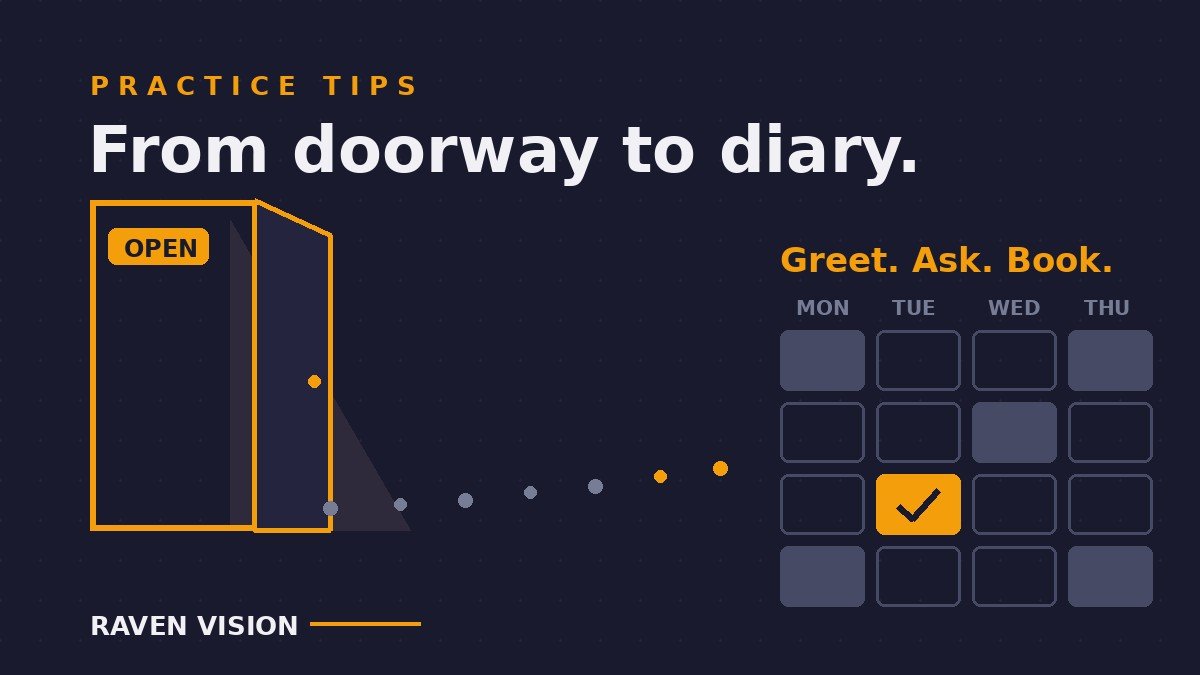

Someone pushes your door open at ten past two on a Tuesday. They spend four minutes at the frame wall, pick up two acetates, angle them at the mirror, put them back, smile politely at your receptionist and leave. Nobody got their name. Nobody knows why they came in. And if they never come back, nobody will ever know they were there.
That’s not a small leak. According to the British Retail Consortium, UK high street footfall fell 9.2% year-on-year in April 2026, with total retail footfall down 10.7%. Fewer people are walking past your practice than a year ago, which means every single person who actually walks in is worth more than they’ve ever been. The practices that thrive on quieter high streets aren’t the ones with the most passers-by. They’re the ones that convert the passers-by they get.
Here’s the good news: walk-in conversion isn’t a personality trait. It’s a front-desk system, and you can build it in a month.
Why walk-ins are the cheapest new patients you’ll ever get
Think about what a walk-in has already done before they touch your door handle. They’ve noticed your practice. They’ve decided it looks worth entering. They’ve physically travelled to you. In marketing terms, they’ve moved themselves halfway down your funnel for free — no ad spend, no cold email, no leaflet drop.
Compare that with what a new patient costs through any other channel. Paid social, Google Ads, local sponsorships — you’re often looking at £30 to £100+ per acquired patient once you count everything. A walk-in costs you the thirty seconds it takes to greet them properly.
And they’re predisposed to buy from you rather than a website. A 2025 Mintel survey found 53% of UK consumers still prefer to buy spectacles in-store, precisely because of the try-on, the fitting and the professional advice a screen can’t give. The person standing at your frame wall is telling you, by being there, that they want what only a physical practice can offer. All you have to do is not let them leave anonymous.
The four walk-ins you’ll meet this week
Not every walk-in wants the same thing, and treating them identically is how conversions die. Most fall into four types.
The frame browser
They drift to the frame wall and start trying things on. Some have a current prescription and are shopping around. Many are overdue a test and don’t realise it — they’re browsing frames because their eyes are telling them something’s changed. This is your highest-value walk-in.
The repair or adjustment
Bent temple, lost screw, slipping frames. They often bought elsewhere — online, a multiple, a practice that’s since closed. They expect to be turned away or charged. This is your goodwill goldmine, and most practices waste it (more on that below).
The price checker
“How much is an eye test?” or “Roughly what would varifocals cost?” They’re comparing you against a multiple’s window poster. A flat price recited at the door loses this person; a question wins them.
The direct asker
“Can I book an eye test?” or “Do you have anything today?” The easiest conversion in the building — as long as booking them takes less time than their patience lasts. If your front desk has to put them on hold in person while the phone rings and the diary loads, you’ll lose even the ones who asked.
The first sixty seconds: greet, don’t hover
Every conversion starts the same way, and it’s not a sales pitch. It’s a greeting within thirty seconds, then space. “Hello — have a browse, I’m right here if you want to try anything” beats both extremes: the ignored walk-in who feels invisible, and the pounced-on walk-in who feels hunted.
Then, after they’ve settled, one open question. Not “can I help?” (invites “just looking”). Try “are you looking for something for distance or for reading?” or “is this to update a current pair?” These questions do quiet diagnostic work — anyone who answers them is telling you about their prescription, and you’ve earned the follow-up that actually converts.
If your reception team already runs a structured morning routine, this slots straight in — we covered the wider system in our guide to front-desk workflow for UK independent practices.
The one question that converts: “When was your last eye test?”
This is the hinge of the whole system. Whatever type of walk-in you’re serving — browser, repair, price checker — at some natural point, ask when they last had their eyes tested.
It works because it’s clinically legitimate, not salesy. You genuinely can’t dispense accurately against an out-of-date prescription, and patients know that. Around 13 million NHS sight tests are carried out in England each year, yet a large share of adults are still overdue — most people can’t actually remember when their last test was, and hearing themselves say “ooh, maybe three years ago?” out loud does half your work for you.
The follow-up is soft: “You’re due, then — shall I see what we’ve got this week while you’re here?” Diary open, next two or three slots offered by name. Not “would you like to book at some point?” — that converts nobody. Specific slots convert.
Repairs and adjustments: your quiet booking engine
The repair walk-in expects friction. They bought online or from a chain, their frames are crooked, and they’re braced for “we can’t touch glasses we didn’t sell.” When you instead say “sit down, this’ll take two minutes, no charge” — you’ve just delivered the single most memorable customer experience they’ll have on that high street all year.
Then, while you’re heating the frame: “When was your last test?” The repair customer is often the most overdue person who’ll enter your practice all week — they’ve been avoiding opticians because they bought elsewhere and feel awkward about it. You’ve just removed the awkwardness for free.
Two rules make this pay. First, never guilt them about buying online — the moment you sniff at their internet frames, the goodwill evaporates. Second, always capture their name and consented contact details “in case we need to follow up on the repair.” Now they’re in your system, and your recall engine can do the rest.
Make booking on the spot effortless
Every second between “yes, I’d like to book” and a confirmed slot is a second in which they can change their mind. The mechanics matter:
- The diary must be visible from the front desk, instantly. If your booking system lives on one PC in the back office, walk-in conversion dies on the walk to the back office. A cloud diary on the front-desk screen (or a tablet at the frame wall) means slots are offered mid-conversation.
- Offer named slots, not vague futures. “We’ve got Thursday at 2:15 or Saturday at 10:40” converts. “Give us a ring sometime” doesn’t.
- Confirm before they reach the door. An instant SMS or email confirmation makes the booking feel real and cuts no-shows — pair it with the reminder sequence from our guide on reducing no-shows without charging fees.
- Give the hesitant a QR escape hatch. Some people genuinely need to check a rota at home. A card or counter stand with a QR code to your online booking page turns “I’ll think about it” into a 9pm sofa booking rather than a lost lead.
This is exactly the job a modern patient management system should do for you: one live diary, visible everywhere in the practice, with online booking feeding the same slots patients see at the desk.
The ones who leave anyway: capture, then follow up
Some walk-ins won’t book today no matter how good your greeting is. Fine. The goal shifts from booking to capture — because a name with consented contact details is a patient your system can win later, and an anonymous browser is gone forever.
Low-friction captures that work: offering to text them a photo of the two frames they tried (“so you can compare at home”), holding a frame for 48 hours under their name, or simply “shall I pop you on our list for appointment reminders?” Each one is genuinely useful to them and quietly valuable to you.
Once captured, they flow into the same recall system that brings your existing patients back — a gentle nudge at one week (“the Tokyo frame you liked is still here”) and a recall entry if they mentioned being overdue. No hard selling. Just not forgetting them, which is more than most practices manage.
Track walk-ins like a channel, not luck
You almost certainly know what your Google Ads cost per lead is. Do you know your walk-in conversion rate? Most practices don’t, because walk-ins feel like weather — something that happens to you.
Treat them as a channel instead. A simple tally at the front desk: walk-ins today, type (browser / repair / price / direct), booked on the spot, details captured, walked out anonymous. Two weeks of honest tallying tells you your baseline. If forty people walk in a week and three book, that’s not a footfall problem — that’s a conversion problem, and it’s fixable with everything above.
Log the source against each new patient record too. When “walk-in” shows up in your PMS reports next to a lifetime value figure, the case for training every locum and Saturday assistant in the greeting routine makes itself. And once they’re booked, their first visit matters more than any other — here’s how to turn one appointment into a patient for life.
A 30-day walk-in conversion plan
Week 1 — measure. Start the front-desk tally. No behaviour changes yet; you want a true baseline. Count walk-ins, types and outcomes.
Week 2 — the greeting and the question. Train the whole team on the thirty-second greeting, the open question, and “when was your last eye test?” Role-play it in a morning huddle. It feels silly for ten minutes and then it becomes muscle memory.
Week 3 — free repairs, always captured. Make the no-charge adjustment policy official, whatever the frames’ origin. Add the capture step to every repair. Put the QR booking stand on the counter.
Week 4 — close the loop. Compare the tally with week 1. Review captured-but-unbooked walk-ins and send the follow-ups. Pick your weakest walk-in type and work on that script.
Most practices that run this see the same shape of result: the walk-in count doesn’t change, but the share leaving with a booking or a captured record doubles. On a high street where footfall is down 9%, that’s the difference between a quiet quarter and a full diary.
Where Raven Vision fits
Everything above works on paper and a shared calendar — for about a fortnight. Then a busy Saturday happens, the tally sheet vanishes under a delivery note, and the system quietly dies. The practices that sustain walk-in conversion are the ones whose software makes it the path of least resistance: a live diary on every screen so slots are offered mid-conversation, online booking that feeds the same diary, two-click patient capture at the desk, automated confirmations and recalls that follow up so your team doesn’t have to remember.
That’s what Raven Vision was built for — inside co-founder Shaukat’s own three practices, where the front desk had exactly these Saturdays. It’s £149/month per location with three months free, free data migration and a free practice website with booking built in, so the QR-code-to-diary journey works from day one. See full pricing here, or book a demo and we’ll show you the walk-in-to-booking flow on a real diary.
The people are already walking through your door. The only question is how many of them leave with their name in it.