
A patient comes in for her sight test. She’s 68, she’s been with you eleven years, and halfway through the history and symptoms she asks you to repeat the question. Twice. Then she mentions, almost apologetically, that her GP won’t do her ears any more and she’s been putting olive oil in them since March.
That’s a hearing patient sitting in your test room. She trusts you, she’s already in your database, and right now you’re sending her somewhere else.
Plenty of independents have worked this out. Hearing care is one of the fastest-growing additions to UK optician practices, and the partner networks that make it possible have grown accordingly. But there’s a step most practices only think about after they’ve signed the audiology deal, and it’s the one that quietly decides whether the service is a pleasure to run or a permanent admin headache: what your practice management software does when a second clinical discipline walks through the door.
This is a comparison guide for that decision. What hearing actually demands of a PMS, how the main systems differ, what to ask on a demo, and the traps that only show up in month three.
Why hearing is arriving in independent optician practices now
Three things happened at once.
The first is demand. RNID now puts the number of people in the UK who are deaf, have hearing loss or live with tinnitus at more than 18 million — roughly one in three adults. That figure went up from the old 12 million estimate because milder loss and single-sided loss are now counted, which is exactly the population that walks past your window and never thinks of itself as needing an audiologist.
The second is the NHS retreat, and it’s blunt. Simple ear wax removal has largely disappeared from GP surgeries. Around 8.1 million people in England can’t access an NHS wax removal service at all, some locally commissioned services are winding up entirely during 2026, and ENT waits in parts of the country run past 19 weeks. The British Academy of Audiology has publicly called for GP wax removal to come back. Until it does, those patients are paying £50 to £100 on the high street — and the high street includes you.
The third is that the partnership model matured. The Hearing Care Partnership, founded in 2017 by Leightons, now embeds audiology inside roughly 400 independent optician practices across the UK. Amplify Hearing and Insight Hearing run comparable optical-partner models. You no longer need to hire an audiologist and buy a booth to offer hearing care. The UK hearing aid market is worth around $1.09 billion in 2026, and private hearing aid sales have been growing at about 7% a year.
So the business case is settled for a lot of practices. The operational case is where it gets messy.
Your model decides your software question
Before you compare a single system, be clear about which version of hearing care you’re actually adding. The three models place completely different demands on your PMS.
The partner model
An audiologist from a network runs clinics in your practice on set days. They usually bring their own clinical software and their own patient records. Your PMS needs to handle the diary, the room, the referral in, the money that flows back to you, and — critically — the fact that the same human being is now a patient in two systems that don’t talk.
The employed or self-employed audiologist
You own the service end to end. Now your PMS needs to hold real audiological records, or integrate properly with software that does, plus hearing aid stock, aftercare recalls on a completely different cycle to sight tests, and repair tracking. This is the model where a weak system hurts most.
Wax removal only
The lightest version, and the one most independents start with. Microsuction, a trained member of staff, a 30-minute appointment type and a price. It sounds like it needs nothing from your software. It needs four things: its own appointment type with its own duration and price, consent and outcome recorded in the patient record, a follow-up rule, and reporting that separates it from everything else so you can tell whether it’s paying. If your PMS can’t give a new service its own appointment type without a support ticket, you’ve learned something useful about the vendor.
The five jobs a PMS has to do once hearing arrives
Strip away the marketing and there are five. Score any system you’re looking at against these.
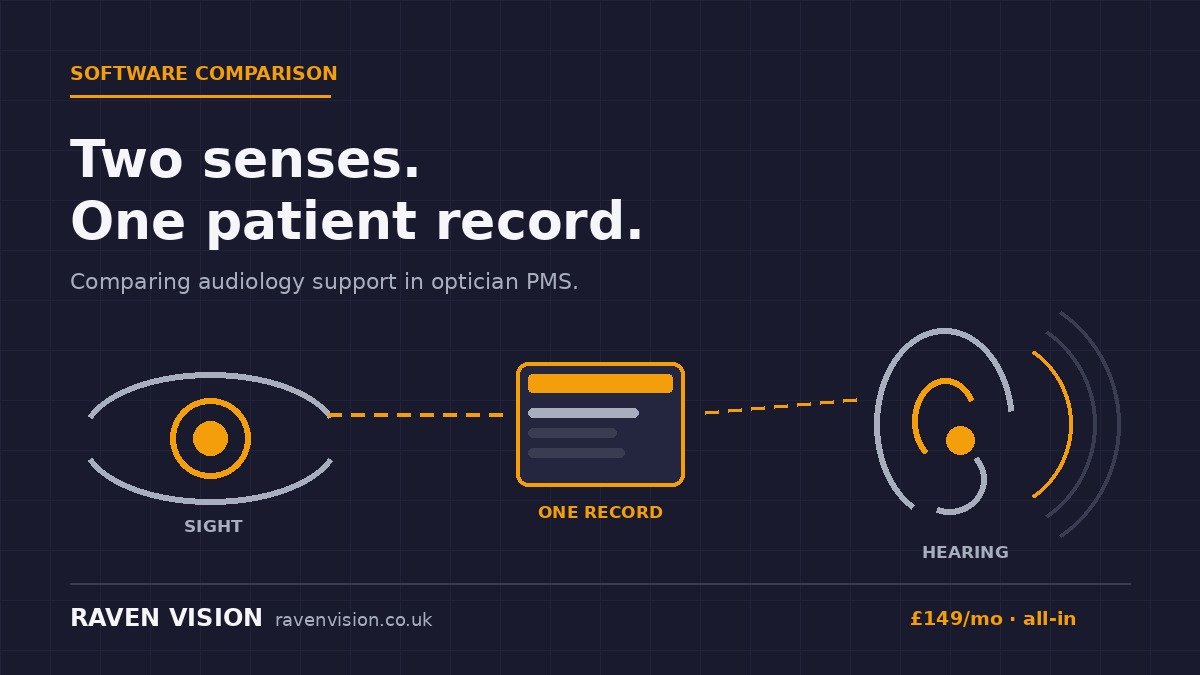
One: hold one patient, not two. Mrs Ahmed is a spectacle wearer and a hearing aid wearer. She should be one record with two care histories, one address, one set of communication preferences, one consent trail. If adding hearing means she exists twice, every address change becomes two jobs and every GDPR request becomes an archaeology exercise. This is the single most important thing to test, and it’s the thing demos gloss over fastest. A proper patient management system should absorb a new discipline without splitting the record.
Two: run two clinical diaries in one place. Hearing appointments are longer, less frequent and often need a quiet room rather than the test room. Your diary needs to handle different appointment types with different durations, different rooms and different clinicians, on the same screen, with online booking that shows the right availability for the right service. Two diaries in two systems means double-booked rooms — usually on the busiest Saturday of the month.
Three: recall on a completely different clock. Sight tests are broadly a two-year rhythm. Hearing is not. A newly fitted patient needs contact at two weeks, six weeks, three months, then annually — and battery or consumable reminders in between. If your system only understands one recall cycle, hearing aftercare ends up in a spreadsheet, and aftercare is precisely where hearing patients decide whether they’ll come back and buy their next set from you. Ask specifically whether the system supports parallel recall pathways per patient, not one recall date per record.
Four: treat hearing aids as stock, because they are. Serial numbers, warranty periods, repair status, loan devices, trial fittings that may come back. That’s inventory with a service tail attached. Bolting it onto a spectacle-frame module sometimes works and sometimes produces nonsense — check whether the inventory system can carry serial-numbered items with warranty dates, or whether you’ll be tracking £2,000 devices in a notebook.
Five: show you the money separately. Hearing revenue behaves nothing like optical revenue. Higher transaction values, longer decision cycles, revenue share or referral fees if you’re on a partner model, finance agreements, and a much more painful cost of goods. You need reporting that splits hearing out cleanly and a billing and finance module that can handle a revenue-share arrangement without a monthly manual reconciliation.
NOAH: the thing nobody explains before you sign
If you’re going anywhere near hearing aid fitting, you’ll meet NOAH. It’s the framework built by HIMSA — the Hearing Instrument Manufacturers’ Software Association, which has been running since 1993 — and it’s how fitting software from different manufacturers stores audiograms and fitting sessions in one place. Every serious audiology system in the UK either is NOAH-compatible or integrates with it. IPRO’s audiology product is built around NOAH 4.10. Auditdata runs a cloud NOAH integrator. TIMS interfaces with NOAH 4.
Here’s the practical bit. NOAH is not a practice management system. It holds the clinical measurement data. It does not run your diary, your stock, your recalls or your till. So when a vendor tells you they “work with NOAH,” you still have to ask the real question: does patient demographic data flow both ways automatically, or does someone retype the name and date of birth into a second system for every hearing patient?
That answer is worth about an hour a week. Over a year, it’s the difference between hearing being a service and hearing being a chore.
What actually breaks when hearing lives in a second system
None of these are hypothetical. They’re the standard complaints from practices six months into a hearing service running on split software.
Reception can’t answer a simple question. “When’s my dad’s hearing appointment?” requires opening a different application that half the front desk doesn’t have a login for. Duplicate demographics drift apart — she updates her mobile number at the spectacle counter and the hearing reminder still goes to the old one, so she misses the appointment and you both lose an afternoon.
Recall goes quiet. Hearing aftercare sits in the audiologist’s system, so when they’re not in the building nobody is chasing it. Reporting becomes a manual export-and-merge job at month end, which means it happens for three months and then stops. And when a patient asks for everything you hold on them, you have to remember there’s a second place to look — which is a compliance problem, not just an inconvenience.
The pattern is always the same. Nothing catastrophic. Twenty small frictions that add up to the service feeling like more trouble than it’s worth, right at the point where it should be maturing into real recurring revenue.
Ten questions to ask on the demo
Take these into any PMS demo where hearing is on the roadmap. Ask them in this order and don’t accept a roadmap answer for numbers one to four.
- Can one patient record hold both an optical and a hearing care history, without creating a second record?
- Can I create a new appointment type — say 30-minute microsuction, £65, back room, any trained staff member — myself, today, without contacting support?
- Can the same patient sit on two independent recall pathways at once, with different intervals?
- Does online booking let a patient choose a hearing service and see only the correct availability?
- How does the system handle serial-numbered stock with warranty dates and repair status?
- Is there a NOAH integration, and does it push demographics both ways or only pull?
- Can I report on hearing revenue, volume and conversion separately from optical, out of the box?
- If I’m on a revenue-share partner model, how does the money get recorded and reconciled?
- Is audiology a paid extra module, and what’s the price per practice per month?
- Show me a practice like mine already running both. Not a case study — a live system.
That last one separates the vendors who have opticians doing this from the vendors who have a slide about it. If you want a fuller method for pressure-testing a system before you commit, we’ve written about how to run a proper trial or demo rather than sitting through a presentation.
Five red flags
Audiology is a separate paid module. Modular pricing is common in this market — one well-known UK system runs a core at around £100 a month with modules at roughly £30 each on top — and it’s not automatically wrong. But it means the cost of adding a service is never the price you were quoted. Ask for the all-in number before you plan the P&L.
“We integrate” with no detail. Integration ranges from real two-way sync to a nightly CSV someone has to import. Make them show you the data moving, live, in the demo.
The demo only shows optical. If they can’t show hearing running in the same session, hearing isn’t really in the product yet.
New appointment types need the vendor. A system where you can’t configure your own services is a system that will slow down every future idea you have, not just this one. The same logic applies to any clinical specialism you decide to build.
Closed to everything. If the system won’t connect to NOAH, won’t export cleanly and has no API, you’re locked into whatever the vendor decides to build next. We’ve covered how to spot a connected PMS versus a walled garden in more detail.
What good looks like in 2026
The honest position: no UK optical PMS does full audiology as well as a dedicated audiology system does. If you’re fitting fifty pairs of hearing aids a month, you’ll want proper audiology software alongside your PMS, connected sensibly. Optix, for example, built its audiology side working directly with audiologists, and that shows.
But most independents adding hearing aren’t fitting fifty pairs a month. They’re doing wax removal twice a week, a partner audiologist two days a month, and maybe a dozen private fittings a year. For that practice, the right answer is a PMS flexible enough to hold the whole thing — one patient record, configurable appointment types, parallel recalls, serial-numbered stock, honest reporting — rather than a second system with its own login, its own bill and its own version of the truth.
Get that right and hearing stops being a project. It becomes another reason the same patient keeps walking back through your door, which is the whole point. Adding a service is also one of the more reliable ways practices have of getting past a revenue ceiling without simply seeing more people in the same number of hours.
How Raven Vision approaches it
Raven Vision was built inside working practices. Shaukat, our co-founder, is an optometrist with 35 years behind him and three practices of his own — the software exists because he needed it, not because someone drew it on a whiteboard.
That shows up in exactly the places this article is about. One patient record holds everything, whatever service the patient came in for. You configure your own appointment types, durations, rooms and prices without raising a ticket. Recall runs as pathways, so a patient can be on a two-year sight test cycle and a three-month aftercare cycle at the same time without either one cancelling the other out. Stock handles serial numbers and warranty dates. Reporting splits by service, so you can see whether hearing is actually paying by the end of quarter one rather than guessing.
And it’s £149 a month per location, everything included. No module for audiology, no module for reporting, no module for online booking. When you add a service, your software bill doesn’t move.
Thinking about adding hearing? Let’s talk before you sign anything
Book a demo and bring the awkward version of the question — the partner arrangement you’re considering, the revenue share, the two-systems problem you’re worried about. We’ll show you how it works in a live system rather than a slide deck.
£149 per month per location. Three months free. Free data migration from whatever you’re on now. A free practice website with live booking built in. No lock-in and a 30-day money-back guarantee.
Book a demo or see the full pricing. Bring your messiest workflow — we’ve probably run it ourselves.