
A woman in her early fifties sits in your test room. She works on screens all day. Her eyes burn by three in the afternoon, her vision goes soft and comes back, and she’s been through four brands of drops from the chemist. She’s not here for a chat. She’s here because she’s had enough.
You look at her tear film. It breaks up fast. Her meibomian glands are not doing what they should. You’ve seen this a hundred times. And there’s a decent chance nobody — not her, not her GP, not the last optometrist she saw — has said the word that ties it all together.
At 100% Optical this year, a panel session called Tearful times opened by asking the room to raise a hand if they felt comfortable discussing menopause in routine practice. About half did. That’s a striking number when you consider roughly 13 million women in the UK are currently perimenopausal or menopausal — around a third of the entire female population — and that dry eye affects roughly twice as many women as men over 50.
This isn’t a niche. It’s sitting in your diary every week. And for independent practices, it’s one of those rare things that’s genuinely good clinical care and a proper differentiator, because the chains are not doing it well.
What’s actually going on in the eye
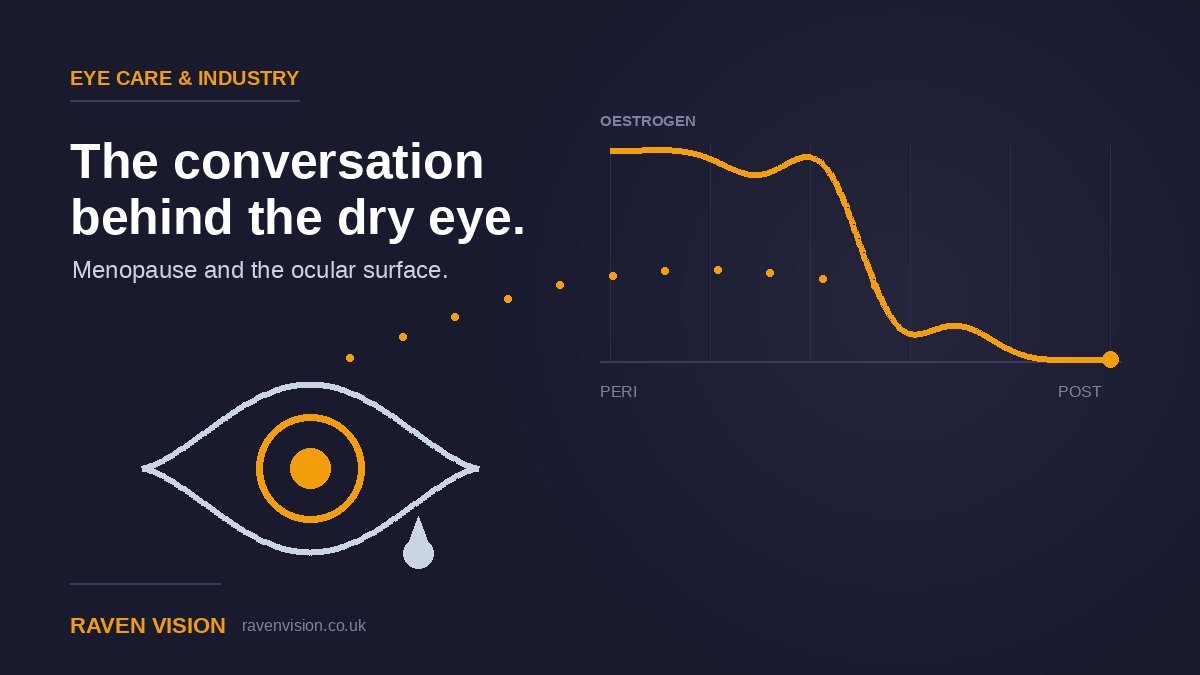
The short version: oestrogen and androgens do a lot of quiet work around the eye, and when levels drop and fluctuate, several things shift at once. That’s why it presents as a mess rather than a tidy single symptom.
The tear film and the meibomian glands
This is the big one. Androgen receptors sit in the meibomian glands and the lacrimal gland. As hormone levels fall, meibum quality changes, glands become more prone to obstruction, and the lipid layer stops doing its job of holding the tear film together. Tear break-up time drops. The surface gets inflamed. Inflammation makes the glands worse. Round it goes.
The research keeps landing in the same place. Studies using OSDI scoring have found dry eye disease in around 57% of menopausal women versus roughly 53% of premenopausal women, and more recent work has shown postmenopausal women with significantly greater tear film instability and more severe disease than age-matched men. Severity, not just prevalence, is the story.
Refraction, cornea and contact lens comfort
The one patients find most unsettling is fluctuating vision. Corneal thickness and curvature can shift with hormonal change, and a compromised tear film adds its own optical noise — which is why a patient can read the 6/6 line perfectly at 9am and struggle at 4pm with the same specs on. If you’ve ever had a patient convinced their brand-new varifocals are wrong when the lenses check out fine, this is often what’s underneath it.
Contact lens wearers feel it first. Wearing time collapses. Lenses that were comfortable for fifteen years suddenly aren’t. A depressing number of these patients quietly drop out of lens wear altogether and never say why. That’s a patient you had a relationship with, and revenue you had every month, gone because nobody asked the right question. Daily disposables, silicone hydrogels with better wettability, and scleral options for the worst ocular surface cases all exist — but only if someone gets to the conversation before the patient gives up.
The longer-term risk picture
Menopause also nudges the risk profile for glaucoma, cataract and AMD. Falling oestrogen has been associated with small increases in intraocular pressure, and early menopause — before 45 — has been linked with higher rates of open-angle glaucoma. Oestrogen appears to have a neuroprotective and antioxidant role, which is part of why postmenopausal risk for cataract and AMD shifts upward.
Be careful with how you frame this. It isn’t cause for alarming anybody in a twenty-minute sight test. But it is a solid clinical reason to be firm about recall intervals with this cohort, and to make sure your fields and discs data is actually being tracked over time rather than sitting in separate places.
Why nobody’s connecting the dots
Three reasons, and none of them are the patient’s fault.
First, the symptoms don’t announce themselves. Burning, grittiness, watering, tired eyes, blurring that comes and goes — patients don’t file any of that under “hormones.” They file it under “I’m getting old” or “it’s the computer.”
Second, general practice is stretched, and eyes are rarely top of the list when someone presents with hot flushes, sleep problems and low mood. NICE updated its menopause guideline NG23 in November 2024, and awareness is genuinely improving — but the ocular surface is not usually where the conversation starts.
Third, and this is ours to fix: many practitioners aren’t sure it’s their place. It feels like straying outside scope. It isn’t. Nobody’s asking you to prescribe HRT. You’re the person looking at the tear film through a slit lamp, which makes you very often the first clinician to spot a pattern the patient hasn’t joined up yet.
How to raise it without making it awkward
The advice from the 100% Optical panel was refreshingly practical, and it boils down to a softly-softly approach: explore the symptoms first, explain that dry eye is multifactorial, and offer hormones as one possible contributor among several. Not a diagnosis. A door.
What that looks like in a real consultation:
Ask about symptoms as standard, for everyone. Not “do you have dry eye” — most patients say no and then describe every symptom of it. Ask whether their eyes feel tired or gritty by the end of the day, whether vision fluctuates, whether they’ve been buying drops. Get this into your history-taking template so it happens whether or not the practitioner remembers.
Explain the mechanism before you name anything. “Dry eye has a few different causes — the oil glands in your lids, screen time, medication, and hormonal changes can all play a part.” That sentence does most of the work. It’s neutral, it’s true, and it lets the patient pick up the thread if they want to.
Mind your language and your age assumptions. Perimenopause commonly starts in the mid-forties and can begin considerably earlier. Phrases like “hormonal fluctuations” or “changes at this stage of life” land far better than the word menopause with a patient in her late thirties who isn’t ready to hear it. Plant the seed and let it grow.
Give them something in writing. A dry eye care sheet covering what you discussed, with the practice’s contact details and the next appointment date at the bottom. Patients retain almost nothing from a consultation. A sheet turns a nice conversation into an actual care pathway — and it’s the thing they show their GP.
The case that gets quoted from that session was a 51-year-old, heavy screen user, at the end of her tether. When hormonal influence was gently raised, she said she’d thought she was going mad, and was relieved it finally made sense. That’s the value here. Not a product sale. Someone finally explaining her own body to her.
Management: start simple and be specific
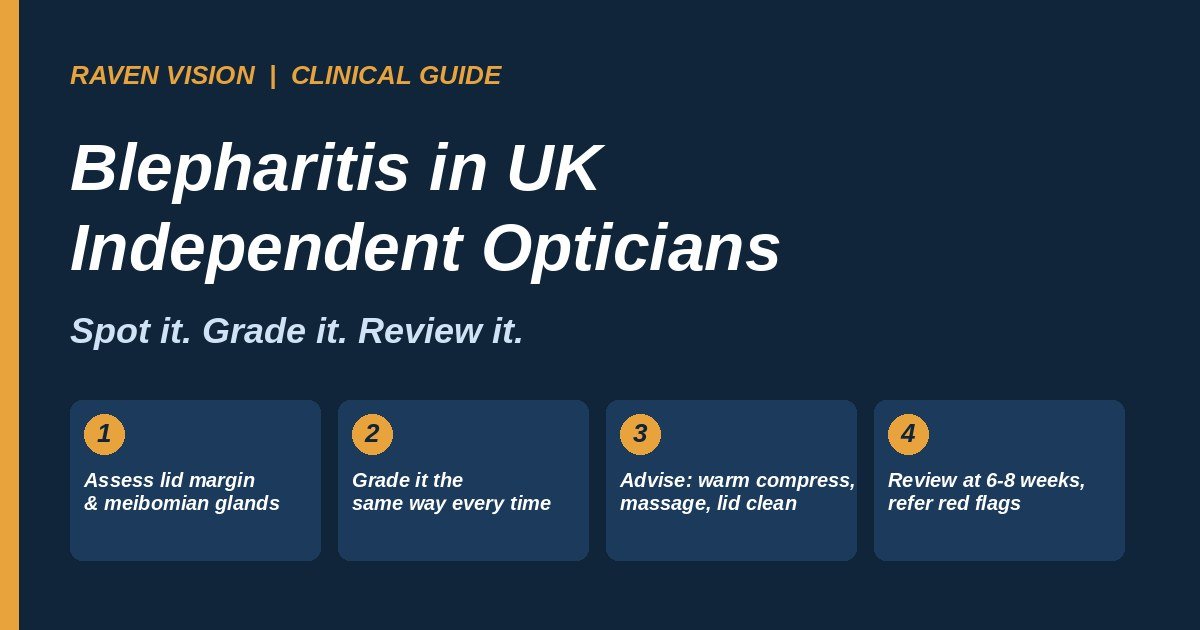
For meibomian gland dysfunction, heat first. But technique is where most of it falls down — the compress has to reach a proper temperature and stay there long enough to soften the meibum. A hot flannel cools within seconds and can scald delicate lid skin, so steer patients towards a proper heat mask and tell them exactly how long, how often, and for how many weeks before they judge it.
Then lid hygiene, then the right drops for the right deficiency rather than whatever’s on offer at Boots, then a review appointment with a date on it. The review is not optional. Dry eye management without a follow-up is just advice, and advice is what the patient already got for free on the internet.
If you want the full build — pricing, room time, equipment, staffing — we covered that in our guide to setting up a dry eye clinic, and the case for going deeper on one area is in our piece on picking a clinical specialism. Menopause-related ocular surface disease is arguably the most natural specialism an independent can build right now, because the patient volume already exists in your own database.
Make it a practice habit, not one person’s interest
Here’s where most good clinical intentions die. One optometrist gets interested, does it brilliantly, and it stops the day they’re on holiday. If this depends on a personality, it isn’t a service.
Four things turn it into something the practice does:
A symptom question in the standard history. Same wording, every patient, every practitioner. If it’s in the template it happens.
A trained front desk. Your reception team hears more than you do. A patient saying “my eyes have been awful lately, I don’t know what’s wrong with me” while paying is a booking opportunity for a dedicated appointment — but only if the team knows that’s a thing you offer and how to phrase the offer.
A named appointment type with a real length and a real price. Trying to do this inside a routine sight test is how you run forty minutes late all morning. Give it its own slot in the diary.
A recall that knows why it’s recalling. A dry eye review at eight weeks is a different thing from a two-year sight test reminder, and it needs to fire on its own schedule with its own message.
Where your software helps — and where it quietly blocks you
None of the above is a software problem in principle. In practice, your system decides how much of it is realistic.
Start with the record. If symptom scores, tear break-up times, gland assessments and photos live in a paper folder or a separate spreadsheet, nobody will look at them and progress becomes invisible. It all needs to sit in the patient record alongside everything else, so the next practitioner can see at a glance what was tried, what worked, and when the patient was last reviewed.
Then the recall. Clinical follow-ups run on their own clock — six weeks, three months, six months — separate from the routine sight test cycle. If your system can only handle one recall interval per patient, you’ll end up managing the follow-ups on a sticky note. Automated recall that runs multiple pathways in parallel is the difference between a service and a good intention.
Then finding the cohort in the first place. You should be able to ask your system a simple question — women aged 42 to 58, seen in the last three years, with dry eye symptoms recorded — and get a list you can actually write to. Most practices have several hundred of these patients already. They’re not new leads. They’re your own patients, waiting for someone to notice.
And then the boring commercial bit: a dedicated appointment type needs its own price, its own diary rules and its own reporting, so you can tell in three months whether this is worth continuing. If setting up a new service in your PMS requires a support ticket and a fortnight, that’s your answer about the software.
Raven Vision was built inside Shaukat’s own practices before it was sold to anybody else, which is why this stuff isn’t bolted on — clinical records, recall pathways, appointment types and reporting are the same system, because that’s how they work on the shop floor.
A 30-day version you can actually run
Week one. Add one dry eye symptom question to your standard history-taking. Agree the wording as a team so everyone says the same thing.
Week two. Write the patient care sheet. One page: what dry eye is, the possible contributors including hormonal change, how to use a heat mask properly, what to do next, your phone number, the review date. Get it printed.
Week three. Create the appointment type. Decide the length, the price, who runs it, and what’s included. Brief reception on how to offer it.
Week four. Pull the list from your database and write to fifty patients. Not a promotion — a note saying you’ve seen a lot of patients with these symptoms recently, that there’s often more to it than dry air and screens, and that you’re now running dedicated appointments to sort it out properly.
Then review at ninety days: how many booked, how many came back for review, what it was worth, and what the team found difficult.
The conversation is the service
The panel at 100% Optical put it well — this isn’t about stepping beyond your scope, it’s about practising holistically. You’re often the first person to notice a pattern the patient hasn’t connected, and a brief, thoughtful comment can send someone to their GP with a question that changes their year.
That’s also, incidentally, exactly the kind of care a large chain running fifteen-minute slots to a national script will struggle to deliver. It costs you a question and a bit of training. It buys you patients who tell their friends.
Give your team the system to make it stick
Raven Vision is practice management software built by an optometrist with 35 years in practice, for UK independents. Clinical records, multi-pathway recall, custom appointment types, patient search and reporting in one place — £149 per month per practice, three months free, free data migration, a free practice website with booking built in, no lock-in and a 30-day money-back guarantee.
Book a demo and we’ll show you how to set up a dry eye pathway in your own diary in about ten minutes, or see the full pricing. Bring your trickiest recall problem — we’ve probably had it ourselves.