
Every independent practice has a version of the same scene. Sunday evening, kitchen table, phone propped against the fruit bowl. You’re shuffling names around a spreadsheet because Priya wants the 22nd off, your Saturday assistant has a college open day, and the part-time optometrist has just remembered a hospital appointment. An hour later the rota “works” — until Tuesday, when someone rings in sick and the whole thing collapses again.
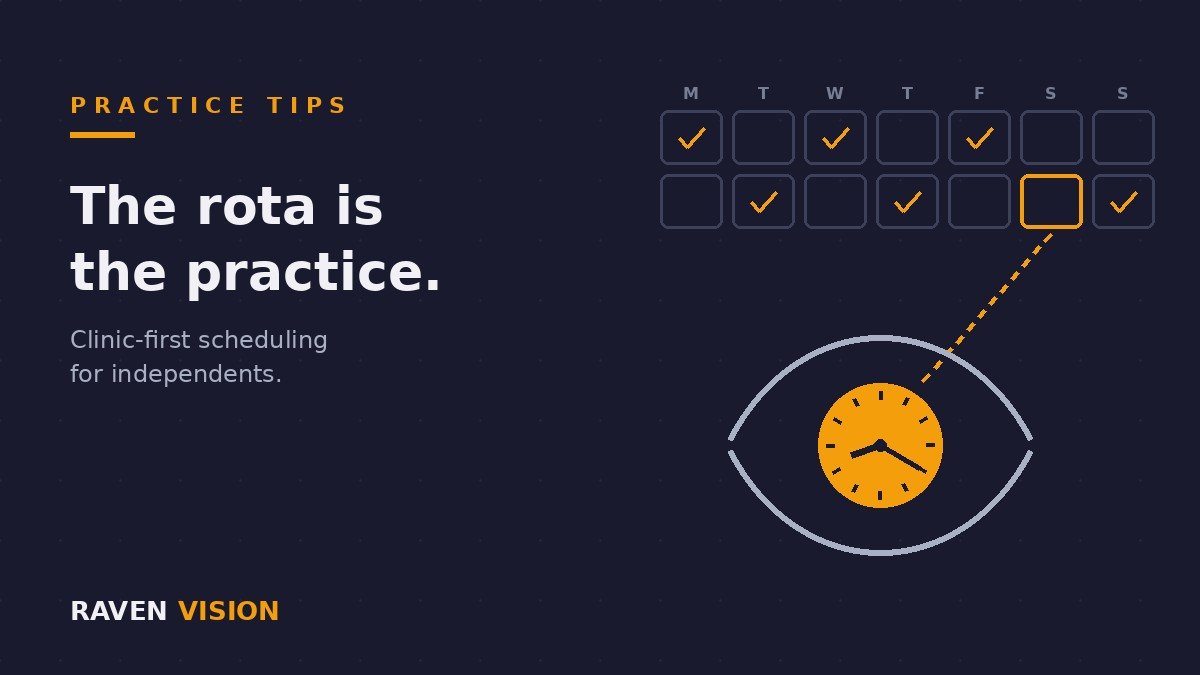
Here’s what most rota advice misses: an optician practice isn’t a shop. When a café is short-staffed, service slows down. When your test room has no optometrist in it, the day’s clinical revenue isn’t reduced — it’s gone. Every eye exam that doesn’t happen takes its dispensing conversion with it, and the recall that filled that slot took months to mature. The rota isn’t admin. It’s the supply side of your appointment diary, and it deserves to be built with the same care.
So let’s build it properly: a rota that protects clinic days, keeps you inside the rules, treats your team fairly — and gets you ahead of the shift-notice changes arriving in October 2026.
Why an optician rota is harder than a shop rota
Three reasons.
First, the interdependence. A full clinic needs more than an optometrist. It needs someone running pre-screening so the test room keeps pace, a dispensing optician free at the moment each patient walks out of the exam, and a front desk that isn’t drowning. Take one link out and the others underperform. A rota that covers the hours but ignores the sequence gives you a fully staffed practice that still leaks money.
Second, the patchwork. Most independents run on a mix of full-timers, part-timers around school hours, a weekend assistant who might still be at college, and an owner who’s also the main clinician. Fitting that puzzle together weekly, by hand, is why the Sunday-evening scene exists.
Third, the market you’re staffing from. Optometry Scotland’s 2025 workforce report found a vacancy rate of 10.3% across the profession, with locums covering 21% of the weekly workforce — and nearly 29% of optometrists saying they plan to reduce their hours in the next few years, citing stress and work-life balance. The report covered Scotland, but ask any practice owner from Cornwall to Carlisle and they’ll recognise the picture. The clinicians you rely on have options, and the thing they increasingly choose jobs for is the schedule.
Which means your rota is no longer just an operations document. It’s part of your recruitment offer.
The rules your rota already has to follow
None of this is new law, but it’s surprising how many rotas quietly break it — usually in the same few places.
- Breaks. Anyone working more than six hours gets an uninterrupted 20-minute break, taken during the shift, not bolted onto the end. “Eat your sandwich while covering the phones” doesn’t count — the break has to be genuinely free time.
- Daily rest. Eleven hours between finishing one shift and starting the next. The classic trap is a late evening — stocktake, CET event, late clinic — followed by an early Saturday start for the same person.
- Weekly rest. Twenty-four hours completely clear each week, or 48 hours over a fortnight.
- Under-18s. If your Saturday assistant is still at school or college, the rules tighten: 12 consecutive hours of daily rest, 48 hours of weekly rest that can’t be averaged out, and a 30-minute break after four and a half hours. Applying the adult pattern to a 17-year-old is one of the most common rota mistakes in retail.
- Holiday. The statutory 5.6 weeks, pro-rated for part-timers — and a plan for how it gets booked, which we’ll come to, because holiday chaos is self-inflicted rota damage.
Ten minutes against that checklist now is cheaper than an employment tribunal explaining it later.
October 2026 is coming for the “text them on Thursday” rota
The bigger change is ahead. The Employment Rights Act 2025 rolls out in stages, and the stage that lands in October 2026 is aimed squarely at how shift-based businesses schedule casual staff.
From October, workers get a right to reasonable notice of their shifts — and to payment when a shift is cancelled or cut short without that notice. The final numbers are still in consultation (it closes on 25 August), but 72 hours is the floor most employment lawyers expect. In practice: if you only confirm Saturday’s cover on Thursday night, you’re operating exactly the pattern this law was written to end. And if you stand someone down on the morning because it’s quiet, that stops being free.
Then, from 2027, comes the duty to offer guaranteed hours. Zero-hours and low-hours staff who regularly work a pattern — the government’s preferred reference period is 12 weeks — will be entitled to an offer of a contract that reflects the hours they actually work. Your “casual” optical assistant who has done every Saturday since March isn’t casual in the law’s eyes any more.
You can read this as red tape, or you can read it as a description of what good practices already do: publish rotas well ahead, don’t cancel people at the last minute, and give regular staff regular contracts. Get there early and October costs you nothing.
Build the rota from the test room outwards
Now the constructive part. The order you build the rota in matters more than the software you build it with.
1. Start with the clinic template, not with preferences
Decide first what the test room should look like in a normal week: how many clinic days, which sessions, what appointment mix. That’s your revenue skeleton — we covered how to design it in our guide to the optician appointment diary. The rota’s first job is to make sure every planned clinic session has a clinician in it. If you start from availability instead — collecting everyone’s preferences and seeing what’s left — you end up staffing the practice around convenience and wondering why Tuesday afternoons never make money.
2. Layer dispensing and front-of-house around the peaks
Testing capacity sets the rhythm; everything else follows it. A patient leaving the test room needs a dispensing optician available within a couple of minutes, or your dispense rate quietly sags. Collections cluster after work and on Saturdays. The phones peak on Monday mornings. Map your support staffing to those curves rather than spreading it evenly — the same logic we used for front-desk workflow. Even coverage feels fair and performs badly.
3. Put your own off-floor time on the rota
If you’re an owner who also tests, you are the most over-committed line on the sheet. Rota your admin, marketing and management time the way you rota a clinic — named, scheduled, protected. If it isn’t written down it gets eaten, which is exactly what we found when we ran the owner’s time audit.
4. Plan leave in seasons, not scraps
Most holiday chaos comes from treating leave as a stream of individual requests. Flip it: open booking windows by season, cap how many people can be off in each role at once, name your blackout weeks (the school-holiday rush, your busiest recall months) and publish the rules so nobody thinks refusal is personal. First-come-first-served with a visible calendar beats quiet resentment every time.
Sickness, gaps and the locum question
Gaps will happen. What separates calm practices from chaotic ones is that the response is decided in advance, not improvised at 8.40am.
Write a one-page gap protocol: who gets told first, which options get tried in which order — swap sessions between your own clinicians, compress the diary into a shorter day, then the locum list, then and only then cancelling patients. Cancelling should hurt; every cancelled test is a patient you’ve taught that booking with you is provisional.
On locums, know your maths before you need it. A community locum typically runs £250–£350 a day, more in London, plus 15–25% on top if an agency’s involved. Against that, a full clinic day — ten to twelve exams plus the dispensing that follows them — is usually worth several times the fee. The locum is rarely the expensive option; the empty test room is. What makes locum cover painful is booking it in a panic. Keep a bench of two or three locums who know your practice, pay them promptly, and treat them like colleagues rather than plumbing — remember, locums are already a fifth of the profession’s weekly workforce. The good ones choose where they return.
A fair rota is a retention tool
Go back to that 29% of optometrists planning to cut their hours. The reasons weren’t pay. They were stress and balance — and the rota is where a practice proves, week after week, whether it respects either.
Fairness here is mostly mechanics. Saturdays shared on a visible rotation, not dumped on whoever won’t complain. Rotas published four weeks out, so people can book dentists and five-a-side and childcare. Swaps allowed but recorded, so cover is never a mystery. The late-plus-early combination banned by rule rather than by luck. None of this costs money. All of it shows up in whether people stay — and in a market where attracting and keeping great staff is the independent’s real constraint, a considerate rota is one of the cheapest competitive advantages you can build.
Where your practice software fits (and where it doesn’t)
Honesty first: software won’t make an unfair rota fair, and it won’t decide your clinic template for you. Those are judgement calls, and they’re yours.
What software should do is kill the friction. The rota shouldn’t live in a spreadsheet that’s three versions out of date on a kitchen laptop — it should sit next to the appointment diary, because they’re two halves of the same question: the diary is demand, the rota is supply. When your practice management system holds both, the everyday collisions get caught before they cost anything — a clinic scheduled with no clinician, a diary still taking bookings on a day you’ve just lost, a Saturday with three staff on leave. It also quietly builds the record of hours actually worked that the 2027 guaranteed-hours rules will make valuable.
And one step upstream: a beautifully staffed clinic still loses money if the diary’s half empty. Staffing and demand rise together, which is why a recall system that reliably fills clinics is part of the same conversation.
Raven Vision was built inside three working independent practices — our co-founder Shaukat still runs them — so the diary, records and day-to-day scheduling live in one system that was shaped by the same Saturday-morning problems you’re solving. No modules bolted on, no spreadsheet in sight.
A 30-day rota reset
Week 1: audit reality. Pull the last eight weeks. Who actually worked what? Where did gaps hurt — which sessions lost testing, how much did locums and overtime cost, how many changes happened inside 72 hours? That last number is about to matter.
Week 2: build the template. Design the ideal normal week from the test room outwards: clinic sessions first, support layered on the peaks, your own off-floor time protected.
Week 3: write the rules down. One page: publication four weeks ahead, swap rules, seasonal leave windows, blackout weeks, the gap protocol, the under-18 limits. Share it. The rules being visible is half their value.
Week 4: publish and hold. Put the next four weeks up, then defend the system — changes go through the rules, not around them. Keep score monthly: locum spend, cancelled clinic hours, changes inside notice. Watch all three fall.
One diary, one rota, one system
The rota is where your week is won or lost — and from October, it’s also where the law starts paying attention. If you’d rather run it alongside your diary, records and recalls in one place, book a demo and we’ll show you how it works in a real practice week. Raven Vision is £149 a month per location, with 3 months free, free data migration, a free practice website with online booking, no lock-in and a 30-day money-back guarantee — full details on our pricing page. Bring your messiest spreadsheet. We’ve seen worse.