
It usually happens at the desk, not in the test room. The sight test went fine, the patient’s pleasant enough, and then somewhere between the frame board and the door they say it: “Could I just take my prescription with me? And have you got my PD?”
Watch what happens next in most independent practices. The optical assistant glances over at whoever’s senior. Someone says “I’ll have to check.” The atmosphere cools by about two degrees. The patient, who was only asking a question, now feels like they’ve been caught doing something.
That moment costs practices more than they realise — not because the patient walks out with a piece of paper, but because of how the paper gets handed over. The law on this is clear and has been for decades. The PD question has a clear answer too. What’s usually missing is a practice policy, so every member of staff improvises, and the improvisation reads as reluctance.
Here’s what you actually have to give, what you don’t, and how to handle the whole thing in a way that keeps the patient rather than quietly pushing them somewhere cheaper.
What the law says you must hand over
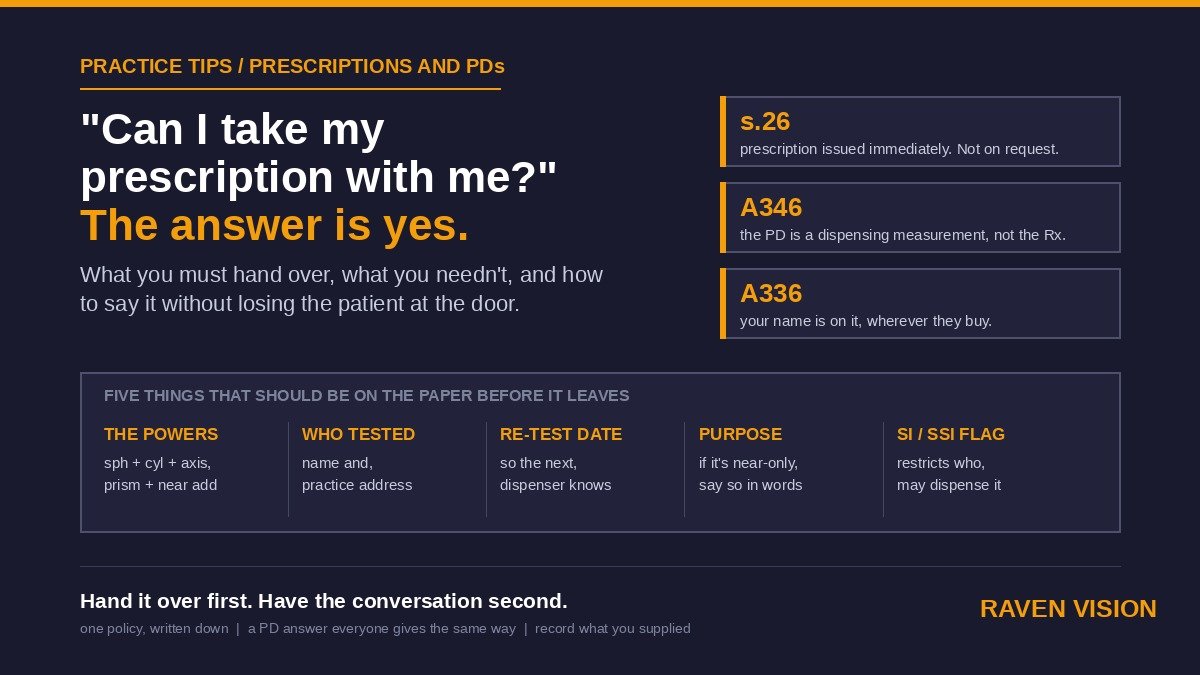
Section 26 of the Opticians Act 1989 is short and leaves very little wriggle room. When a registered optometrist or medical practitioner tests someone’s sight, they must give that person — immediately after the test — either a signed, written prescription for an optical appliance, or a signed, written statement that no appliance is needed.
Immediately. Not on request. Not when the patient asks twice. Not after they’ve been talked through the frame range first.
The College of Optometrists says the same thing in its Guidance for Professional Practice (A330): immediately after an NHS or private sight test, you must issue a prescription or a statement that no prescription is necessary. A331 adds a detail that trips people up — if there’s no clinically significant change, you still issue the prescription, along with a statement saying there’s no clinical change. “Same as last time” isn’t a substitute for the document.
What has to be on it
The required particulars sit in the Sight Testing (Examination and Prescription) (No. 2) Regulations 1989. In practice that means the spherical power of each lens; where relevant, the cylindrical power and its axis, any prismatic power and its orientation, and the near addition; plus the name and practice address of the optometrist or doctor who did the test. The College also says you should write prescriptions to British Standards (A333) and should make clear on the face of it if the spectacles are only for a specific purpose (A334) — the reading-only script that comes back as a complaint because someone drove in them is an avoidable problem.
One line most practices forget
A335 says you should indicate on the prescription if the patient is registered sight impaired or severely sight impaired. That isn’t box-ticking. A prescription issued to a child under 16, or to someone registered SI or SSI, can only legally be dispensed by — or under the supervision of — a registered optometrist, dispensing optician or doctor. If that flag isn’t on the document, whoever dispenses it next can’t see the restriction that applies to them.
The same restriction sits behind Section 27, which governs who can sell optical appliances at all. The GOC withdrew its old 2006 position statement on the sale and supply of optical appliances on the basis that it was no longer needed — but the underlying legal requirement didn’t go anywhere, and the supervising registrant still has to be on the premises at the key stages and genuinely able to exercise clinical judgement.
You stay responsible after they walk out
A336 is the one to put on the staffroom wall: you remain responsible for any prescription you’ve issued, irrespective of where the patient chooses to buy their spectacles. That cuts both ways. It’s the reason you can’t be casual about accuracy. It’s also the reason you have nothing to gain from being obstructive — the prescription is your professional work either way, and it has your name and address on it.
The PD question, answered properly
Now the awkward one. Patients ask for the pupillary distance because the online checkout won’t let them finish without it, and they’ve usually read somewhere that you’re “refusing” to give it.
The position is straightforward. College guidance A346 says the PD is one of several facial measurements taken as part of the dispensing process, and it’s not part of the prescription. That’s the whole of it. The duty in Section 26 is a duty to give the prescription. The PD sits on the dispensing side of the line, along with heights, vertex distance and frame measurements, and there’s no obligation to supply it on request.
So you can say no. The real question is whether saying no is working for you.
Three ways practices handle it
Flat refusal. “We don’t give those out.” Defensible, quick, and it tells the patient exactly one thing: this practice would rather they didn’t go elsewhere. They’ll get a PD from a phone app, a friend with a ruler, or the next practice down the road, and the measurement will probably be worse than yours. You’ve lost the sale and the goodwill.
Give it, no questions. Write it on the prescription and hand it over. Easy, friendly, and it does carry a genuine professional worry: a monocular PD taken for a specific frame at a specific vertex distance isn’t a universal number, and if the patient’s glazed into something very different, you own a measurement you had no control over.
Give it with a boundary. This is the one that ages best. Supply the PD when it’s asked for, record that you supplied it, and be explicit about what it is and isn’t: “That’s your distance PD, measured today. If you’re getting varifocals you’ll also need heights, and those have to be measured in the actual frame — nobody can do that remotely.” You’ve been helpful, you’ve been honest, and you’ve drawn the line at the point where remote dispensing genuinely falls down. Plenty of those patients come back for the varifocal pair.
Whichever you pick, pick it once, write it down, and make sure the Saturday team knows it. The damage in these conversations almost never comes from the answer. It comes from three people giving three different answers in the same week.
What your prescription looks like when it leaves the building
Assume the document is going to be read by a stranger — another dispenser, an online retailer’s verification team, sometimes a solicitor. Legally required content is the floor, not the ceiling. Five additions that cost nothing:
- A re-test date. The patient needs to know when this stops being current, and the next dispenser needs to know too.
- Purpose, when it’s restricted. “For near work only” in plain words, not just a near add sitting on its own.
- The SI/SSI flag where it applies, per A335.
- A note when change is coming. A339 says you should tell a patient if their prescription is likely to shift soon — before cataract surgery, for instance — so they can decide whether new specs now are money well spent. Put it on the document, not just in the conversation.
- Your practice’s name, phone number and a line inviting questions. If a remote retailer queries something, you’d much rather they ring you than guess.
If your practice management system still prints a prescription that looks like it came off a dot-matrix in 1994, that’s a fixable problem and a surprisingly visible one. The prescription is often the only document a patient keeps from their visit. Ours is one of the screens practices ask us to adjust most often when they move onto an electronic record system, which is why prescription and dispensing layouts are part of what you can change yourself rather than raising a ticket for.
The conversation that keeps the patient
A337 says that when you give a patient their prescription, you should explain your findings and the lens types you’d recommend. Read that as a clinical duty if you like. It’s also the single best commercial move available to you, because it’s the part no website can do.
Three versions of this conversation cover almost everything that lands at the desk.
“I’d like to take my prescription with me.”
“Of course — it’s yours, I’ll print it now.” Then, while it’s printing: “Before you go, can I show you what I’d have recommended for this script? Takes two minutes and it’ll help you compare whatever you’re looking at.” You’ve complied instantly, you’ve removed the friction, and you’ve earned the right to the two minutes.
“I’ve seen these for £29 online.”
Don’t argue with the £29. Say what’s inside your price instead — the measurements taken in the frame, the fitting, the adjustments for as long as they own them, the fact that if something’s wrong they walk in rather than post it back. If you’ve never mapped out that pitch properly, our pieces on competing on something other than price and on publishing your prices openly are the two to read next.
“Can you just give me the PD?”
Your policy answer, delivered warmly, in one sentence, with the varifocal caveat if it applies. No sigh. No “well, technically.”
Something worth keeping in view while you’re having these conversations: in-store is still where most of this market is. Mintel’s 2025 consumer research found 53% of UK consumers prefer to buy spectacles in a practice, though more than a quarter of younger buyers go online — which is roughly what you’d expect and exactly why the under-40 patient deserves a different conversation from the one that works on a 68-year-old varifocal wearer.
Turn it into a policy, not a mood
Half a side of A4, pinned where the team can see it, answering five questions:
- When does the prescription get printed? (Answer: every time, before the patient reaches the desk.)
- Who hands it over, and what do they say?
- Do we give the PD — and if so, with what caveat?
- What do we record when we give either out?
- Who does a team member ask if something unusual comes up?
Then run it once in a morning huddle, with two people role-playing it badly and then well. Ten minutes. It’ll save you an awkward Saturday.
Record-keeping matters more here than most people assume. If a patient later complains about specs made elsewhere from your script, what protects you is a dated record showing what you issued, what you explained, and what you supplied. That’s the same discipline that underpins handling complaints well — the notes decide the outcome long before anyone’s opinion does.
The numbers that tell you whether this is a problem
Most practices have a feeling about how many patients “take the script and go” and no data at all. Three things worth counting for a single month:
- Tests that ended without a dispense. Your dispense rate is the headline; the interesting bit is which optometrist, which day, which slot.
- PD requests. A tally on the desk is enough. If it’s one a fortnight, this is a non-issue. If it’s four a week, you have a pricing or positioning conversation to have, not a policy problem.
- Come-backs. Patients returning with online specs that don’t work — for adjustment, for a remake, for reassurance. Every one is a walk-in aftercare moment and a live demonstration of what your price includes.
Where Raven Vision fits — and where it doesn’t
The software job here is narrow but real. The prescription should generate from the record the moment the test is signed off, in a layout you control, carrying the fields you’ve decided matter. Whether you gave out a PD should be a recorded field on the visit, not a memory. And the patient’s history — what was issued, when, what was explained — needs to be findable in seconds when someone rings up eighteen months later with a question. That’s ordinary patient record work, and it’s the kind of thing Raven Vision was built to do, because it was built inside working practices by an optometrist who was fed up with the alternative.
Now the honest half. If you’re a single-room practice seeing 15 patients a day, and your current system prints a legible prescription with the right fields on it, none of this is a reason to change software. Write your policy, fix your prescription template, brief the team, and carry on. A PMS won’t teach anyone to say “of course, it’s yours” without hesitating — that’s a management job, and it’s free.
Where software does earn its keep is scale and consistency: three sites, six optometrists, a rotating cast of locums, and no way of knowing whether Tuesday’s team does what Thursday’s team does.
What to do this week
Print one of your own prescriptions and read it as a stranger would. Is the re-test date there? The purpose, if it’s restricted? The SI/SSI flag where relevant? Your phone number? Fix whatever’s missing — that’s a template edit, not a project.
Then write your five-line policy, brief the team, and start the PD tally. In a month you’ll know whether you have a problem or a feeling.
If your current system fights you on the prescription layout — or you can’t record who was given a PD without adding a note nobody will ever find again — that’s worth twenty minutes of your time. Raven Vision is £149 a month per practice, with free data migration, no setup fee and no lock-in. Have a look at what’s included in the current offer, or go straight to the pricing page and see the whole thing in numbers. Bring one of your awkward prescriptions to the demo and we’ll show you how it would print.