
“Should I be taking something for my eyes?”
If you work in a test room, you’ve heard that question this week. Probably today. The patient asking it has usually already bought something — a tub of capsules from the supermarket, a “vision formula” from an online ad, or whatever their neighbour swears by. The UK supplement market is enormous, the marketing is confident, and the evidence behind most of it is thin. Which puts independent opticians in an awkward but genuinely valuable position: you’re one of the few people who can give a straight, evidence-based answer.
This post is that answer, laid out so you can use it chairside. What the research actually supports, what it doesn’t, who should be taking an AREDS2-style supplement, who shouldn’t bother, and how to turn all of it into advice patients remember — and that your practice records properly.
Why the nutrition conversation matters more than it looks
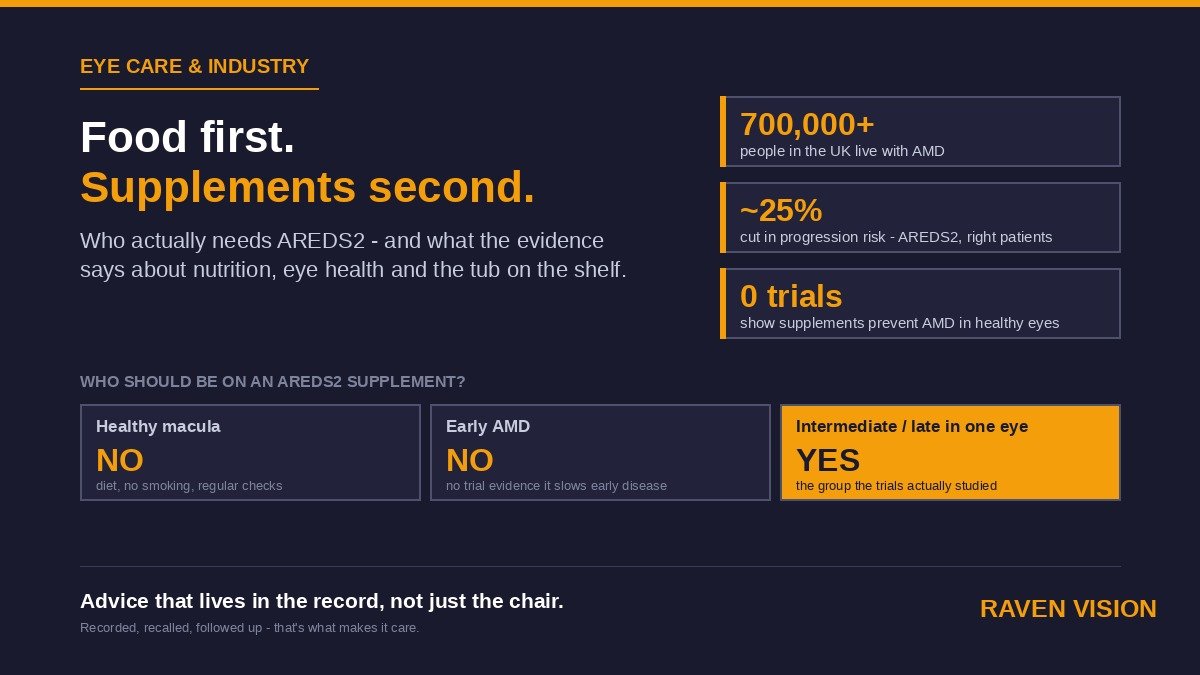
Age-related macular degeneration is the biggest cause of sight loss in the UK, affecting more than 700,000 people. Late AMD affects around 2.4% of people over 50 — and 12.2% of those over 80. Every independent practice with an ageing patient base is managing this, whether it feels like it or not.
And patients are hungry for something they can do. A diagnosis of early AMD comes with no injections, no drops, no operation — just monitoring. Diet and supplements are the one lever patients feel they can pull themselves. Handled well, that’s an opportunity to build trust and genuinely change outcomes. Handled vaguely — “eat your greens, buy some lutein if you like” — it’s a missed clinical intervention and, frankly, a missed reason for patients to value your practice over a multiple.
UK research backs this up: in a cross-sectional survey of eye care professionals, around 68% of optometrists said they frequently give dietary advice to patients with established AMD. But the advice varies wildly in quality and specificity, and very little of it gets recorded or followed up. That’s the gap this post is about closing.
What the evidence actually says
AREDS2: the supplement that earns its place
The Age-Related Eye Disease Studies (AREDS and AREDS2) are the backbone of every legitimate eye supplement on the shelf. The headline findings are worth having word-perfect:
- The original AREDS formulation reduced the risk of progression to late AMD by around 25% over five years — but only in people with intermediate AMD, or late AMD in one eye.
- AREDS2 swapped beta-carotene for lutein and zeaxanthin. The 10-year follow-up, published in 2022, confirmed the swap was right twice over: the lutein/zeaxanthin version delivered a further ~20% reduction in progression risk compared with the beta-carotene formula, and it removed a real harm — beta-carotene nearly doubled the risk of lung cancer in former smokers. Lutein and zeaxanthin carried no such risk.
So the honest chairside summary is: for the right patient, an AREDS2-formula supplement is one of the best-evidenced interventions in eye care. The right patient has intermediate AMD (extensive medium drusen or large drusen, with or without pigmentary changes) or late AMD in one eye. That’s it. That’s the group the trials studied and the group the benefit applies to.
What supplements don’t do
Here’s the part the adverts skip. The Cochrane systematic reviews — summarised for UK practice by the College of Optometrists — are clear that taking antioxidant vitamin supplements does not prevent AMD from developing in people with healthy maculae. A 55-year-old with no drusen and a family history buying a vision formula “to be safe” is spending money on something the evidence doesn’t support. They’d do more for their eyes by sorting their diet and — above all — not smoking.
That’s not a comfortable message to deliver if your practice sells supplements at the front desk. But it’s the message the evidence supports, and patients can tell the difference between a recommendation and a pitch. Reserve the recommendation for the patients it actually helps, and your word carries more weight when you give it.
Omega-3 and dry eye: weaker than everyone hoped
For years, omega-3 supplements were the default add-on for dry eye patients. Then the DREAM study arrived — 535 participants, properly randomised, one-year outcomes — and found oral omega-3 no better than placebo for either the symptoms or the signs of dry eye disease.
There are fair criticisms (the olive-oil placebo may itself have had mild benefits, and both arms improved), so this isn’t a case for telling patients omega-3 is useless. But it is a case for honesty: the evidence for omega-3 capsules in dry eye is weak, and they shouldn’t be sold as a fix. If a patient enjoys oily fish, encourage it — the wider health case is solid. If they’re spending £25 a month on fish-oil capsules purely for their dry eye, they deserve to know what the best available trial found. Our earlier piece on menopause and eye health covers a patient group where this conversation comes up constantly.
Food first: the advice that holds up
Strip away the capsule marketing and the dietary advice with genuine evidence behind it is refreshingly simple — and cheap:
- Dark leafy greens, most days. Kale, spinach, chard and broccoli are the richest dietary sources of lutein and zeaxanthin — the carotenoids that concentrate in the macula. Eggs help too, and the carotenoids in egg yolk are particularly well absorbed.
- Oily fish once or twice a week. Salmon, mackerel, sardines. The trial evidence for capsules may be weak, but observational evidence consistently favours people who eat fish over people who don’t.
- A broadly Mediterranean pattern. Higher adherence to a Mediterranean-style diet — vegetables, fruit, olive oil, fish, less processed food — is repeatedly associated with lower risk of AMD progression in large cohort studies.
- Stop smoking. Not a nutrient, but it belongs at the top of every eye-health lifestyle conversation. Smoking remains the biggest modifiable risk factor for AMD — smokers carry up to four times the risk of non-smokers. We’ve written a full practice guide on smoking, vaping and eye health.
Notice what that list does in the consulting room: it gives every patient something actionable — including the majority for whom a supplement isn’t indicated. “The evidence doesn’t support a supplement for you, but here’s what it does support” turns a “no” into a plan.
Turning evidence into a two-minute chairside conversation
Most nutrition advice fails not because it’s wrong but because it’s vague, rushed, and forgotten by the car park. A workable structure, patient by patient:
1. Segment before you speak
Three groups, three different messages:
- Healthy macula, worried patient: no supplement indicated. Diet, smoking, sunglasses, regular checks. Reassure — and be honest that the tub in their kitchen isn’t doing what the label implies.
- Early AMD: still no trial evidence that supplements slow progression from early disease. Diet and smoking advice, and a proper monitoring interval. This is the group most often oversold to, so it’s where your honesty earns most trust.
- Intermediate AMD, or late AMD in one eye: recommend an AREDS2-formula supplement by name and composition, explain the 25% figure in plain English (“in the big trials, this cut the risk of the serious stage by about a quarter”), and check smoking history before anything containing beta-carotene ever enters the conversation. In the UK survey data, 93% of optometrists would recommend supplementation for a patient with advanced AMD in one eye — the evidence says they’re right.
2. Say the dose, not just the idea
“Get some lutein” is forgettable. “An AREDS2 formula — 10mg lutein, 2mg zeaxanthin, 500mg vitamin C, 400IU vitamin E, 80mg zinc, 2mg copper — taken daily” is a recommendation a patient can act on and a pharmacist can check. Name a couple of compliant products available in the UK so the patient isn’t left googling into the arms of whoever bought the best ad slot.
3. Write it down — in the record, and for the patient
Advice that isn’t recorded didn’t happen — clinically or medico-legally. Record what you advised, why, and the patient’s smoking status in a structured field, not buried in free text. This is exactly the kind of thing a modern patient record system should make effortless: a nutrition-advice field the next clinician sees at a glance, so the message stays consistent between your optometrists, your locums and your dispensing team. Then hand the patient something physical — a one-page diet-and-supplement sheet with your practice name on it beats any leaflet from a supplement brand.
Making the advice stick between visits
The consulting-room conversation is the start, not the whole job. Two practice systems do the heavy lifting afterwards:
Recall that matches the risk. A patient with intermediate AMD on a supplement plan shouldn’t be on the same recall cycle as your 25-year-old contact lens wearers. Segment your recalls so AMD-risk patients come back at clinically sensible intervals, with the reminder referencing the plan you set — “we’ll check how you’re getting on with the supplement” gets bookings that a generic “you’re due an eye test” doesn’t. That segmentation takes minutes in a recall system built for it, and it’s the difference between advice as a one-off speech and advice as ongoing care.
Stock decisions led by evidence, not reps. If you retail supplements, stock AREDS2-compliant formulas and let your inventory reporting tell you honestly whether they move. Selling an evidence-based product to the specific patients it’s indicated for is good clinical retail. A wall of assorted vision gummies is not — and your patients’ trust is worth more than the margin.
The bottom line
Nutrition advice is one of the few areas where an independent optician can out-practise every online retailer and most multiples — because the honest version of this advice takes clinical judgement, a real record, and a follow-up system. The evidence is settled enough to be usable: AREDS2 supplements for intermediate AMD and late AMD in one eye; food and smoking cessation for everyone; healthy scepticism about everything else in a shiny tub.
The practices that do this well have one thing in common: the advice doesn’t live in the optometrist’s head. It lives in the patient record, drives the recall, and shows up in what’s on the shelf. That’s a systems job as much as a clinical one.
Raven Vision was built inside working practices by Shaukat, an optometrist with 35+ years in the test room, to make exactly this kind of joined-up care the default — structured clinical records, segmented recalls, and reporting that shows what’s working, at £149 a month per location with free data migration and no lock-in. If you’d like to see how it handles an AMD-risk patient from advice to recall, book a walkthrough or have a look at our pricing — bring a real anonymised case and we’ll walk it through together.
Sources: AREDS2 Report 28 (JAMA Ophthalmology, 2022); Cochrane systematic reviews on antioxidant supplements and AMD (Evans & Lawrenson), summarised by the College of Optometrists; DREAM study (NEJM, 2018); Macular Society and NICE NG82 prevalence data; UK cross-sectional survey of eye care professionals on dietary advice (BMC Public Health).