
It’s 11:40 on a Tuesday. You’re mid-clinic, the diary’s full, and someone walks in holding a pair of glasses that look like they’ve been through a washing machine. Bent temples, a missing screw, one nose pad hanging on out of loyalty.
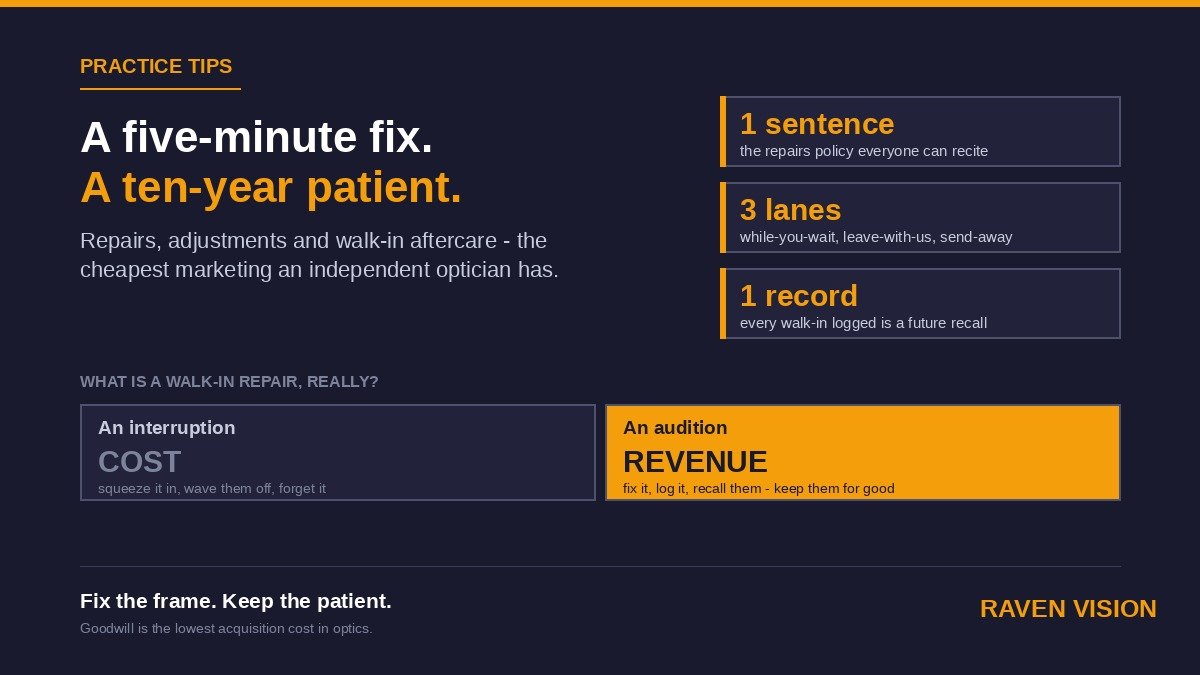
There are two ways to see that person. The first: an interruption. Squeeze them in, straighten the frame, wave them off, forget it ever happened. The second: an audition. Because that walk-in is deciding, right there at your front desk, whether your practice is the kind of place they’ll trust with the next ten years of their eye care.
Most independent practices handle repairs and adjustments every single day and treat them as noise. This post is about treating them as what they actually are — the cheapest, warmest marketing channel you have — and building a workflow around them that doesn’t derail your clinic.
What a five-minute fix is actually worth
Think about who walks in with a broken frame. Some are your own patients. Some bought online and have nowhere else to go. Some bought from a multiple and couldn’t get seen — or didn’t fancy the queue. Every one of them is standing in your practice, talking to your team, watching how you treat someone who isn’t spending money today.
Fix their glasses well, charge them fairly (or not at all), and something happens that no ad campaign can buy: they tell people. “Just took them into the opticians on the high street, sorted in five minutes, didn’t charge me a penny.” That sentence, repeated at school gates and office kitchens, is how independent practices grow.
And the maths is simple enough to do on the back of a repair envelope. A patient who joins your practice and stays is worth years of sight tests, dispenses, second pairs and contact lens fees. Against that, the cost of a nose pad and five minutes of a dispensing optician’s time is nothing. You’re not giving away a repair. You’re buying a patient at the lowest acquisition cost in optics.
Decide your repairs policy — and make it one sentence long
The fastest way to turn goodwill into awkwardness is to make your team guess. If the Saturday assistant charges £5 for a screw that the practice owner fitted for free last week, the patient notices, and not in a good way. Whatever your policy is, everyone in the building should be able to recite it in one sentence.
Your own patients: free for life, and say it out loud
For glasses you dispensed, minor adjustments and repairs should be free, forever — and most UK practices already work this way for their own patients. The trick isn’t the policy. It’s the announcement. At collection, when the fit is checked and everything’s comfortable, add one line: “Any time these need adjusting or tightening, just pop in — it’s free for as long as you own them.”
That single sentence does two things. It plants a reason to come back through your door between sight tests, and it quietly reframes the price of the glasses. A £250 pair with lifetime aftercare is a different product from a £60 online pair with none. ABDO’s guidance on the sale and supply of spectacles expects finished spectacles to be checked on the patient for fit, function and comfort before they leave the practice — good aftercare simply extends that professional duty across the life of the glasses, instead of ending it at the till.
Frames bought elsewhere: decide, then be consistent
Glasses bought online or from another practice are where policies vary. Some independents fix them free as a goodwill play. Others charge a modest fee for parts and labour, often waived if the person books a sight test. Both approaches work — what doesn’t work is deciding on the spot, differently, every time.
A sensible middle path: minor adjustments free for anyone, a small charge for parts on frames bought elsewhere, and be upfront about it before you touch the glasses. Nobody resents a fair price quoted in advance. People do resent a surprise. And if the frame is beyond saving, you’re now the honest professional who tried — which is exactly who they’ll come to for the replacement.
If you charge, take payment properly
Repair income will never be a profit centre, and it shouldn’t try to be. But if you do charge for parts, solder jobs or send-away repairs, put it through the system like any other sale — a proper line item, a receipt, the till reconciled at the end of the day. A billing system that handles small odd charges without a workaround means repairs don’t become the drawer of loose fivers that ruins your Friday cash-up.
Build a walk-in repair workflow that doesn’t derail your clinic
The reason repairs feel like a nuisance in many practices is that there’s no workflow — just whoever’s free, whenever they’re free, with the testing room door as a bottleneck. You don’t need anything elaborate. You need triage.
Every repair that comes through the door falls into one of three lanes:
While-you-wait. Screws, nose pads, standard adjustments, temple tips. Five to ten minutes for anyone trained. The front desk handles the greeting, takes the details, and the fix happens at the bench without touching clinic time.
Leave-with-us. Anything fiddly — snapped rimlon cords, lens refits, frames that need real bench time. Take the glasses, set an honest promise time (“ready after 2pm tomorrow”), and log it so it can’t be forgotten. A repair sitting in a drawer with no owner and no due date is how you turn a fan into a one-star review.
Send-away. Solders, replacement joints, plating. Quote the price and the turnaround before it leaves the building, and update the patient if the lab is slow. Silence is the killer here, not the wait itself.
Train everyone on the front desk to sort incoming repairs into those three lanes in under a minute. It’s the same principle as the rest of your front-desk workflow — decisions made once, by policy, instead of two hundred times a week by improvisation.
Log every repair — walk-ins are patient records waiting to happen
Here’s the step most practices skip, and it’s the one that turns goodwill into growth: record the repair. Name, contact number, what was done, which frame. Two minutes, while the glasses are on the bench.
For your own patients, that note builds the story of the frame. Three tightening visits in two months? The frame’s fatigued, and the next conversation is about whether it’s worth re-glazing at their next test or looking at something sturdier. That’s not a sales pitch — it’s a professional noticing a pattern, which is exactly what patients want from an independent.
For strangers, the record is the whole prize. Someone who walked in off the street with online-bought glasses is now in your system with a name and a number. Ask one natural question while you work: “When was your last eye test?” If it’s been a while, the offer makes itself. We covered the mechanics of this in our guide to converting walk-ins into booked patients — repairs are the warmest walk-in of all, because you’ve already done them a favour before you ask for anything.
This only works if creating a record is fast. If logging a walk-in means five screens and a form nobody remembers how to fill in, your team will skip it by Wednesday. In a cloud-based system, anyone at any terminal can create the record and add the repair note in the time it takes the glue to dry — no “the repairs book is at the other branch” nonsense.
Stock the bench like you mean it
Nothing deflates a while-you-wait promise like not having the part. A repair bench that’s out of the common screw sizes is a repair bench that sends people to the multiple down the road.
Keep a proper parts kit and treat it like stock, not stationery: screws in the sizes your frame ranges actually use, nose pads in the two or three styles that cover most frames, temple tips, cable ends, a decent screwdriver set, pliers that aren’t older than the practice. Set minimum levels and reorder before you run out, the same way you’d manage frames — your inventory system shouldn’t stop at the display wall.
It’s a tiny discipline with an outsized payoff. “Fixed while you wait” is only a superpower if it’s true every time.
Turn the fix into the follow-up
The repair is done, the glasses sit straight, the patient is grateful. This is the single warmest moment your practice ever gets with someone — don’t waste it.
Three follow-ups, used with judgement rather than all at once:
The recall. If they’re overdue a sight test — theirs to know, yours to ask — book it there and then. “While you’re here, shall we get you in for a test? Your prescription’s two years old” converts far better than any reminder letter, because the goodwill is thirty seconds old.
The review. A delighted repair customer is the perfect person to ask for a Google review, and the story they’ll tell (“popped in with broken glasses, fixed free in minutes”) is precisely the one that makes other locals choose you. If you’ve built the review-asking system we’ve written about before, repairs should be one of its main triggers.
The replacement conversation. Some frames are beyond dignity. When a repair is really a postponement, say so kindly, and treat it as the natural opening for a proper dispense — or a second pair so the next breakage isn’t a crisis. You’re not upselling; you’re telling the truth about a tired frame, with a solution in hand.
Where the software fits
None of this needs software to start. A one-sentence policy, three triage lanes and a stocked bench are decisions, not purchases — you could put all of it in place by Friday.
What software changes is whether it sticks. In Raven Vision, a walk-in repair becomes a patient record in seconds, the repair note lives on the frame’s history, parts sit in the same inventory as your frames, any charge goes through billing properly, and the recall is set before the patient reaches the door. It’s the difference between “we should log repairs” and repairs actually being logged in March, when the January enthusiasm has worn off.
Raven Vision was built by Shaukat, an optometrist with more than 35 years in practice, inside his own three practices — where the repair bench is not a theory. It’s £149 a month, with free data migration and no long contract. If you’d like to see how the walk-in-to-record-to-recall loop works on a real screen, book a walkthrough — bring your current repairs drawer, metaphorically or otherwise — or have a look at the pricing first.
Either way, change the way you see the next person who walks in with bent glasses. That’s not an interruption to the day’s work. Done right, it’s the start of a ten-year patient relationship — and it only costs you a screw.