
It’s 8:52 on a Tuesday. The optometrist is in the test room checking the slit lamp. The dispenser is unlocking the frame cabinets. The receptionist is switching on the screen, and the phone’s already ringing. Nobody has said a word to each other about the day ahead, because everyone assumes everyone else knows what’s coming.
By 10:15 the first surprise lands. The 9:40 was a diabetic patient who needed dilating and nobody flagged it, so the clinic is now twelve minutes behind. The 10:00 arrived with a form saying they’d been in three weeks ago for a repair, and the dispenser had no idea. Two pairs of glasses that were promised for “Tuesday” came in yesterday afternoon and nobody’s rung anyone. Meanwhile there’s an 11:20 slot that’s been empty since Friday.
None of that is a people problem. It’s a ten-minute-at-the-start-of-the-day problem. And the fix is one of the oldest tools in practice management, borrowed from dental surgeries, GP practices and hospitals: the morning huddle.
What a morning huddle actually is (and isn’t)
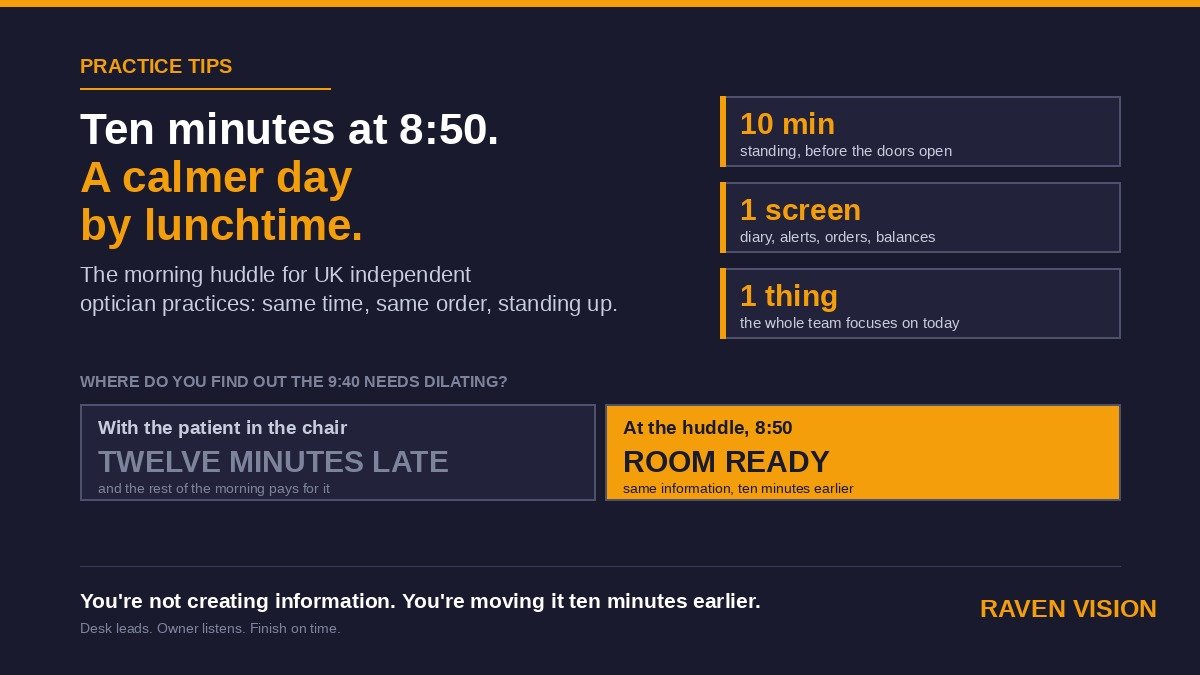
A morning huddle is a short, standing, whole-team look at the day before the doors open. Ten minutes, tops. Everyone who’s working that day is there. You go through the diary, name the things that could go wrong, agree who’s doing what, and then you start.
It is not a team meeting. Team meetings are where you talk about the new frame range, the recall campaign, the rota for half term. The huddle is only ever about today. If something comes up that isn’t about today, someone writes it down and it goes on the next team meeting agenda.
It’s also not a lecture. The owner shouldn’t be the only voice. The best huddles are led by whoever is running the desk, because they’re the person who sees the whole day laid out.
Optometry practices have the same structure that makes the huddle work so well in dentistry: a clinical diary with fixed slots, a retail floor that depends on that diary, a small team where one absence changes everything, and a steady stream of small pieces of information (a lab delay, a patient who’s anxious, an NHS voucher that needs signing) that only cause trouble when they’re stuck in one person’s head.
Why ten minutes at 8:50 saves an hour by lunchtime
Most of what goes wrong in a practice day isn’t dramatic. It’s a dozen small things that each cost five minutes and a bit of goodwill. The dilating patient nobody planned for. The child’s appointment where a parent has questions about myopia management and the optom hasn’t looked at the previous notes. The collection where the glasses aren’t ready because the lens order got stuck and nobody checked.
Each of those is easy to handle if you see it coming. They’re all painful when they land on you cold with a patient standing in front of you.
The huddle moves that discovery from “in front of the patient” to “before the doors open”. That’s the whole trick. You’re not creating information; you’re moving it ten minutes earlier and putting it in everyone’s head instead of one person’s.
There’s a second benefit that owners underestimate. When the team starts the day together, looking at the same screen, agreeing the same priorities, the day feels shared. Reception doesn’t feel like it’s protecting the optom from the diary. Dispensing doesn’t feel like it’s waiting for scraps. Everyone knows the 11:20 is empty and everyone has a reason to fill it. That’s a very different atmosphere from three people in three rooms, each surprised by what the others are doing.
The ten-minute agenda that works in a practice
Keep the same order every day. Same order means nobody has to think about the format, and things don’t get missed just because a busy morning made everyone skip ahead. Here’s a structure that fits an independent practice with one or two test rooms.
Minute 1: Who’s in, who’s out, what’s different
Who’s working, who’s on lunch when, is anyone leaving early, is the locum in, is the rep coming at two. Thirty seconds. If someone’s off sick, this is where you decide what the day looks like now, not at 9:30 when the first patient of the missing clinician walks in. (There’s a longer piece on rota gaps and cover in our staff rota guide.)
Minutes 2 to 5: Walk the diary
Open the day in the appointment diary and go through it appointment by appointment. Not to read names out, but to flag the ones that matter:
- New patients. Who’s coming in for the first time? Are their details complete? Has anyone had a look at what brought them in? A new patient’s first visit is the one you can’t redo.
- Clinical flags. Diabetic, glaucoma monitoring, post-cataract, anyone on the low vision pathway, a child who was seen for myopia management. Anything where the optom needs to have read the last notes and the room needs to be set up differently.
- Time risks. Which appointments are likely to overrun? Where are the tight back-to-backs? Is there a catch-up gap, and is it in the right place?
- Empty slots. Where are the gaps, and who’s on the standby list? If the diary shows an empty 11:20, the huddle is where someone owns the job of filling it before ten o’clock.
- Money moments. Who’s due to collect? Who has a balance outstanding? Who’s on a contact lens plan that’s lapsed? Who was recalled three times and finally booked?
Minutes 6 and 7: Collections, orders and the lab
Which spectacle orders are due in today? Which ones are late? Has the lab rung about anything? Who’s coming to collect and are their glasses actually here, checked and ready? This is the bit most practices skip, and it’s the bit that generates the most awkward conversations at the desk. If you’ve got order tracking in your system, this takes ninety seconds. If you’re working from a notebook and a pile of lab dockets, it takes longer, and that tells you something.
Minute 8: Yesterday’s loose ends
Anything left over from yesterday that still needs doing today. The patient who asked for a call back. The GOS form that needs a signature. The repair that’s sitting on the bench. The uncollected pair that’s now been waiting three weeks. One person names each item, one person owns it.
Minute 9: Today’s one thing
Pick one thing the whole team is focusing on. Not five. One. This week it might be “ask every patient over 45 about a second pair for the office.” Next week it might be “get every new patient’s mobile number and consent for text reminders.” Say it out loud, every day, for a week, and it becomes a habit. Say it once in a team meeting and it evaporates.
Minute 10: Questions, then go
Anything anyone needs before we open? No? Then we’re done. Stand up, don’t sit down, and finish on time. A huddle that runs to twenty minutes stops happening within a month.
Who runs it, and where
The receptionist or practice manager should lead. They have the diary in front of them all day and they’re the ones who feel the consequences of a surprise most directly. The owner attends, contributes, and does not take over.
Do it standing, around one screen. In a small practice that’s usually the reception desk before the sign flips. If you’ve got a tablet that shows the patient records and diary, take it into the dispensing area so you’re not huddled behind the counter where a passing patient can see the screen.
Do it at the same time every day. 8:50 for a 9:00 open, or whatever your equivalent is. Not “when everyone’s in”. The time is fixed, and the huddle starts whether everyone’s arrived or not. That sounds harsh; in practice it fixes lateness in about a fortnight without anyone having to have a difficult conversation.
What good looks like in a two-optom practice
The mechanics don’t change much with size, but a couple of things matter more once you’ve got two test rooms and a bigger floor.
First, pre-test becomes part of the diary walk. Who’s doing pre-test today, which patients need OCT or fields, and is the kit ready? A badly planned pre-test flow is where a two-room practice loses its whole morning. (Our pre-test workflow guide covers this properly.)
Second, the handover. Which optom is handing to which dispenser, and is there a moment in the diary where two tests finish at once and one dispenser has to cope with both? Naming that at 8:50 lets you stagger a slot or pull in a second person. Finding out at 11:30 means one patient waits and the other one leaves with a prescription in their pocket. The handover post goes into that in detail.
Third, the numbers. In a bigger practice it’s worth one line on how yesterday went: how many tests, how many dispensed, how many empty slots. Not as a performance review, just so the team hears the rhythm of the business. People who know that yesterday ran three empty slots make more effort to fill today’s.
The common ways huddles die
Every practice that’s tried a huddle and dropped it tells one of the same four stories.
It became a meeting. Someone raised the new pricing structure, someone else raised the fridge, and fifteen minutes later the first patient was waiting. Fix: a parking list. Anything not about today goes on a bit of paper for the team meeting, and the huddle moves on.
It became a monologue. The owner used it as a daily briefing and the team learned to switch off. Fix: hand the lead to the desk, and have the owner ask questions rather than answer them.
The information wasn’t there. You can’t walk the diary if the diary doesn’t show clinical flags, outstanding balances or order status. The huddle turns into “does anyone remember anything about Mrs Khan?” and dies of frustration. This one is a software problem, and it’s the reason a lot of practices can’t make the routine stick. More on that below.
Nobody wrote anything down. “Someone should ring the lab” isn’t a task. “Priya rings the lab about the Ahmed order before ten” is. If the action doesn’t have a name and a time, it didn’t happen.
The evening bookend
A morning huddle works better when it’s paired with a short close-down at the end of the day. Not another meeting, just the last person on the desk running through tomorrow’s diary for two minutes, flagging anything obvious, and making sure the till and the orders are in order. The end-of-day cash-up routine covers the money side. Do that properly, and the morning huddle starts with fewer surprises because half of them were caught the night before.
Between the two, you’ve got a practice day with a clear beginning and a clear end. Everything in the middle is easier when the edges are tidy.
What your practice software has to show you at 8:50
Here’s the honest bit. The huddle stands or falls on whether the information the team needs is on one screen, in the diary, in the order it happens. If your system makes you open three modules and a spreadsheet to answer “who’s collecting today and are their glasses here?”, the huddle takes twenty minutes and the team stops doing it.
So the test of your practice management software isn’t the feature list. It’s whether, at 8:50, the desk can see:
- the day’s diary with each patient’s clinical alerts and notes visible without clicking into every record;
- which patients are new, which are recalls, and which have an outstanding balance;
- every spectacle and contact lens order due in, due out, or overdue;
- the standby list for filling a gap, and a way to message those patients in one go;
- yesterday’s unfinished tasks, assigned to a named person.
That’s the whole huddle, on one screen. If your software can do it, the routine costs you ten minutes a day. If it can’t, the routine costs you the routine.
How we do it at Raven Vision
Raven Vision was built by Shaukat, an optometrist with more than 35 years in practice, for his own three practices before it was ever offered to anyone else. His teams run a huddle every morning, and the software was shaped around exactly that moment: the day’s diary opens with alerts on each patient, the recall status and outstanding balances sit next to the appointment, and orders due in are on the same view as the patients who are coming to collect them.
We won’t claim it makes a bad team good. It doesn’t. What it does is make the ten minutes at 8:50 possible without anyone opening a filing cabinet. Raven Vision costs £149 a month per practice, with three months free to start, free data migration from whatever you’re using now, and no long contract. Our pricing is on the site, all of it.
Start tomorrow, not after the software decision
You don’t need new software to start a huddle. You need ten minutes and a diary. So start tomorrow with what you’ve got. Same time, same order, standing up, desk leads, owner listens. Do it for two weeks and notice what changes: fewer surprises, fewer “I didn’t know”, more empty slots filled, more collections that go smoothly.
Then notice what got in the way. If it was the team, the huddle will fix that on its own. If it was the fact that your system can’t put today on one screen, that’s a different conversation, and it’s one we’re happy to have. Book a walkthrough and bring your diary for a real Tuesday. We’ll run tomorrow’s huddle on it together and you can see what’s missing.