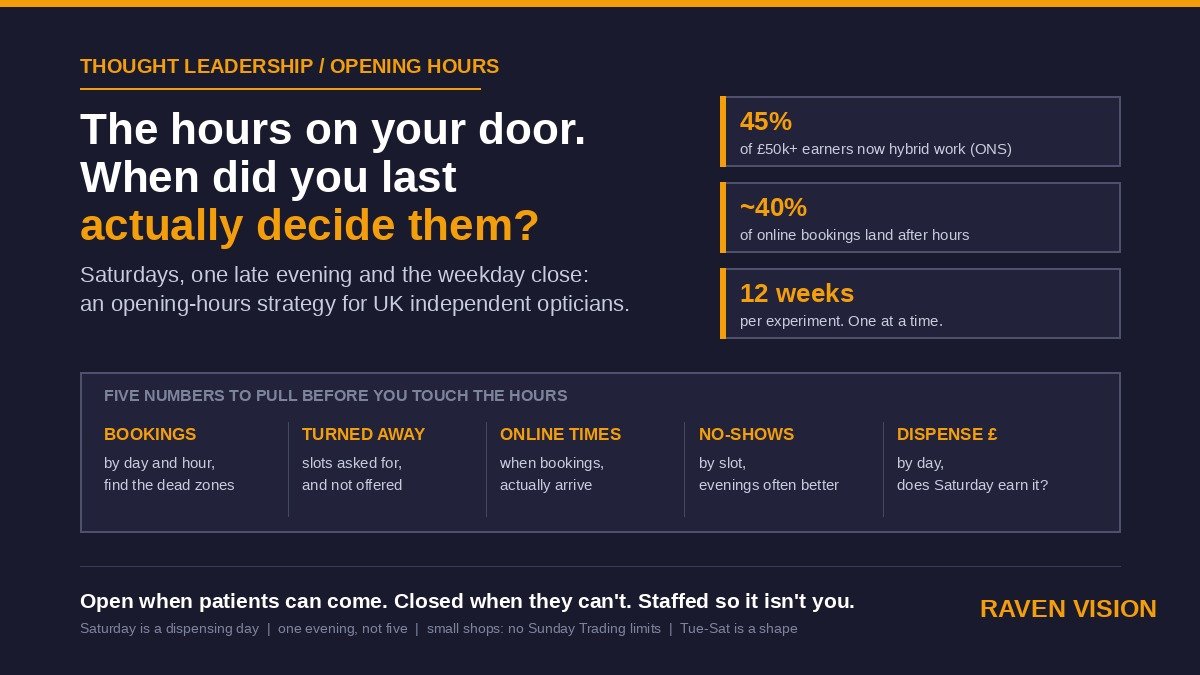

Look at the hours on your door. Now ask yourself when you last decided them. Not adjusted them for a bank holiday. Decided them.
For most UK independent opticians the honest answer is never. The hours came with the practice, or were copied from the practice down the road, or were set in the year the owner bought in and haven’t been questioned since. Nine to half five, Monday to Saturday, maybe an early close on Wednesday because that’s what the town did when the town still had an early-closing day. Everything else in the practice has been rebuilt at least once since then. The hours haven’t.
This post is about treating optician opening hours as what they are: one of the few business decisions an independent gets to make that the multiples can’t easily copy, and one of the few that touches revenue, staffing and the owner’s own life all at once.
Your opening hours are a decision you probably never made
Here’s the thing that’s changed under the hours you inherited. The people you want in the chair don’t work the way they did when those hours were set.
The Office for National Statistics put the proportion of working adults in Great Britain who hybrid work at 28% for January to March 2025, and it’s been climbing since 2022. Among workers earning £50,000 or more it’s 45%. Read that second number again with your private-pay patients in mind. Nearly half of the people most likely to buy a varifocal at full price, or to sign up to a contact lens plan, are at home two or three days a week with a flexible diary and no reason to wait until Saturday.
Meanwhile your 9-to-5:30 Tuesday looks the same as it did in 2005. The diary fills with retired patients in the morning, goes quiet after two, and picks up when the school run finishes. That’s not a problem with your marketing. It’s a problem with the hours.
The second thing that’s changed is when people book. Industry data from online booking platforms consistently puts around 40% of online appointment bookings outside business hours. Healthcare-specific figures from the US run higher still, with roughly a quarter of bookings made between 5pm and 11pm. Whether the number for your practice is 30% or 50%, the point stands: a large slice of the people who want to see you are deciding at 9pm on a Tuesday. If your only way to book is a phone that rings out at 5:31, those people go to whoever answers, or whoever has a working online booking page.
None of this says open longer. It says your hours should be a response to how your patients live now, and most independents have never checked.
What the multiples know about Saturdays that independents pretend not to
Saturday is the busiest day on the UK high street. It has been for as long as MRI Software, formerly Springboard, has been counting footfall, and their 2025 figures show the same pattern week after week: a Friday and Saturday peak, with Saturday on top. The multiples have built their whole operating model around it. Seven-day opening, Saturday teams, Sunday hours in the bigger towns. Some of their branches open at 7am. Several close at 8 or 9pm.
Independents usually draw one of two wrong conclusions from that. Either “we can’t compete, so we won’t try”, or “Saturday is chaos, let’s cut it to a half day”. Both miss what Saturday actually is in an optical practice.
Saturday is a dispensing day, not just a testing day
The value of a Saturday in an independent isn’t the extra sight tests. It’s that the patient who was tested on Wednesday comes back with their partner to choose frames, and the partner books a test, and the collection happens while both of them are in the building. Saturday is when the dispensing floor earns its rent. Take it away, or shrink it to a morning, and you’ve cut your highest-value dispensing time to save a locum day-rate.
That’s also why “we’ll cover Saturday with a locum” quietly costs more than the invoice says. We went through the maths in the locum-dependency post: the test gets done, the dispense conversation doesn’t happen the same way, and the difference shows up in the average dispense value on Saturdays versus weekdays. If you’ve never split that number by day, you’re running your busiest day blind.
The half-day Wednesday question
If your practice still closes early one weekday afternoon, ask what that afternoon is for. If it’s admin, the frame rep and a clinical catch-up, that’s a fine reason to keep it. If the answer is “we’ve always done it”, you’ve got a half-day of rent, rates and salaries earning nothing, in the middle of the week, exactly where hybrid workers would fill it. The decision isn’t keep or drop. It’s what is this time for.
The case for one evening. One, not five
The multiples’ answer to hybrid working is to open every evening. That’s a staffing model an independent shouldn’t try to copy, and doesn’t need to.
The independent version is one late evening a week. Open until 7pm or 7:30pm on a Tuesday or Thursday. Advertise it. Put it at the top of the website, in the recall text, on the door. Then hold it for at least twelve weeks before you judge it, because the first month will be quiet while patients find out it exists.
The economics work because the fixed costs are already paid. The building is lit and heated, the equipment is there, the software’s running. What you’re adding is two to three hours of staff time and one clinician session. If that session books six tests and two of them dispense at your average, it’s paid for itself several times over. If it books two tests a week after twelve weeks, you’ve learned something real about your patch and you close it again with no harm done.
Where independents go wrong is running the evening with whoever’s left. If the owner-optom does the late session on top of a full day, it becomes the session everybody resents, and it gets cut in month three because “it wasn’t working” when actually it was the owner who wasn’t working. Build it into the rota properly: a late start for the evening team, a proper break, and a session that’s someone’s regular shift rather than an act of goodwill.
The case for closing on a weekday
Now the part that makes owners uncomfortable. If you’re going to open an evening, or protect a full Saturday, something has to give. For a lot of independents the right answer is to close a weekday entirely.
First, the legal position, because people assume there’s a rule. For a shop with an internal sales area of 280 square metres or less, which is nearly every independent optician in the country, the Sunday Trading Act imposes no restrictions at all. You can open any hours on any day, including Sunday, and close any day you like. Your NHS contract requires a registrant to be present for GOS sight tests and sets no opening hours. Your lease may say something about “usual trading hours”; check it, but it’s rarely a barrier. The hours are yours to set.
Second, the evidence on shorter weeks isn’t fringe any more. The UK four-day-week pilot in 2022 covered 61 companies and around 2,900 workers. At the end of it 56 of the 61 continued, and a year on 89% were still running it, with 71% of staff reporting reduced burnout. Those weren’t optical practices, and a practice can’t cut hours without cutting capacity the way an office can. But the pattern is worth noticing: teams that got a whole day back stayed, recruited more easily and didn’t fall apart.
The maths of a closed day
Closing a day doesn’t cut your fixed costs. The rent is the same on a Monday whether you’re open or not. So a closed day only works if the capacity moves rather than disappears. That means the Monday tests go somewhere: into the new evening, into a fuller Saturday, into a tighter weekday diary with fewer empty slots. We wrote about how much capacity most diaries waste in the appointment diary post. If your diary is currently 70% booked across five and a half days, you can very likely see the same patients across four and a half and lose nobody.
What you gain is a day with the lights off. No salaries for that day if the team moves to a four-day pattern on the same hours. A day the owner can use for the business, the admin and the numbers, or, occasionally, for nothing at all. Plenty of independents find that the “Tuesday to Saturday” practice, closed Sunday and Monday, is the shape that fits: the quietest weekday goes, the busiest day stays whole, and the whole team gets a proper two-day weekend, just not the conventional one.
What you’d have to move
Be honest about the friction. Some patients will grumble. Reps and deliveries need retraining. Recall texts need to stop offering Monday. The website, Google Business Profile, answerphone and NHS listing all need updating on the same day; it’s remarkable how many practices leave one of them on the old hours for a year. And the owner needs to actually not come in on the closed day, which is harder than it sounds and the subject of half of the owner’s time audit.
Read your own diary before you change anything
Everything above is a hypothesis until your data says otherwise. Before you touch the hours, pull twelve weeks from the practice management system and look at five things.
Bookings by day and by hour. Not tests done, bookings taken. Where are the dead zones? A dead 2pm to 4pm every weekday is a different problem from a dead Monday.
The slots people asked for and didn’t get. This is the number nobody tracks and it’s the most useful one. If the front desk has been saying “sorry, we’re closed then” to Saturday afternoon or early evening requests, you want a count. Ask the team to tally it for a fortnight if the system doesn’t already show it.
When online bookings arrive. Timestamps, not appointment times. If a third of your online bookings land after 6pm, that tells you your patients are making decisions when you’re closed, and it makes the case for online booking being live 24 hours a day even if the doors aren’t.
No-show rate by slot. First slot of the day and the one straight after lunch tend to be the worst, and evening slots often behave better than owners expect because the patient chose them. We covered the fixes in the no-shows post; here you just want the pattern.
Dispense value by day. If Saturday’s average dispense is 30% higher than Tuesday’s, that’s the number that decides whether Saturday stays whole. If it isn’t, and you assumed it was, that’s worth knowing too.
Then run one experiment at a time, for twelve weeks, with the numbers above measured before and after. One evening. Or one closed day. Not both at once, or you won’t know which one moved the diary.
Hours you can’t staff aren’t hours
The reason most owners never change their hours isn’t the patients. It’s the rota. A Saturday needs a clinician, a DO or dispensing-competent assistant and someone on the desk. An evening needs a registrant on the premises for the tests and a late shift for whoever’s dispensing. If the practice is the owner plus two part-timers, the hours are constrained by the people before the patients get a say.
That’s a real constraint, but the answer to it isn’t “so we can’t change anything”. It’s that the hours decision and the staffing decision are the same decision. A full Saturday plus an evening may need one more part-time DO, or an associate on a fixed Thursday-late-and-Saturday pattern, which is a shift plenty of clinicians actively want because it fits their own lives. From October 2026 the new rules on guaranteed hours and shift notice make “we’ll text you on Thursday” rotas harder to run anyway, so it’s a sensible year to put the pattern on paper.
And if the owner is the only clinician, the hours question is really the bottleneck question. Changing the hours on the door won’t help if every hour still has to be yours.
Where Raven Vision fits, honestly
Raven Vision was built inside real independent practices, including ones that went through exactly this: a full Saturday, one late evening, a closed Monday. What the software does for the decision is make the five numbers above visible without a spreadsheet. The diary reports bookings and utilisation by day and by hour, so the dead zones show themselves. Online booking runs around the clock, so “open for bookings” and “open for patients” stop being the same thing, and every booking carries a timestamp you can look at later. Recall messages go out on a schedule you set and can push patients towards the sessions you’re trying to fill, which is how a new evening stops being a secret. And because the dispense sits on the same patient record as the test, dispense value by day is a report rather than a reconstruction.
It’s £149 a month for all modules, no per-user fees and no long contract, and the details are on the pricing page. Against ourselves: if you’re a single-room practice with 400 active patients and a paper diary, you don’t need software to try one late evening for twelve weeks. Put a sheet on the desk, tally the requests you turn away, and see. The software earns its keep when you want to know what actually happened rather than what it felt like.
Decide your hours on purpose
You don’t need to become a seven-day practice. You need to be open when the patients you want can come, closed when they can’t, and staffed so that neither of those depends on the owner giving up an evening they’ll come to resent.
So, this week: pull the last twelve weeks of bookings by day and hour. Ask the desk to tally turned-away requests for a fortnight. Pick one experiment, an evening or a closed day, and give it twelve weeks with a before-and-after number attached. Then, for the first time in a while, the hours on the door will be ones you chose.
If you’d like to see how the diary and booking reports look on your own data, book a walkthrough. Bring your current hours. We’ll show you where the dead zones are and let you decide what to do about them.